In short ⚡
How to Import Machinery from China: Inspection, Shipping and Installation requires managing the purchase as a controlled industrial project, from technical specifications and factory checks to FAT, customs clearance, installation and commissioning. Follow these six essential steps:- Define the machine’s output, materials, utilities, safety requirements, components, documents, languages and measurable FAT acceptance criteria.
- Audit the factory and verify destination-market compliance, including NRTL requirements in the United States and applicable CE, UKCA or EU machinery rules.
- Use a contract that specifies the machine configuration, warranty, crating, spare parts, installation and training, with the balance payable only after a passed FAT.
- Run and document the Factory Acceptance Test using approved materials, checking performance, safety functions, controls, documents and spare parts.
- Prepare ISPM 15-compliant crating, select the appropriate transport solution, insure the shipment and classify the exact tariff code for customs duties and taxes.
- Prepare site utilities, complete installation and Site Acceptance Testing, train operators and keep essential wear parts available.
The complete process covers the real cost of importing machinery, technical specifications, factory audits, US, UK and EU compliance, contract terms, FAT procedures, crating, shipping, customs clearance, installation and after-sales planning.
We hope you’ll find this article genuinely useful, but remember, if you ever feel lost at any step, whether it’s finding a supplier, validating quality, managing international shipping or customs, DocShipper can handle it all for you!
Importing machinery from China: what you are really buying
Importing machinery from China can pay off when you compare the cost of a compliant machine running safely in your plant, not the quoted FOB price. Your real project cost may also include market compliance, a factory acceptance test, crating, freight, duties, installation, training and a stock of wear parts.
China is a significant source for machine tools, packaging equipment, food-processing machinery, plastics equipment and CNC systems. In 2025, China produced about €30 billion of machine tools, representing 37% of world production, and became the largest machine-tool exporter for the first time, according to the VDW. However, a lower factory price does not automatically mean lower operating cost, especially for highly specific machines requiring rapid technical support.
The same point appears in European trade data. Eurostat reports that the EU imported €559.4 billion of goods from China in 2025, including €106.5 billion of mechanical machinery and appliances. The opportunity is real, but so is the consequence of receiving a machine that cannot connect to your utilities, satisfy local workplace rules or achieve the promised production rate.
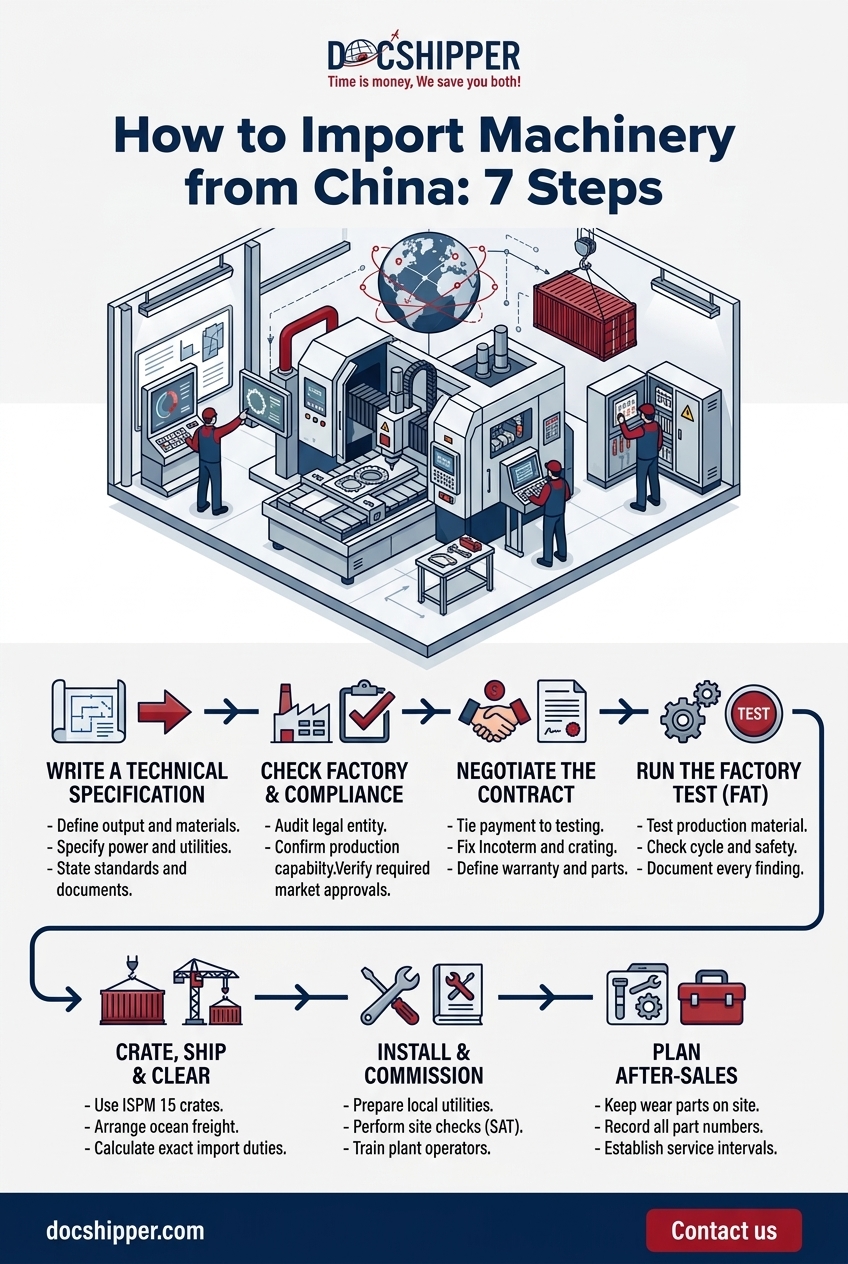
Use the following seven-step path: define the specification, audit the factory and compliance route, negotiate the contract, run the FAT, prepare freight and customs, then install and commission the machine. This process turns a listing or quotation into a controlled industrial project.
| Cost line | Who usually pays | When it occurs | Common trap |
| Machine price | Buyer | Order | Comparing quotations with different specifications |
| Factory audit and FAT | Buyer, unless negotiated otherwise | Before shipment | Assuming the supplier has tested the machine adequately |
| Crating and export preparation | Depends on Incoterm | Before dispatch | Using untreated wood or insufficient bracing |
| Freight and insurance | Depends on Incoterm | Transit | Choosing a container before checking dimensions and weight |
| Duty and import taxes | Usually buyer under DAP or similar terms | Customs clearance | Using a generic tariff rate instead of the exact code |
| Installation and training | Buyer unless included in the contract | After delivery | Negotiating technician travel only after arrival |
| Spare and wear parts | Buyer | Order and operation | Waiting for a breakdown before ordering the first kit |
DocShipper Info
Build your landed-cost estimate before comparing suppliers, including compliance, freight, installation and spare parts.
Step 1: write a technical specification the factory cannot misread
Your specification sheet should define the output rate, materials, utilities, standards, languages, components, documents and measurable acceptance criteria. It becomes the technical reference for the quotation, contract and FAT, so vague wording here creates disputes later.
Power and utilities compatibility
Write the required voltage, frequency and phases in the first section. A machine designed for a Chinese electrical configuration is not automatically suitable for your plant. For example, many US facilities use 480 V, 60 Hz, three-phase power, while many European facilities use 400 V, 50 Hz, three-phase power. Treat these as examples to verify, not assumptions about your site.
Also specify compressed-air pressure and quality, water or cooling requirements, exhaust, floor loading, access dimensions and connection points. Ask the supplier to confirm in writing that the proposed electrical cabinet, motors, drives and protection devices match your installation. For a US project, request the brand and approval status of key electrical components and define any NRTL requirements before manufacturing starts.
Standards, language and documents to require
State the required HMI language, operator manual language, warning labels and maintenance documentation. Identify the PLC, motors, drives, sensors and other critical components by brand or approved equivalent where availability and after-sales support matter.
Define performance with measurable tests rather than phrases such as “high efficiency” or “stable operation.” A usable criterion is: “Nominal rate X parts per hour for two hours without an unplanned stop, with scrap below Y%,” where you insert the production rate and scrap threshold your process requires. Add tolerances, test materials, cycle duration and the method used to record results.
Copy this checklist into your request for quotation:
- Product, material and maximum dimensions to be processed
- Nominal output, acceptable tolerance and scrap-rate limit
- Voltage, frequency, phases, connected load and plug or connection standard
- Compressed air, water, ventilation, extraction and floor requirements
- PLC, HMI, motor, drive and safety-component brands
- Applicable standards and conformity route for the destination market
- HMI, labels, manuals, electrical drawings and maintenance documents in the required language
- Safety guards, emergency stops, interlocks and operator-access points
- Initial wear-parts and spare-parts list with part numbers
- FAT acceptance criteria, test material, test duration and record format
| Specification item | Write this down |
| Production | Rate, tolerance, cycle time and scrap limit |
| Utilities | Voltage, frequency, phases, air, water, extraction and floor load |
| Controls | PLC, HMI language, software access and backup files |
| Safety | Guards, emergency stops, interlocks and applicable standard |
| Documentation | Manuals, drawings, parts list, certificates and declaration documents |
| Acceptance | Test material, duration, output and permitted defects |
DocShipper Tips
Send us your requirements to verify utilities, performance targets, documentation and acceptance criteria before requesting final quotations.
Step 2: check the factory and your market’s compliance before paying the deposit
Before paying a deposit, verify that the supplier is the actual manufacturer and that the machine can be documented for your destination market. A US workplace may require NRTL-approved electrical equipment, while a machine placed on the UK or EU market requires the appropriate conformity documentation. The buyer or employer remains exposed if the machine cannot legally or safely be used.
Real manufacturer or trading company?
Confirm the legal entity on the quotation, business licence, factory address, bank account and contract. An onsite supplier audit should check production capacity, engineering resources, quality controls, similar machines in production, testing equipment and the ability to provide spare parts. Ask for references for comparable machines, not only general export references.
DocShipper can schedule a supplier audit within 48 hours and provide a full illustrated report within 24 hours of the visit, according to its industrial sourcing service information. A factory audit does not replace a FAT, but it helps establish whether the quoted supplier can actually build and support the equipment.
Looking for a Reliable
Sourcing Partner?
We handle the entire sourcing process, supplier research, negotiation, production, and inspections, so you can focus on what matters most: growing your business.


United States: OSHA, NRTL approval and NFPA 79
For US machinery, a CE declaration from the Chinese factory does not by itself replace the approval expected for electrical equipment used in a workplace. OSHA explains in its official interpretation that electrically powered industrial machinery is utilization equipment covered by Subpart S and that, where an NRTL offers approval for that equipment, an independent inspection body cannot substitute for NRTL approval.
Check the requirements with the authority having jurisdiction, your insurer and the relevant installer before production. Specify the required NRTL route, such as listing or a planned field evaluation, and address industrial machinery wiring through the applicable edition of NFPA 79. A late field evaluation can be a last resort, not a substitute for planning.
UK and EU: CE marking today, Regulation (EU) 2023/1230 from 20 January 2027
For the UK, confirm the applicable machinery requirements and whether CE marking is accepted for your placing-on-the-market date. In the UK government announcement, then Business Minister Kevin Hollinrake stated: “By extending CE marking use across the UK, firms can focus their time and money on creating jobs and growing the economy.” UKCA may remain relevant depending on the product and current rules, so verify the route before ordering.
For the EU, request the declaration of conformity, technical documentation, risk assessment, instructions, serial-number information and the legislation cited. High-risk machinery may require a notified-body route. Regulation (EU) 2023/1230 applies from 20 January 2027 and replaces Directive 2006/42/EC. It includes provisions concerning digital instructions, cybersecurity, AI-related safety and substantial modifications.
For example, if you order in October 2026, production takes 60 days and transit takes approximately 35 to 45 days, delivery may occur in early 2027. Do not rely only on the order date. Confirm with the manufacturer which rules apply when the machine is placed on the EU market or put into service. Used machinery may also be subject to the rules applicable when it was first put into service in the relevant market.
| Market | What to verify | Documents | Red flag |
| United States | OSHA workplace requirements, NRTL route and NFPA 79 application | NRTL listing or evaluation plan, drawings and safety documentation | “CE certified” presented as the complete US solution |
| United Kingdom | Current CE recognition and any UKCA requirement | Declaration of conformity, technical file and English instructions | No market-specific declaration or manual |
| European Union | Applicable machinery legislation and notified-body route where relevant | Declaration, risk assessment, technical file and instructions | Delivery after 20 January 2027 with no review of Regulation 2023/1230 |
DocShipper Alert
Check your market requirements before paying, including NRTL, CE, UKCA and upcoming EU machinery rules.
Step 3: negotiate a contract that ties payment to testing
The contract should release the balance only after a passed FAT and signed report. It should also fix the Incoterm, crating standard, warranty, spare-parts kit, technician visit, training and the remedy if the machine fails its acceptance criteria.
A 30% deposit and 70% balance released after final inspection approval is the payment logic shown on DocShipper’s quality-control process. It is an example, not a universal rule. The important principle is to retain meaningful leverage until the machine has demonstrated the agreed performance and documentation.
Use precise contract wording for the machine model, configuration, serial number, drawings, component brands, test material, output criteria and defect classification. Attach the final specification and FAT checklist to the contract. State that changes require written approval and that an unsuccessful FAT triggers correction and a repeat test before balance payment.
Also negotiate the first spare-parts kit and the factory technician before placing the order. Define the number of days onsite, travel and accommodation responsibility, visa assistance, daily rates, training deliverables and what happens if commissioning cannot be completed during the planned visit.
| Clause | Sample wording to adapt | Why it matters |
| Payment | “The balance is payable only after the FAT is passed and the report is signed by both parties.” | Preserves leverage after production |
| FAT | “The supplier shall test the machine against the attached checklist using the buyer’s approved material.” | Prevents a generic factory test |
| Crating | “The machine shall be protected against corrosion and secured in an ISPM 15-compliant crate, with photographs before closure.” | Reduces transit and customs risk |
| Warranty | “Warranty begins on successful commissioning or another expressly defined date.” | Prevents warranty time being consumed in transit |
| Spare parts | “The initial wear-parts kit listed in the annex shall ship with the machine, with part numbers and replenishment lead times.” | Limits downtime after installation |
| Installation | “The supplier shall provide the agreed technician days, training and travel terms stated in the annex.” | Avoids an unplanned commissioning bill |
DocShipper Tips
Link the balance to a passed FAT, documented performance and closure of every reservation before shipment.
Step 4: run the Factory Acceptance Test (FAT)
A Factory Acceptance Test is the documented acceptance test performed at the manufacturer’s site before the machine is dismantled and packed. It should verify operation with your material, production rate, safety functions, markings, documents and supplied spare parts, and end with a signed report.
What to test
Start with a dry run, then use your approved production material. Check the agreed cycle rate, tolerances, scrap level, alarms, recipe settings, changeover, cleaning and maintenance access. Test emergency stops, guards, interlocks, light curtains and other safety functions relevant to the machine.
Compare the physical machine with the approved specification. Verify the nameplate, serial number, electrical cabinet, component brands, cable markings, HMI language, manuals, drawings, declaration documents and software backups. Count the spare-parts kit and record every missing or substituted component.
Use a numbered checklist with pass, fail or reservation status. Record photographs and videos, including the machine operating and the crate markings before closure. If a point fails, describe the defect, corrective action, responsible party and deadline. A reservation is not closed by a verbal promise.
Why Choose DocShipper
Lower risk, transparent pricing, and a single point of contact from pickup to delivery.
-
One single point of contactA dedicated consultant coordinating every step and keeping you informed.
-
9,200+ operations / 6,000+ clientsProven processes on China ↔ EU/US lanes (FCL, LCL, air, road, rail).
-
No hidden feesTransparent quotes and document guidance to avoid surprises.
Attend in person, remotely or delegate
You can attend personally, appoint a technically qualified third-party inspector or join through a live video session. In-person attendance gives better access to measurements and physical safety checks. Remote attendance can reduce travel but depends on camera access, reliable connectivity and a factory willing to show every requested detail.
DocShipper’s inspection service uses AQL sampling under ANSI/ASQC Z1.4-2003 and ISO 2859-1 for applicable product lots, with reports provided within 24 hours according to its service information. For a complete machine, the FAT should still be built around your specification and functional tests rather than relying only on statistical sampling.
For example, a report may contain 12 checked points and two reservations: a badly fixed guard and a manual available only in Chinese. The balance remains withheld until both reservations are corrected, evidence is supplied and the report is re-signed. The final inspection report should also state whether a second FAT is required.
| FAT item | Evidence to record |
| Dry run | Cycle sequence, alarms and abnormal noise |
| Production test | Material used, duration, output and scrap result |
| Safety | Emergency stops, guards, interlocks and reset behaviour |
| Controls | HMI language, recipes, PLC backup and alarm history |
| Physical conformity | Nameplate, serial number, dimensions and component brands |
| Documents | Manuals, drawings, declaration and maintenance schedule |
| Spare parts | Part numbers, quantity and condition of the initial kit |
DocShipper Info
Book an independent inspection to verify performance, safety, documents and spare parts against your checklist.
Step 5: crate, ship and clear customs
Machines should travel in treated and marked ISPM 15 wooden crates, with corrosion protection, internal bracing and clear centre-of-gravity and lifting marks. Use a standard container when the packed dimensions and weight fit safely; otherwise assess an open-top container, flat rack or breakbulk solution.
Container or oversized cargo
Measure the dismantled and packed machine, not only the assembled machine. Confirm gross weight, lifting points, axle limits, port restrictions and unloading equipment at destination. A heavy crate that fits inside a container may still require specialist handling if its centre of gravity or loading method creates a safety issue.
Ask for photographs before the crate is closed and include anti-corrosion protection suited to the transit conditions. Arrange all-risk cargo insurance with the actual machine value and confirm the claims procedure. For a detailed packing reference, consult this industrial goods packing guide.
Duties and documents: US, UK and EU
Do not use a single generic “China machinery tariff.” Classify the exact machine under the correct tariff code, then verify the current treatment at publication date. For the US, use the HTS code to check the MFN duty, applicable Section 301 list and exclusions, and any Section 232 duty related to metal content. The February 2026 Supreme Court decision in Learning Resources, Inc. v. Trump struck down IEEPA-based tariffs, but Section 301, 232, 122, 201 and 338 remain available authorities.
From 24 July 2026, a new 12.5% forced-labor Section 301 tariff applies to Chinese goods covered by the relevant lists. Combined with the existing 25% Section 301 tariff, the aggregate Section 301 rate is 37.5% for goods on those lists, in addition to MFN duty. USTR also extended 178 Section 301 exclusions until 10 November 2026, so check the exact HTS code and exclusion status through USITC HTS and relevant USTR and CBP information.
For the EU, check TARIC and import VAT. For the UK, check the UK Trade Tariff and VAT, including the applicable VAT treatment. The core document set normally includes the commercial invoice, packing list, bill of lading, conformity documents, manuals and any documents required for the specific machine and destination.
As a variables-only calculation, let the customs value be V. Duties equal V × (MFN rate + applicable additional rates for the exact tariff code). Insert a real rate only after checking the specific code, origin, exclusions and import date.
| Shipment condition | Likely solution | Control point |
| Fits safely in a standard container | FCL container | Internal bracing, weight distribution and unloading plan |
| Too tall or wide for a closed container | Open-top container | Weather protection and lifting clearance |
| Too wide or heavy for standard loading | Flat rack | Securing plan, route and port equipment |
| Exceptional dimensions or weight | Breakbulk or specialist project cargo | Engineering survey, permits and destination handling |
DocShipper Alert
Verify the exact tariff code and current rates before shipping, including applicable exclusions and additional duties.
Step 6: install, commission and plan after-sales
Installation can be handled by a factory technician, a local integrator or remote factory support. In every case, prepare utilities before arrival, repeat the critical FAT checks as a Site Acceptance Test, train operators and keep essential wear parts on site.
A factory technician offers direct knowledge of the machine and can resolve settings or assembly questions quickly. Negotiate flights, visa support, hotel, transport, day rates, working days, overtime, translation and training before the order. The technician is not a free extension of the quotation simply because the machine was manufactured in China.
A local integrator may be more practical when the machine must connect to an existing production line or local safety system. Remote video support can work for a genuinely plug-and-play machine, but it is less suitable when the equipment requires complex alignment, electrical modifications or market-specific safety validation.
Run the SAT on site using the FAT checklist. Confirm utilities, start-up sequence, output, quality, alarms, guards, emergency stops, operator training and maintenance access. In the US, if the machine arrives without the required listing, a field evaluation by an NRTL may be possible, but plan it with the authority having jurisdiction before shipment rather than treating it as an automatic remedy.
Order the first wear-parts kit with the machine. If it arrives together with the equipment, it is available during commissioning; if you wait for a breakdown, the replacement may require a new shipment, potentially by air. Record part numbers, expected service intervals, supplier lead times and an approved alternative for critical components.
| Installation option | Advantages | Limits | When to choose it |
| Factory technician | Direct machine knowledge and training | Travel, visa, accommodation and day-rate planning | Complex equipment or contractual commissioning requirement |
| Local integrator | Local availability and plant-integration expertise | May need factory training or remote support | Existing production line, local controls or safety work |
| Remote support | Lower travel burden and rapid video access | Limited for complex mechanical or electrical work | Plug-and-play equipment with prepared utilities |
Conclusion
The safest way to import machinery from China is to manage the project as a commissioning process, not as a simple purchase and shipment. The quotation is only the starting point: the machine must satisfy your specification, market rules, FAT, freight plan and production requirements.
- Compare the cost of a compliant, installed machine rather than the quote alone.
- Use a written specification covering power, utilities, standards, language, components, documents and acceptance criteria.
- Check the factory and destination-market rules before the deposit: NRTL requirements in the US, CE and applicable UK rules, and Regulation (EU) 2023/1230 from 20 January 2027 for relevant EU machinery.
- Release the balance only after a passed FAT and signed report.
- Plan ISPM 15 crating, the correct equipment, insurance and a duty calculation for the exact tariff code.
- Negotiate installation, training, commissioning and the initial wear-parts kit with the order.
Found a machine in China? Our team can audit the factory, check the documents required for your market and attend the factory acceptance test before shipment. Contact DocShipper to secure your machinery project before you pay the deposit.
FAQ | How to Import Machinery from China: 7 Steps from Quote to Commissioning
Treat this as a serious commercial warning. Ask whether the refusal is caused by confidentiality, scheduling or a genuine technical limitation, then propose a live video FAT or an independent inspection. Do not release the balance unless the contract provides another documented acceptance mechanism, such as a signed third-party report and objective test evidence. If the supplier still insists on payment without verification, consider pausing the order or switching to a supplier willing to accept reasonable controls.
The FAT and Site Acceptance Test serve different purposes. A FAT confirms that the machine meets the agreed specification at the factory, while the SAT confirms that it performs correctly with your utilities, materials and production environment. Your contract should define the remedy if commissioning fails, including the supplier’s obligation to provide remote support, replacement parts or technician days within a fixed timeframe. Also define when the warranty starts and whether unresolved commissioning defects suspend final acceptance.
The right choice depends on who can realistically manage customs, taxes and delivery risks in the destination country. Under DAP, the seller generally arranges transport to the named destination, while the buyer handles import clearance and import taxes. DDP places more import responsibilities on the seller, but some suppliers may not be legally or operationally able to act as the importer of record. Before selecting an Incoterm, confirm who handles unloading, customs declarations, duties, VAT, inland transport and cargo insurance in writing.
Do not accept a machine that depends entirely on the supplier’s remote access or an undocumented password. Require the PLC and HMI program backups, parameter files, alarm history exports, electrical schematics and a clear list of administrator credentials before final acceptance. The contract should also state whether you may use a local integrator for troubleshooting and whether software updates or remote access require your written approval. Store the files securely and test that the backups can actually be restored.
Request the original serial number, manufacturing date, previous operating history, maintenance records and a written list of replaced or refurbished components. Ask the supplier to demonstrate the machine under load rather than relying on photographs or an unloaded start-up. You should also verify whether the machine’s original conformity documents remain relevant after refurbishment or modification, especially if safety systems, controls or the intended use have changed. A used machine may require additional guarding, electrical work or a new risk assessment before it can be put into service.
Record the condition before unloading and take dated photographs of the container, crate, seals, impact marks, moisture, lifting points and damaged components. Ask the carrier or terminal operator to note the damage on the delivery receipt and notify the insurer and seller immediately, even if the damage appears minor. Keep the packing materials until the claim is assessed. Do not authorise repairs or dispose of damaged parts before receiving instructions from the insurer, unless an urgent safety measure is necessary. The commercial invoice, packing list, bill of lading, inspection report and crate photographs will usually be important evidence.
Need Help with
Logistics or Sourcing ?
First, we secure the right products from the right suppliers at the right price by managing the sourcing process from start to finish. Then, we simplify your shipping experience - from pickup to final delivery - ensuring any product, anywhere, is delivered at highly competitive prices.