In short ⚡
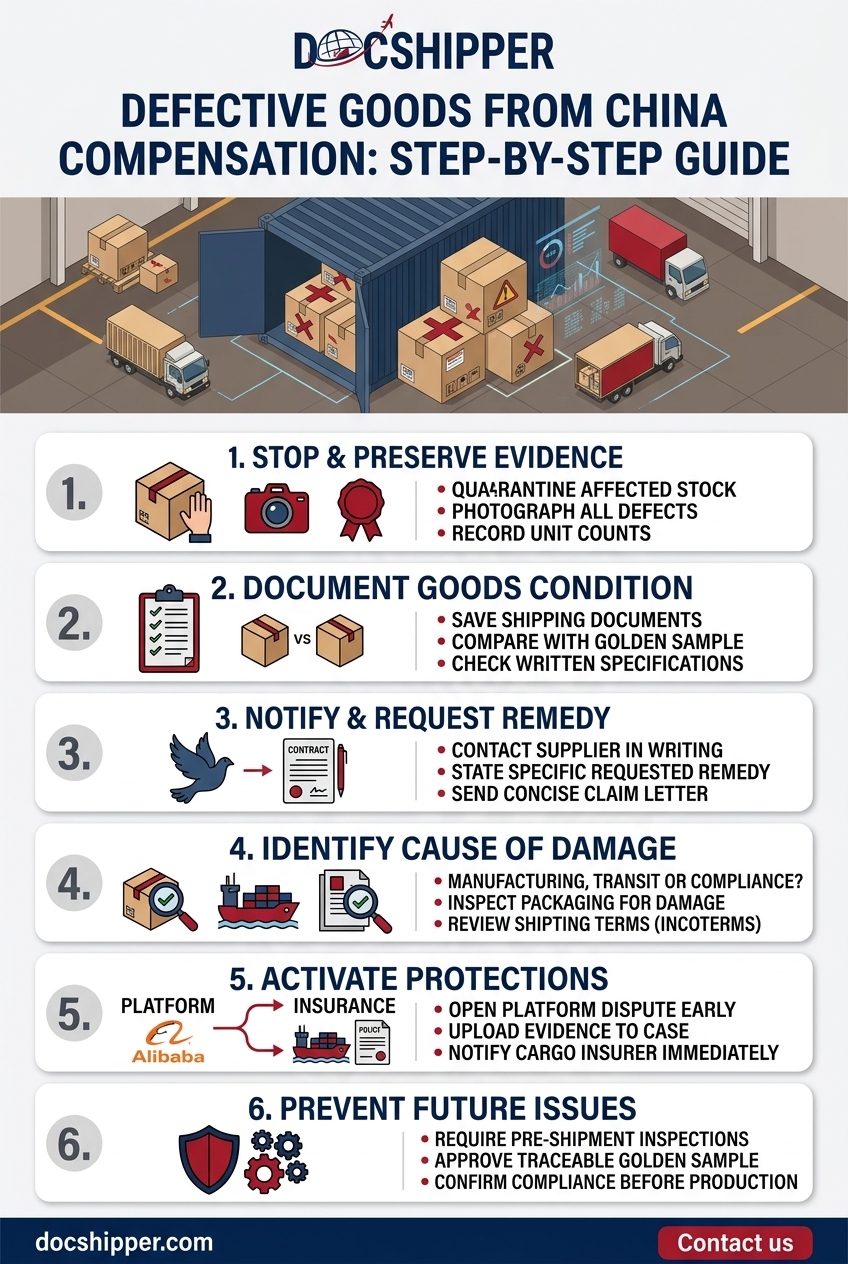
Defective goods from China: what to do and how to get compensation starts with preserving evidence, quarantining the affected batch and identifying whether the supplier, carrier, insurer or compliance failure is responsible. You can then request replacement, rework, a discount, refund or credit through the appropriate claim or dispute channel. Follow these essential steps:- Quarantine the goods, count affected units and document defects with photographs, videos, packaging records, specifications and the approved golden sample.
- Notify the supplier in writing and compare the shipment with the contract, inspection report, AQL criteria and agreed product requirements.
- Identify the likely cause: manufacturing defects usually concern the supplier, transit damage may involve the carrier or cargo insurer, and compliance failures depend on the contract and destination-market requirements.
- Submit a specific claim requesting replacement, rework, discount, refund or credit, with the affected quantity, commercial impact, supporting evidence and response deadline.
- Use Alibaba Trade Assurance or other payment protection within the applicable deadlines; Alibaba’s published guidance states that Trade Assurance disputes generally have a 15-day inspection window after delivery, subject to current rules and exclusions.
- For transit damage, notify the carrier, forwarder and insurer immediately, preserve the packaging, record delivery reservations and request a survey if required; seek legal advice for large claims, repeated refusal or serious compliance exposure.
The process covers first-48-hour evidence preservation, supplier and transit responsibility, negotiation remedies, Trade Assurance and payment protection, cargo insurance, legal action, and preventive factory and pre-shipment inspections.
We hope you’ll find this article genuinely useful, but remember, if you ever feel lost at any step, whether it’s finding a supplier, validating quality, managing international shipping or customs, DocShipper can handle it all for you!
When goods from China arrive defective or different from the agreed specification, your first priority is not compensation. It is preserving evidence, isolating the batch and identifying who is responsible. A clear record gives you leverage to request a replacement, rework, discount, refund or credit.
Your strongest position usually exists before you pay the balance and while the evidence is objective. Compare the goods with the contract, approved sample and inspection criteria, then use the payment protection, insurance policy or dispute procedure that actually covers the problem.
DocShipper Info
Document the shipment before making any claim or remedy request.
First 48 hours: stop and document
Quarantine the goods, count and photograph the defects against the agreed specification and sample, preserve the packaging and shipping documents, and notify the supplier in writing. Do not sell, modify, repair or discard the batch before you have documented its condition.
Start by separating the affected stock from saleable inventory. Mark pallets, cartons or units clearly, record the quantity received and note whether the issue affects the entire shipment or only a sample of products.
Build an evidence folder with the purchase order, commercial invoice, packing list, product specifications, approved golden sample, quality agreement, inspection report, photos, videos and delivery records. A golden sample is the physical reference unit approved before production; it gives both parties a concrete basis for comparison.
If your inspection uses AQL, record the inspection level, sample size, critical defects, major defects and minor defects. AQL, or Acceptable Quality Limit, is a sampling method commonly associated with ISO 2859-1. It does not make every unit perfect, but it defines how a sampled batch is accepted or rejected under the agreed inspection plan.
Use a consistent photo method: show the carton or product label first, then the defect close-up, followed by a wider image that identifies the unit or batch. Keep original files with their metadata where possible, and create a defect log that connects each image to a product reference, carton number and count.
- Quarantine the affected goods and prevent resale or rework.
- Count total units received and affected units.
- Photograph product defects, labels, cartons, pallets and protective packaging.
- Compare each issue with the written specification and golden sample.
- Save the AQL or inspection report, if one exists.
- Keep the bill of lading, delivery receipt, packing list and customs records.
- Notify the supplier in writing and request a written response.
DocShipper Alert
Quarantine the batch and document its condition before any resale, repair or disposal.
Identify the cause: supplier, transit or compliance
Manufacturing defects normally point to the supplier, physical damage during transport points to the carrier or cargo insurer, and compliance failures depend on the contract and the applicable product requirements. Do not send the same claim to every party without first establishing the likely cause.
Inspect the packaging before opening every carton. Crushed corners, water marks, broken seals or impact damage may support a transit claim, while identical production defects inside undamaged cartons may indicate a manufacturing or specification problem.
Review the Incoterm and shipping arrangement to understand when risk transferred and who arranged carriage or insurance. Incoterms help allocate delivery responsibilities and certain transport risks, but they do not replace the product specification, quality agreement or applicable insurance wording.
Compliance failures require a separate review. A product can be physically acceptable but still unusable because its labelling, materials, certificates, safety documentation or technical characteristics do not meet the agreed market requirements. Compare the contract with the documents your destination market requires before demanding a remedy.
| Cause | Likely responsible party | Potential remedy | Useful evidence |
| Manufacturing defect or product different from the specification | Supplier, subject to the contract | Replacement, rework, discount, refund or credit | Specification, golden sample, photos, counts, AQL report and production records |
| Damage caused during transport | Carrier, freight party or cargo insurer, depending on the contract and policy | Repair, replacement or insured compensation | Delivery reservations, packaging photos, survey report and transport documents |
| Missing or incorrect compliance documents | Party responsible under the contract | Corrected documents, compliant replacement or refund | Contract, certificates, test reports, labels and destination-market requirements |
DocShipper Tips
Match the defect pattern, packaging condition and compliance gap to the right party.
Looking for a Reliable
Sourcing Partner?
We handle the entire sourcing process, supplier research, negotiation, production, and inspections, so you can focus on what matters most: growing your business.


Negotiate with the supplier
Ask for a defined remedy rather than making a general complaint. Replacement, rework, a price discount, a refund or a credit on the next order can each be appropriate, but the right option depends on defect severity, timing, resale value and the cost of returning or repairing the goods.
Send a concise claim letter through the contractual communication channel and, where relevant, through the platform used for payment. State what was ordered, what arrived, how the goods differ, how many units are affected and which documents prove the difference.
Then make a specific proposal with a response deadline. For example, you can request replacement of the non-conforming units, reimbursement of agreed rework costs, a partial refund for units that remain usable, or a full refund where the batch cannot reasonably be sold.
Do not accept a small discount as a final settlement unless it actually covers the commercial impact and the agreement clearly releases the supplier from further claims. If the supplier offers a credit on a future order, define its amount, expiry, order reference and what happens if you do not place another order.
A practical claim letter can follow this structure:
- Subject: Quality claim for purchase order and shipment reference.
- Contract basis: Identify the purchase order, specification, golden sample, inspection standard or agreed tolerances.
- Finding: Describe each defect and distinguish critical, major and minor issues where your inspection system does so.
- Quantity: State the units received, units inspected and affected units, using the attached evidence.
- Impact: Explain whether the goods are unsellable, repairable, delayed or usable only at a reduced value.
- Requested remedy: Choose replacement, rework, discount, refund or credit and specify the amount or quantity requested.
- Evidence: Attach the defect log, photographs, report, packaging records and relevant contract pages.
- Response process: Request written confirmation of the remedy, collection arrangements and payment date.
| Remedy | When it may fit | Point to define in writing |
| Replacement | Goods are unusable and a compliant batch is still commercially useful | Quantity, specification, inspection, shipping and timing |
| Rework | Defects can be corrected without compromising compliance | Work scope, cost, approval test and responsibility for transport |
| Discount | Goods remain saleable at a reduced value | Discount basis, affected quantity and final settlement wording |
| Refund | Goods cannot be used or the supplier cannot provide a reliable correction | Refund amount, payment route and return or disposal instructions |
| Future credit | You expect to continue buying from the supplier | Credit value, validity, order reference and fallback remedy |
DocShipper Info
Specify the affected quantity, requested remedy, supporting evidence and response deadline.
Use Trade Assurance or your payment protection
If you paid through Alibaba Trade Assurance, preserve the dispute route by opening the case within the applicable inspection window after delivery and submitting evidence through the platform. Keep the communication, specifications and agreement in Alibaba’s own records rather than relying only on private messaging.
Alibaba’s published seller guidance states that Trade Assurance can cover products that do not match agreed specifications, late shipment and, where the seller arranged shipping, certain transit damage. The same source states that buyers have a 15-day inspection window after delivery to open a dispute, but you should verify the current official rules, exclusions and procedure for your transaction.
Submit the order details, agreed specifications, photos, inspection report, defect counts and requested remedy. Evidence outside Alibaba chat may carry little weight in the platform process, so upload the relevant documents and keep your explanation factual, chronological and tied to the order terms.
Other payment methods offer different protection. A letter of credit may provide documentary control if the documents do not comply, while PayPal or a bank transfer may have separate procedures and limitations. Check the actual terms before assuming that a payment reversal or chargeback will resolve a quality dispute.
Do not close a platform dispute simply because the supplier promises to solve the problem privately. Obtain the replacement, refund or agreed payment first, or confirm with the platform how accepting a settlement affects your remaining rights.
| Step | Action |
| 1 | Confirm the order, delivery date and current platform deadline. |
| 2 | Keep all relevant communication in the platform record. |
| 3 | Upload the specification, golden sample references, photographs and inspection report. |
| 4 | Describe the defect rate and requested remedy without unsupported assumptions. |
| 5 | Follow the platform’s response, evidence and settlement instructions. |
For the current Trade Assurance overview and conditions, consult Alibaba’s Trade Assurance guidance and verify the rules that apply to your order.
DocShipper Alert
Upload evidence through the official payment channel and verify the rules before accepting a private settlement.
Cargo insurance for transit damage
When the goods were damaged in transit, notify the carrier, freight forwarder and insurer immediately, record reservations on the delivery documents and preserve the packaging. A cargo insurance claim is different from a supplier quality claim because the key question is where and how the physical damage occurred.
Write a reservation on the delivery receipt when damage is visible, using precise wording rather than signing for goods as apparently sound. If damage is discovered later, notify the relevant parties as soon as possible and record when the cartons were opened, who was present and what was found.
Ask the insurer or carrier whether a survey report is required. A surveyor may examine the goods, packaging and transport conditions before repair, disposal or reconditioning, so do not destroy evidence or alter the shipment without instructions.
Review the cargo policy, including the applicable Institute Cargo Clauses, exclusions, deductibles, notice requirements and valuation basis. Coverage can depend on the insured risk, packing quality, route, exclusions and the party that arranged insurance, so never assume that every damaged shipment is automatically covered.
- Photograph the external packaging and visible damage before moving the goods.
- Record reservations on the delivery receipt where possible.
- Notify the carrier, forwarder and insurer using the contact details in the documents.
- Preserve cartons, pallets, seals, labels and damaged units.
- Request a survey report if the policy or insurer requires one.
- Submit the transport documents, invoice, packing list, photos, claim amount and inspection evidence.
- Follow the policy’s time limits and obtain written approval before disposal or repair.
DocShipper Alert
Preserve packaging, record delivery reservations and obtain insurer instructions before repair or disposal.
Why Choose DocShipper
Lower risk, transparent pricing, and a single point of contact from pickup to delivery.
-
One single point of contactA dedicated consultant coordinating every step and keeping you informed.
-
9,200+ operations / 6,000+ clientsProven processes on China ↔ EU/US lanes (FCL, LCL, air, road, rail).
-
No hidden feesTransparent quotes and document guidance to avoid surprises.
When legal action makes sense
For a large claim, repeated refusal, serious compliance exposure or an insolvent-looking supplier, obtain legal advice early. Arbitration or court action in China or Hong Kong may be possible, but the practical route depends on the contract, jurisdiction clause, evidence, recoverability and the value of the claim.
Check the dispute clause before threatening proceedings. It may name a Chinese court, CIETAC, HKIAC or another forum, and the wording may determine whether a decision can be enforced where the supplier’s assets are located.
CIETAC is the China International Economic and Trade Arbitration Commission, while HKIAC is the Hong Kong International Arbitration Centre. These institutions administer arbitration under their respective rules, but the suitability of arbitration depends on the clause, parties, evidence and enforcement strategy.
Organise the evidence before meeting counsel: signed contracts, purchase orders, product specifications, payment records, inspection reports, defect logs, communications and proof of loss. A lawyer can then assess the governing law, available forum, damages theory and realistic enforcement options without relying on an incomplete narrative.
Legal action is not automatically the best first move for every defective batch. Compare the likely recovery with the cost, time, management effort and risk of enforcement, and preserve negotiation, platform and insurance channels while counsel reviews the case.
DocShipper Tips
Use measurable specifications, pre-shipment inspection and balance-payment controls before production begins.
Prevent the next bad batch
The most reliable compensation mechanism is preventing the balance from being paid for a batch that has not passed inspection. Put detailed specifications, a golden sample, tolerances, packaging requirements, testing documents and the inspection right into the purchase documents before production starts.
Use a factory audit when you need to assess production capability, quality systems, equipment and process controls before placing or scaling an order. A pre-shipment inspection then checks a production batch before dispatch, giving you an opportunity to require correction while the goods remain at the factory.
Make the inspection result operational. Define which defects are unacceptable, which tolerance applies, who pays for reinspection, what happens after a failed result and whether the remaining balance is released only after a passed inspection.
Keep compliance in the same workflow as quality. Confirm the destination-market requirements, product labels, materials, test reports and technical file before production, because a visually acceptable product can still be impossible to import or sell.
- Write measurable product and packaging specifications.
- Approve and retain a signed or otherwise traceable golden sample.
- Define the inspection standard, including AQL where appropriate.
- Audit the factory when capability or process control is uncertain.
- Arrange pre-shipment inspection before releasing the balance.
- Require corrective action when defects exceed the agreed limit.
- Verify compliance documents before shipment, not after arrival.
- Keep a complete supplier and batch record for future claims.
Conclusion
Defective goods from China compensation starts with evidence, not an angry message. Once the batch is documented and the cause is identified, you can direct the claim to the supplier, carrier, insurer or contractual dispute channel.
- Document defects before selling, repairing or discarding anything.
- Identify whether the cause is supplier quality, transit damage or compliance failure.
- Negotiate a defined replacement, rework, discount, refund or credit.
- Use Trade Assurance or cargo insurance within the applicable deadlines.
- Ask counsel to review large claims and arbitration or court clauses early.
- Pay the balance only after an agreed pre-shipment inspection has passed.
Received defective goods from China? We can inspect the batch, document defects against your specification and support your negotiation with the supplier.
FAQ | Defective Goods from China Compensation: What to Do Step by Step
Possibly, but these amounts are usually harder to recover than the purchase price. Check whether the contract limits liability or excludes indirect losses, then document the amount, the reason it arose and its direct connection with the defective goods. Keep invoices, customer cancellations, warehouse charges and customs records, and take reasonable steps to reduce the loss.
Not automatically. Returning the goods can create additional transport, customs and proof-of-condition risks. First obtain written agreement covering the return address, shipping cost, customs responsibility, insurance, inspection method and payment timing. Unless the goods create a safety risk, avoid shipping them back until those points and the proposed remedy are confirmed.
Treat the shipment as separate affected and unaffected quantities rather than rejecting everything automatically. Keep the defective units identifiable, confirm the defect rate with a reliable sample or full inspection where necessary, and propose a remedy limited to the affected stock. If the remaining goods cannot be sold separately or the defect creates a compliance risk, explain that commercial impact in the claim instead of reporting only a percentage.
You may still have useful evidence in the purchase order, invoice, product listing, approved artwork, supplier quotations, platform messages, payment records, samples and shipping documents. Preserve the original versions and avoid relying on screenshots alone when the platform can export or verify the conversation. The more precisely these records show the agreed specifications, quantities and tolerances, the stronger your position will be.
Stop further distribution or processing and preserve the remaining stock exactly as it is. Create a traceability record showing which units were sold, modified or discarded, when the issue was discovered and what evidence existed before the change. You can still pursue a claim, but the supplier may challenge the cause or the size of the loss, so independent testing and customer-return records can become particularly important.
Treat the replacement as a new delivery and inspect it before accepting it as a final remedy. Compare it with the original specification and record whether the same or a different defect has returned. Notify the supplier immediately that the replacement has not resolved the claim, and do not allow the second shipment to replace your original rights unless the written settlement clearly says so.
Need Help with
Logistics or Sourcing ?
First, we secure the right products from the right suppliers at the right price by managing the sourcing process from start to finish. Then, we simplify your shipping experience - from pickup to final delivery - ensuring any product, anywhere, is delivered at highly competitive prices.