In short ⚡
EU General Product Safety Regulation (GPSR) imposes new obligations on importers of consumer products sold to EU consumers since 13 December 2024, including identifying an EU-established economic operator, documenting risk and safety checks, ensuring traceability, local-language warnings, accident procedures, and complete information on online listings. CE marking does not replace these duties.The key themes are the GPSR’s changes for importers, responsible economic operators, product documentation and traceability, CE marking, online marketplace requirements, and separate rules for Northern Ireland and Great Britain.
We hope you’ll find this article genuinely useful, but remember, if you ever feel lost at any step, whether it’s finding a supplier, validating quality, managing international shipping or customs, DocShipper can handle it all for you!
What the GPSR changes for importers and non-EU sellers
The General Product Safety Regulation, Regulation (EU) 2023/988, has applied since 13 December 2024 to consumer products sold to EU consumers, whether they are offered online or offline. It requires an EU-established economic operator for each product, documented safety checks, traceability information and complete safety information on product listings.
The GPSR repealed Directive 2001/95/EC and modernised the EU product safety framework for e-commerce, imported goods and connected supply chains. It applies to new and used consumer products, unless a product is covered by more specific EU rules that address the same safety risks in full.
The practical change for a business sourcing in China is significant: product quality alone is not enough. Before a product reaches an EU consumer, you need to know who is legally responsible in the EU, which documents support the safety assessment, how the product can be traced and what information the buyer will see online.
The enforcement context is becoming more demanding. The European Commission’s Safety Gate recorded 4,671 alerts in 2025, a record since 2003. Products originating in China represented about 43% of those alerts, while dangerous chemicals accounted for 53% of notifications. Cosmetics, toys and electrical appliances were the leading categories, according to reporting on the European Commission’s 2025 Safety Gate report.
As European Commissioner for Consumer Protection Michael McGrath stated, “Wherever they come from and whatever their purpose, they must be safe.” The quotation was reported by Euronews in its coverage of the Safety Gate results.
Use the Regulation itself as the legal reference, then build an operational file around it. The official EUR-Lex text of Regulation (EU) 2023/988 is the starting point for checking the obligations applicable to your product.
| Point | Directive 2001/95/EC | Regulation (EU) 2023/988 |
| Legal form | Directive requiring national implementation | Regulation with directly applicable EU rules |
| Online sales | Less detailed rules for online offers | Specific obligations for online product offers |
| EU responsible person | No equivalent GPSR structure for every product | An EU-established economic operator is required in the supply chain |
| Traceability | General product safety requirements | Product identification, contact details and supply-chain traceability are made operational |
| Accidents | General cooperation and notification framework | Businesses must have procedures for accident reporting and corrective action |
| Marketplaces | Less specific platform obligations | Online marketplaces have defined cooperation and removal duties |
Are you the responsible economic operator?
A consumer product can only be placed on the EU market when an economic operator established in the EU is responsible for it. This may be the manufacturer, an importer, an authorised representative or, in certain situations, a fulfilment service provider. If you buy in China and sell directly to EU consumers, you must identify this operator before shipment.
You are a non-EU brand or seller
If your company is established in the United States, the United Kingdom, Asia or another non-EU country, you cannot assume that your Chinese factory becomes your GPSR contact. A manufacturer outside the EU must generally be linked to an EU-established responsible operator before the product is placed on the EU market.
For a non-EU brand, the practical options may include appointing an authorised representative or working with a fulfilment service provider that falls within the Regulation’s definition. The appointment should be documented, product-specific where necessary and reflected on the product, packaging or accompanying documentation and in the online offer.
You import into the EU
An EU importer is not simply a logistics intermediary. The importer must check that the manufacturer has completed the relevant safety work, that the product carries the required identification and contact details, that instructions and warnings are available in the required language and that the technical documentation can be made available to authorities.
The importer’s name and contact details must appear on the product, its packaging or an accompanying document, depending on what is practicable and required. Ask the factory to confirm the exact label artwork and marking method before production, rather than discovering after arrival that the importer details cannot be added without opening or relabelling stock.
Looking for a Reliable
Sourcing Partner?
We handle the entire sourcing process, supplier research, negotiation, production, and inspections, so you can focus on what matters most: growing your business.


You sell on a marketplace
Amazon, a specialist marketplace and your own website do not transfer your seller obligations. The seller remains responsible for ensuring that the product can legally be placed on the EU market and that the online offer displays the required information.
Marketplaces have separate duties under the GPSR. When an authority orders action, the platform must remove or disable access to a dangerous offer within two working days under CELEX:32023R0988″ target=”_blank” rel=”nofollow noopener” style=”color:#05224d;text-decoration:underline;font-weight:bold”>Article 22. This platform obligation does not replace your responsibility to prepare a compliant product file.
| Role | Example | Main GPSR duties |
| Non-EU manufacturer or brand | A US brand designs and sells a product made in China | Identify an EU-established operator, maintain the product file and ensure the listing and product information are complete |
| EU importer | An EU company buys from a Chinese factory and imports the goods | Check safety documentation, traceability, markings, instructions and corrective-action procedures |
| Authorised representative | An EU-based entity appointed by a non-EU manufacturer | Carry out the tasks assigned in the written mandate and cooperate with authorities |
| Fulfilment service provider | An EU service stores and ships goods for a non-EU seller | May become the relevant EU economic operator where the Regulation’s conditions apply |
| Distributor | A retailer purchases already imported products | Check visible compliance information and avoid supplying products that appear unsafe or incomplete |
| Marketplace | A platform hosts an offer from a third-party seller | Cooperate with authorities, maintain marketplace processes and remove or disable access to ordered offers |
For example, a US brand that ships a product from its Chinese factory to Amazon.de must identify an EU-established responsible operator, ensure that the operator is shown in the required product information and prepare the manufacturer, identification and warning data for the listing. A high-quality product with no EU operator is still not ready for sale.
Your concrete obligations, product by product
For each product, the importer should verify a documented risk analysis, technical documentation, traceability marks, manufacturer and importer details, local-language instructions and warnings, and a procedure for complaints, recalls and accident reports. Treat each reference, model or variant as an auditable compliance file rather than as a general statement covering an entire catalogue.
Risk analysis and technical documentation
A risk analysis identifies the reasonably foreseeable risks linked to the product, its use, foreseeable misuse, users, packaging and instructions. The technical documentation should allow you to explain why the product is safe and which evidence supports that conclusion, including relevant test reports, specifications, drawings, materials information and corrective actions.
The European Commission published non-binding GPSR guidelines and Safety Business Gateway guidance on 19 November 2025, including templates intended to help document risk analysis. Thomas Klindt and Arun Kapoor, lawyers in Product Regulation and Compliance at Noerr, explain in a analysis of the Commission guidelines that the documents are not legally binding but reflect the Commission’s position and should therefore be taken seriously by companies.
Where testing is needed, use an appropriate laboratory and match the test scope to the product’s risks. DocShipper’s product-compliance service uses ISO 17025-accredited laboratories, with testing typically taking 10 to 15 days. Testing does not replace the technical file, but it can provide important evidence for it.
Traceability and labelling to request from the factory
Ask the Chinese supplier to confirm, before production, where the type, batch or serial number will appear and how it will remain legible during normal use. The same pre-shipment review should verify the manufacturer’s name and contact details, the importer or other responsible operator’s details, product identification, instructions and safety warnings.
Language is part of the control. Instructions and safety information must be available in the language required by the Member State where the product is sold. Prepare the artwork centrally, approve the final version against the production sample and request photographs of the actual marking before the goods leave China.
The most preventable failures are often inexpensive to correct at the factory and expensive to correct after arrival. Adding a batch reference, changing a contact line or replacing a warning translation before shipment is usually simpler than opening finished cartons, relabelling stock or suspending a listing.
Why Choose DocShipper
Lower risk, transparent pricing, and a single point of contact from pickup to delivery.
-
One single point of contactA dedicated consultant coordinating every step and keeping you informed.
-
9,200+ operations / 6,000+ clientsProven processes on China ↔ EU/US lanes (FCL, LCL, air, road, rail).
-
No hidden feesTransparent quotes and document guidance to avoid surprises.
Accidents, recalls and the Safety Business Gateway
Your file should include a process for handling complaints, safety incidents, corrective action and recalls. If a serious accident is linked to a product, the relevant information must be reported through the European Commission’s Safety Business Gateway when the reporting conditions apply.
Do not wait for an authority request to decide who will investigate an incident, identify affected batches, contact distributors, notify customers or record the action taken. National authorities recorded 5,794 follow-up measures in 2025, a 35% increase from the previous year, according to analysis by Mason Hayes & Curran of the Safety Gate report.
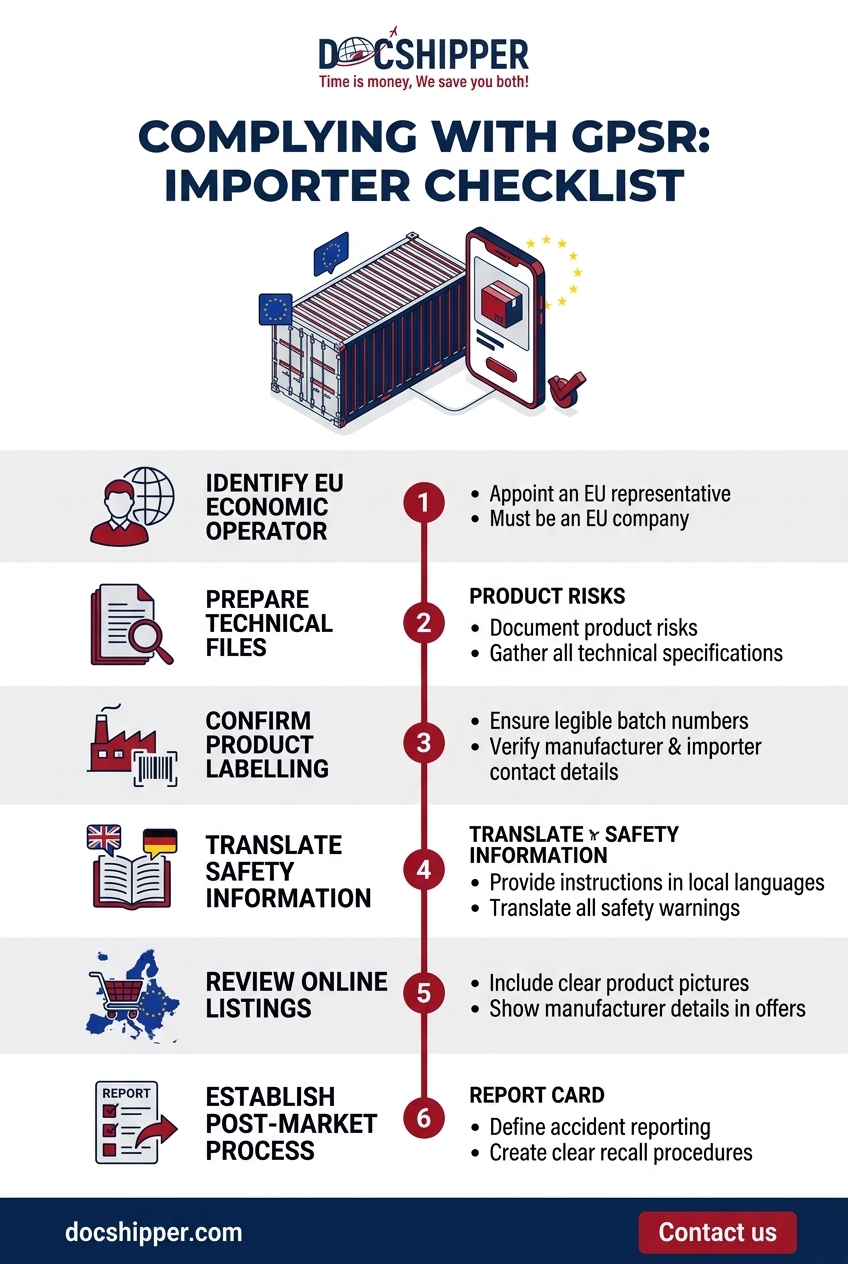
Use the following checklist for every reference. A product that fails one item should be placed on hold until the gap is assessed and corrected.
- Confirm the product falls within the GPSR scope and identify any more specific EU legislation.
- Record the manufacturer, EU importer, authorised representative or applicable fulfilment service provider.
- Complete and retain a product-specific risk analysis.
- Assemble technical documentation, including relevant test reports and product specifications.
- Confirm the type, batch or serial number and its location on the product, packaging or accompanying document.
- Verify manufacturer and economic-operator contact details.
- Approve instructions and warnings in the language required for each destination market.
- Document complaint handling, accident reporting, corrective action and recall procedures.
| GPSR importer checklist | What to verify before shipment |
| Scope | Product category, intended users, foreseeable use and applicable EU rules |
| Risk file | Risk analysis linked to the actual product and supporting technical evidence |
| Factory marking | Type, batch or serial number, manufacturer details and EU operator details |
| Safety information | Instructions and warnings reviewed for the destination Member States |
| Online data | Manufacturer, EU responsible person, product identification, image and warnings |
| Post-market process | Complaint log, accident reporting route, corrective-action and recall procedure |
GPSR and CE marking: which applies to your product?
CE legislation applies first where a product falls under EU harmonised legislation, while the GPSR covers residual risks and economic-operator duties. If no specific EU product legislation addresses the product’s safety requirements, the GPSR applies in full.
CE marking is not a GPSR exemption. A toy, electrical product or other CE-marked product may still need a GPSR risk approach, traceability information, an EU economic operator, compliant warnings and a complete online offer.
Consider two different products. A general phone case that is not covered by a specific harmonised product-safety regime is assessed primarily under the GPSR. A toy must meet the applicable toy-safety requirements, while the GPSR can still matter for risks, traceability, online information and duties not fully addressed by that sector legislation.
GPSR is therefore a safety net, not a second mark. For the wider map of product compliance requirements, consult DocShipper’s product compliance overview rather than treating a CE mark as the end of the assessment.
| Product situation | Practical framework |
| Product with no specific harmonised safety legislation | GPSR applies in full, including safety assessment and economic-operator duties |
| Product covered by CE legislation | Apply the relevant sector legislation first, then address GPSR residual risks and operator duties |
| Product with a CE mark but incomplete traceability | Not ready for sale: CE marking does not replace GPSR information and process requirements |
| Product with test reports but no EU operator | Not ready for placement on the EU market under the GPSR structure |
Selling online or on a marketplace: what your listing must show
Every online offer directed at EU consumers must show the manufacturer’s name and contact details, the EU responsible person when the manufacturer is outside the EU, product identification including a picture and type, and applicable warnings or safety information. The listing is now part of the compliance file, not merely a marketing page.
Review the offer itself under Article 19 before publishing it. A product page can contain attractive photographs and accurate commercial claims while still failing because the responsible person is missing, the product cannot be identified, or a safety warning appears only inside a downloadable manual that the buyer does not see before purchase.
Build a listing template that draws its information from the approved technical file. Keep the product identifier, image, manufacturer details, responsible-person details and warnings consistent with the packaging and the physical product. If a product is sold in several Member States, confirm that the safety information is available in the languages required for each offer.
Marketplaces also have their own obligations and authority-response processes. The Regulation requires a marketplace to remove or disable access to an offer within two working days when an authority orders that action. That response time is a reason to correct the source product information before listing, not a substitute for seller-side compliance.
Before publishing a listing for a product imported from China, check each line below:
- Manufacturer name and contact details are visible in the offer.
- EU responsible person name and contact details are visible where required.
- Product name, type, model or other identifier matches the physical product.
- A clear product picture is included.
- Warnings and safety information are displayed in the required language.
- The listing does not contradict the approved label, instructions or technical file.
| Listing element | What the seller should confirm |
| Manufacturer | Name and contact information are displayed and match the product file |
| EU responsible person | Name and contact information are displayed when the manufacturer is outside the EU |
| Product identification | Picture, type, model or other identifier allows the offer to be distinguished |
| Warnings | Safety warnings and information appear before purchase in the required language |
| Consistency | Online information matches the packaging, instructions and approved technical documentation |
UK sellers: Northern Ireland and Great Britain
The EU GPSR applies directly in Northern Ireland from 13 December 2024. Great Britain remains under the General Product Safety Regulations 2005 for now, while the UK government is consulting on reforms to product safety, marketplace duties and digital information.
This creates two different compliance routes for UK-based sellers. A product placed on the Northern Ireland market must be assessed against the EU GPSR, while a product placed only in Great Britain follows the current GB framework and any applicable sector rules. Do not use “the UK” as a single answer in your product matrix.
GOV.UK guidance confirms the direct application of the EU GPSR in Northern Ireland. The UK reform discussions also point towards stronger expectations for online marketplaces, digital product information and enforcement, but proposed changes should not be treated as current GB law before they are adopted.
Where commercially practical, prepare one label and documentation set that works for the EU and Northern Ireland, then check whether additional GB information is needed. The relevant GOV.UK GPSR guidance should be checked alongside the EU Regulation and the latest OPSS materials.
Conclusion
GPSR compliance for importers is a decision about market access, not an additional logo to place on a box. Before your next shipment from China, identify the EU economic operator, close the product-file gaps, approve the factory markings and make the online listing reflect the same information.
- Regulation (EU) 2023/988 has applied since 13 December 2024 to consumer products sold in the EU, including online.
- Every product needs an economic operator established in the EU: no operator means no compliant sale.
- Prepare a risk analysis, technical file, traceability marks and local-language warnings for each product.
- CE legislation does not exempt a product from GPSR duties or residual safety requirements.
- Online listings must show the manufacturer, EU responsible person where required, product identification and warnings.
- Correct labelling and traceability at the factory before shipment, when changes are faster and less costly.
Not sure your file and labels will pass an EU check? Send us your documents before the goods leave China. We verify the declaration or certificate of conformity, test reports, markings and traceability, then return a clear Go/No-Go report with correction priorities. DocShipper’s compliance verification starts from 290 USD per reference, with a report within 5 business days or 48 hours express.
FAQ | GPSR Obligations for Importers: What to Prepare Before Selling in the EU
Usually, yes. If you place the product on the EU market under your own name or trademark, you may be treated as the manufacturer even if a Chinese factory designed or produced it. This can make you responsible for the product’s safety assessment, technical documentation, identification, instructions, warnings and corrective actions. A supplier’s test report alone does not transfer these responsibilities to the factory.
No. A customs broker, freight forwarder or carrier generally handles transport or customs formalities, not product-safety obligations. The GPSR role must be held by an eligible EU-established economic operator, such as the manufacturer, importer, authorised representative or, in specific circumstances, a fulfilment service provider. Confirm the role in writing rather than assuming that the company clearing the goods is legally responsible for the product.
Yes, but the written mandate should define the exact products, brands, models and responsibilities covered. The representative must have access to the relevant technical documentation and be able to cooperate with national authorities. A general service agreement that does not identify the products or assign GPSR tasks may be difficult to rely on during an inspection.
Treat the product as not ready for EU sale until you can obtain sufficient evidence of safety. Ask for the documents needed to support your own product file, such as specifications, materials information, test reports, drawings and details of safety-related components. If the supplier only sends a generic certificate or an unrelated report, check that it matches the exact model, materials, intended use and applicable risks before accepting it.
Potentially, yes. Changing a material, battery, component, packaging, instruction, manufacturing site or intended use can introduce new risks or invalidate existing evidence. Before selling the revised version, compare it with the approved product, update the risk analysis and technical file where necessary, and determine whether additional testing or new warnings are required. Keep clear version records so you can identify which batches were made before and after the change.
A withdrawal stops a product from being supplied when it has not yet reached consumers. A recall concerns products that have already been sold or made available to consumers and requires action to obtain an appropriate remedy, such as repair, replacement or reimbursement where applicable. Your procedure should identify affected batches, sales channels and customers, define who communicates with authorities and buyers, and record the corrective action taken.
Product-safety records should remain accessible throughout the period required by the GPSR and any applicable sector legislation; for manufacturers, the Regulation generally requires technical documentation to be retained for 10 years after the product is placed on the market. In practice, keep the risk assessment, test evidence, label versions, supplier records, complaints and corrective-action history together for each model and batch. Apply the longest applicable retention period where another EU rule imposes a longer requirement.
Need Help with
Logistics or Sourcing ?
First, we secure the right products from the right suppliers at the right price by managing the sourcing process from start to finish. Then, we simplify your shipping experience - from pickup to final delivery - ensuring any product, anywhere, is delivered at highly competitive prices.