In short ⚡
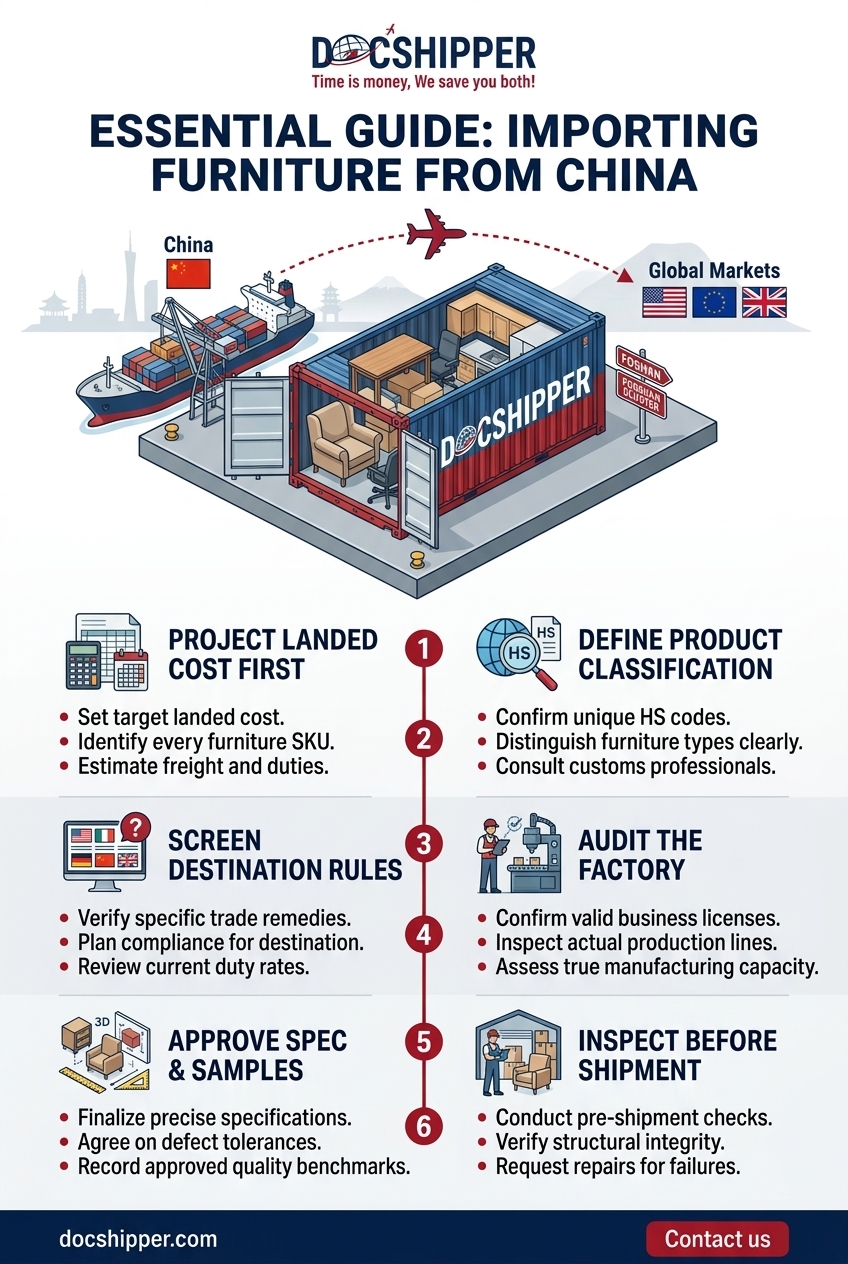
How to Import Furniture from China: Suppliers, Shipping and Compliance requires calculating the landed cost, verifying suppliers, confirming destination rules, inspecting production, and planning transport before placing an order. Key steps include:- Define costs and classify products: List each SKU, material, dimensions, carton size, destination, HS code and target landed cost, including freight, duties, inspection, clearance and delivery.
- Check destination requirements: Review US trade remedies, EU TARIC, GPSR and EUDR requirements, or UK tariff and upholstered-furniture fire-safety rules before ordering.
- Find and vet suppliers: Use relevant Chinese furniture clusters, CIFF and online channels, then verify the business licence, factory address, production capacity, export history and quality procedures.
- Approve products and compliance evidence: Confirm materials, dimensions, finishes, hardware, packaging, labelling, test reports, warnings, care instructions and timber information against an approved sample.
- Inspect and prepare shipment: Conduct a pre-shipment inspection covering quantity, structure, finish, function, safety and packaging, then choose FCL or consolidation and coordinate carton marks and loading.
- Clear customs and monitor delivery: Ensure the commercial invoice, packing list, bill of lading, origin information and compliance records match the goods, then check quantities and damage immediately after arrival.
Key considerations include China’s furniture sourcing hubs, supplier audits, destination-specific duties and regulations, quality control and packaging, FCL or LCL shipping, and the complete import sequence from classification to customs clearance.
We hope you’ll find this article genuinely useful, but remember, if you ever feel lost at any step, whether it’s finding a supplier, validating quality, managing international shipping or customs, DocShipper can handle it all for you!
Importing furniture from China can still work well in 2026, but the right decision depends on your destination and product category. A sofa, wooden bedroom set, office chair and kitchen cabinet do not face the same duty, compliance or quality risks.
China offers broad product variety, mature component networks and large production capacity. However, US trade remedies can transform a competitive quotation into an unprofitable landed cost, while EU and UK buyers must focus heavily on product safety, timber traceability and fire regulations.
DocShipper Info
Our team can assess duties, compliance and supplier competitiveness for your market.
Is China still a good source for furniture in 2026?
China exported USD 20.8 billion of wooden furniture in 2025, although export value fell while shipment volumes increased. For EU and UK buyers, China may remain competitive when the supplier can document compliance; for US buyers, Vietnam may be more attractive for categories affected by Chinese trade remedies.
According to Lesprom Analytics, China’s wood furniture exports fell 10.1% in value to USD 20.8 billion in 2025, while units rose 2.7% to 481.08 million pieces. The average export price declined 12.4% to USD 43.20 per piece, showing both China’s scale and the pressure on unit pricing.
The US market illustrates why a country-level decision is not enough. Between January and August 2025, Vietnam represented 45.3% of US wooden furniture imports, compared with 10.4% for China. This shift does not mean Vietnam is automatically cheaper, because factory capability, material specification, freight, testing and origin rules still affect the final result.
China remains particularly strong when you need many styles, custom finishes, hardware options or coordinated products from several factories. Foshan and surrounding Guangdong furniture clusters offer extensive sourcing depth, while other Chinese regions specialize in office seating, wood products, metal components and contract furniture.
| Destination | China exposure | Vietnam comparison | Practical advice |
| United States | High exposure for certain wooden bedroom, upholstered and cabinet categories | Vietnam’s US wooden furniture share reached 45.3% for January to August 2025 | Calculate trade remedies before requesting a final quotation |
| European Union | Broad supplier choice, with compliance and timber traceability as key controls | Compare total landed cost and documentation, not only factory price | Confirm the HS code, GPSR obligations and EUDR timing |
| United Kingdom | Supplier flexibility, with particular attention to upholstered furniture safety | Assess fire testing and documentation for both origins | Validate UK furniture fire safety requirements before production |
DocShipper Tips
Verify the factory before negotiating your furniture order.
Where and how to find furniture suppliers in China
The most effective approach is to combine a relevant furniture cluster, a verified supplier channel and an on-site audit. Foshan and Shunde, including the Lecong furniture market, are important starting points for household, hospitality and interior products, while Dongguan, the Yangtze River Delta and Zhejiang’s Anji area can be relevant for other furniture categories.
Manufacturing hubs and markets
Foshan is useful for comparing many designs and factories in a short time, but a market showroom is not necessarily the production site. Ask whether the displayed product is made by the seller, produced by a partner factory or simply resold from another manufacturer.
Dongguan and the wider Guangdong region can be relevant for furniture involving mixed materials, hardware and export-oriented production. Zhejiang’s Anji area is associated with office chairs and seating, while factories around Shanghai and the Yangtze River Delta may support different wood, metal and contract-furniture requirements.
Trade fairs
CIFF, the China International Furniture Fair, is a useful channel for meeting manufacturers and comparing collections. Check the official CIFF calendar for the relevant Guangzhou or Shanghai edition rather than relying on an old event date, and record each supplier’s booth, factory location, product scope and export markets.
Online platforms can provide a broad initial shortlist, but platform status is not a substitute for verification. A factory visit, production audit and sample comparison are more valuable than a polished profile when your order involves expensive materials, custom dimensions or a long warranty period.
Looking for a Reliable
Sourcing Partner?
We handle the entire sourcing process, supplier research, negotiation, production, and inspections, so you can focus on what matters most: growing your business.


Vetting a supplier
Before negotiating price, request the Chinese business licence, registered company name, factory address, export history, product catalogue and evidence of relevant testing. Match the legal entity on the quotation, contract, bank account and shipping documents. A mismatch can complicate payment, claims and customs clearance.
Use an independent supplier audit to check ownership, equipment, production lines, quality procedures, subcontracting and capacity. Capacity should be assessed against your peak order, not only the number of workers present during a short visit.
Send the same questionnaire to every shortlisted supplier. This makes the comparison less dependent on sales presentation and exposes differences in materials, lead times, packaging and documentation.
| Supplier question | Evidence to request | Risk it helps identify |
| Are you the manufacturer of this product? | Business licence, factory address, production photos and audit access | Trading company presented as a factory |
| Which materials and grades do you use? | Material specification, supplier records and sample approval | Substitution of wood, foam, fabric or hardware |
| Which countries do you export to? | Redacted shipping records or customer references where available | Limited experience with your destination |
| What is your monthly and peak capacity? | Production plan, equipment list and staffing information | Late delivery or uncontrolled subcontracting |
| How do you inspect furniture? | Quality-control plan, inspection reports and defect procedure | Inconsistent dimensions, finish or assembly |
| How will you pack the order? | Packaging specification, carton test information and photos | Transit damage and excessive dimensional weight |
DocShipper Alert
Audit the legal entity, capacity and quality system before payment or production.
DocShipper Alert
Confirm classification, trade remedies and compliance before accepting a quotation.
Duties, trade remedies and compliance by destination
Check the HS code, destination, furniture type, material composition and exporter status before accepting a quotation. In the US, Chinese wooden bedroom furniture can face an antidumping cash deposit rate of 216.01% for the China-wide entity, while upholstered furniture and kitchen cabinets or vanities are affected by Section 232 measures reported as in force from 14 October 2025.
United States
The antidumping order on wooden bedroom furniture from China is order A-570-890, originally issued on 4 January 2005. The US Department of Commerce published the final results of the 2024 administrative review on 12 August 2026, with a China-wide entity cash deposit rate of 216.01% for exporters without their own applicable rate.
This rate is not a generic “China furniture duty”. It applies to the scope of the specific order, so you must verify whether the planned product is covered and whether the exporter has a separate rate. Ask a customs broker or trade-remedy specialist to review the order and confirm the current treatment in ACE or through U.S. Customs and Border Protection.
Section 232 measures also matter for US imports of upholstered furniture and kitchen cabinets or vanities. Retail TouchPoints reported a 25% base tariff from 14 October 2025, with a planned increase to 30% and 50% on 1 January 2026 delayed by one year. Confirm the current rate at the time of entry because tariff measures can change.
Illustrative calculation: if USD 40,000 of wooden bedroom furniture is covered by the order and the exporter has no separate applicable rate, the antidumping cash deposit calculation is:
- Customs value: USD 40,000
- China-wide antidumping rate: 216.01%
- USD 40,000 × 2.1601 = USD 86,404
- Antidumping cash deposit: USD 86,404, before regular customs duties and other import costs
This is an illustration based on the rate in the cited Federal Register notice, not a landed-cost quotation or a substitute for a US customs determination.
European Union
For many furniture HS codes, EU conventional duties are often 0%, but you must verify the exact classification in TARIC. “Furniture” is too broad for a reliable duty answer: bedroom furniture, seating, lighting, mattresses and parts can fall under different codes and rules.
The General Product Safety Regulation, or GPSR, requires businesses to manage product safety, traceability and responsible economic-operator information for applicable consumer products. Review DocShipper’s guide to product compliance and identify the technical file, warnings, instructions and contact information required for your sales channel.
For wooden furniture, the EU Deforestation Regulation is a separate planning issue. The Netherlands Enterprise Agency states that EUDR applies from 30 December 2026 to large operators and timber traders and covers wooden furniture. Prepare supplier data on wood species, country of harvest and geolocation requirements rather than waiting until the shipment is ready.
Why Choose DocShipper
Lower risk, transparent pricing, and a single point of contact from pickup to delivery.
-
One single point of contactA dedicated consultant coordinating every step and keeping you informed.
-
9,200+ operations / 6,000+ clientsProven processes on China ↔ EU/US lanes (FCL, LCL, air, road, rail).
-
No hidden feesTransparent quotes and document guidance to avoid surprises.
United Kingdom
UK importers should check the Furniture and Furnishings (Fire) (Safety) Regulations 1988 for upholstered furniture. The rules affect materials and articles such as upholstery, fillings, covers and furniture supplied to consumers, so ask for evidence that the exact construction and fabric combination meets the applicable requirements.
Do not treat a general material certificate as proof that the finished sofa, chair or bed complies. Confirm which component was tested, whether the test method matches the product and whether the test report identifies the same materials, construction and supplier as the production sample.
| Destination | Duty starting point | Trade remedies | Key compliance action |
| US | Confirm HS code and customs value | Wooden bedroom furniture China-wide antidumping rate of 216.01%; Section 232 exposure for upholstered furniture and cabinets | Check the exact scope, exporter rate and current CBP or Commerce treatment before ordering |
| EU | Verify the HS code in TARIC; many furniture lines are often 0% | Check whether a product-specific measure applies | Prepare GPSR documentation and EUDR timber information from 30 December 2026 |
| UK | Verify the commodity code and UK tariff treatment | Check product-specific measures separately | Validate the Furniture and Furnishings (Fire) (Safety) Regulations 1988 for upholstered products |
Quality control and packing for furniture
Furniture should be inspected against an approved golden sample before shipment. The inspection must cover structure, materials, dimensions, finish, hardware, function, safety and packaging, because a visually attractive showroom sample does not guarantee production consistency.
Start with the frame and hidden structure. Check wood species or board specification, moisture condition where relevant, joints, welds, screws, load-bearing points and stability. For upholstered goods, inspect foam density documentation, fabric composition, stitching, seams, odour and the fit of removable covers.
Measure critical dimensions with a defined tolerance, including length, width, height, thickness, hole positions and assembly points. Test doors, drawers, hinges, slides, recliners and adjustable mechanisms repeatedly. Record defects with photographs, sample references and a clear classification such as critical, major or minor.
Ask the supplier which laboratory tests are required for your destination and product. Depending on the furniture, testing may concern stability, strength, flammability, chemical restrictions, formaldehyde, coatings or electrical components. A laboratory report is useful only when it relates to the final construction and the applicable market.
Packaging should protect corners, edges, glass, polished surfaces and hardware during handling and container movement. Define the carton, foam, corner protection, moisture barrier, pallet and stacking requirements in the purchase specification. For wooden crates or pallets, use ISPM 15-compliant treated and marked wood where required by the destination.
- Materials: confirm wood, board, metal, foam, fabric, glass and hardware against the approved specification.
- Dimensions: measure visible and assembly-critical dimensions using the agreed tolerance.
- Structure: inspect joints, welds, fasteners, stability and load-bearing points.
- Finish: check colour, gloss, scratches, stains, edge treatment and coating consistency.
- Function: operate doors, drawers, slides, hinges, recliners and adjustable parts.
- Safety: check sharp edges, tipping risks, gaps, stability and market-specific test evidence.
- Labelling: verify care instructions, warnings, country information and traceability marks.
- Packaging: test protection, carton identification, moisture resistance and loading orientation.
Use a pre-shipment inspection when at least the agreed production quantity is complete and packed sufficiently for random checks. If defects exceed the acceptance level in your inspection plan, hold shipment, request corrective action and repeat the inspection rather than relying on a promise to repair the goods later.
| Defect | Possible cause | Check before shipment |
| Warped panel or unstable frame | Material moisture, poor storage or weak construction | Material specification, moisture condition, level and stability test |
| Drawer or door misalignment | Incorrect drilling, hardware substitution or assembly variation | Repeated operation and dimensional measurement |
| Colour or finish variation | Uncontrolled batches, coating variation or unapproved materials | Compare with the approved sample under consistent lighting |
| Broken corner or scratched surface | Insufficient protection or movement inside the carton | Drop or handling test defined for the packaging and visual inspection |
| Missing hardware | Poor packing control or incomplete kitting | Count components and verify assembly instructions |
DocShipper Tips
Define protection standards before production and inspect packed goods before shipment.
Shipping furniture from China
Most commercial furniture moves by sea, commonly in 40-foot high-cube containers when the products are bulky. The right shipping plan depends on cubic volume, carton dimensions, stackability, product value, delivery schedule and whether several suppliers must be consolidated.
Ports such as Shenzhen or Yantian, Guangzhou or Nansha, Ningbo and Shanghai may be relevant depending on the factory location. Select the export port after confirming the supplier’s loading point, inland transport cost, cut-off time and ability to deliver correctly documented cargo.
A full-container load, or FCL, gives you control over the container and is usually suitable when the shipment fills most of the available space or when furniture must be protected from repeated handling. Less-than-container-load consolidation can work for a smaller order, but extra handling, packaging requirements and warehouse coordination need to be priced in.
If you buy from several factories, appoint one party to coordinate collection, carton markings, export documentation and container loading. The packing list should identify cartons by supplier and product, while the commercial invoice, bill of lading and origin information must remain consistent with the customs declaration.
Do not choose an Incoterm only because the supplier offers the lowest unit price. Compare EXW, FOB and other options by separating factory price, inland transport, export charges, ocean freight, destination charges, duty, inspection, customs clearance and final delivery.
For packaging specifications and product-specific transit protection, consult DocShipper’s complete guide to packing goods. Ask the freight forwarder for a current quotation because freight, surcharges and destination fees change over time.
DocShipper Info
DocShipper can coordinate consolidation, inspection, customs clearance and final delivery.
Step by step: importing furniture from China
The safest sequence is to calculate the landed cost first, then validate the supplier and product before committing to production. Customs classification, trade-remedy exposure and compliance evidence should be decided before the purchase order, not after the container has departed.
- Define the range and target landed cost. List every SKU, material, dimension, weight, carton size, intended market and sales channel. Set the maximum landed cost after freight, duty, inspection, clearance and local delivery.
- Classify each product. Identify the likely HS code and distinguish wooden bedroom furniture, upholstered furniture, cabinets, office seating, outdoor products and furniture parts. Ask a customs professional to confirm classifications that affect duty or trade remedies.
- Screen destination rules. For the US, check antidumping, countervailing and Section 232 exposure. For the EU, verify TARIC, GPSR and EUDR planning. For the UK, check the applicable tariff and upholstered furniture fire safety requirements.
- Shortlist suppliers. Use Foshan or other relevant clusters, CIFF and online channels to identify manufacturers. Send the same supplier questionnaire and remove businesses that cannot provide consistent legal, technical and export information.
- Audit the factory. Verify the business licence, production location, equipment, subcontractors, quality system, capacity and previous export experience. Keep the audit report with the sourcing file.
- Approve the specification and sample. Record materials, dimensions, colour, finish, hardware, tolerance, labelling, packaging and acceptable defect levels. A purchase order should refer to this approved specification.
- Complete compliance checks. Obtain relevant test reports, declarations, warnings, care instructions and timber information. Confirm that reports relate to the final product, not a visually similar sample.
- Negotiate the commercial terms. Confirm price, currency, payment milestones, lead time, Incoterm, tooling ownership, replacement policy and document responsibilities. Keep the contracting entity and receiving bank account consistent.
- Plan consolidation and loading. Decide between FCL and consolidation, approve the container loading plan, verify carton marks and ensure the packing list matches the actual goods.
- Inspect before shipment. Carry out a pre-shipment inspection covering quantity, dimensions, finish, function, safety, accessories and packaging. Correct failures before releasing the balance or loading the container.
- Clear customs and monitor delivery. Give the broker the commercial invoice, packing list, bill of lading, origin information and compliance records. Reconcile received quantities and damage immediately after delivery so claims remain actionable.
This process creates a decision record for each range. If a product fails because of an excessive trade-remedy cost, missing test evidence or weak packaging, you can change the category or supplier before paying for a full production run.
Conclusion: importing furniture from China in 2026
China remains a viable furniture source, but the answer is not simply whether Chinese furniture is cheap. The correct decision combines destination, product type, exporter status, compliance evidence, inspection discipline and the complete landed cost.
- China exported USD 20.8 billion of wooden furniture in 2025, while average unit prices declined.
- US wooden bedroom furniture can face a 216.01% China-wide antidumping rate when the exporter has no separate applicable rate.
- US upholstered furniture and kitchen cabinets or vanities require a current Section 232 review.
- EU furniture often has 0% conventional duty by HS code, but GPSR and EUDR planning remain essential.
- UK upholstered furniture must be checked against the Furniture and Furnishings (Fire) (Safety) Regulations 1988.
- Supplier audits, approved samples and pre-shipment inspections reduce the risk of an expensive first container.
Sourcing furniture in China? We can audit suppliers, check compliance for your market, inspect production and ship your containers with customs clearance. Contact DocShipper before you negotiate the order, so you plan the right factory, the right paperwork and the duty you can actually afford.
FAQ | How to Import Furniture from China in 2026
Avoid paying the full amount before production. A common structure is a deposit to start manufacturing, with the balance released only after a satisfactory pre-shipment inspection and confirmation that the goods are ready for loading. The exact percentages should reflect your order value, supplier history and bargaining position.
Pay only the legal contracting entity, using the bank account named in the signed quotation or contract. Do not send funds to a personal account or to an unrelated company without written legal justification and independent verification. For a first order, consider using a controlled payment method or trade-assurance service where available.
Treat the approved sample and specification as contractual references, not merely as design inspiration. Your purchase order should identify the exact wood or board grade, foam density, fabric composition, hardware model, finish, dimensions and permitted tolerances.
If the supplier proposes a substitution, request the reason, technical details, price impact and a new sample. Do not approve the change informally by chat alone. Record your written acceptance, update the specification and require the inspector to check the substituted material during production and before shipment.
Before sharing detailed drawings, disclose only the information needed to assess feasibility and ask the supplier to sign a suitable confidentiality and non-use agreement. The agreement should identify your drawings, prototypes, dimensions, finishes, customer information and packaging as confidential.
For commercially important designs, consider registering relevant intellectual property in China before production. Also separate your files: provide manufacturing drawings and branding assets only after the supplier has passed verification and the commercial terms are documented. This will not prevent every imitation, but it gives you stronger evidence if the supplier uses or sells your design without permission.
Ask whether the minimum applies per model, colour, finish, fabric, size or total order value. A supplier may accept a lower quantity if several variants share the same frame, board material, hardware or production process, while custom finishes may still require a separate minimum.
You can also negotiate a pilot order, a mixed-SKU production plan or a staged commitment. Before accepting a smaller quantity, check whether tooling, packaging and freight costs make the unit price uneconomical. The relevant comparison is the landed cost per saleable unit, not only the factory quotation.
A pre-shipment inspection confirms the condition and quantity at a particular point; it does not eliminate transport risk. Before unloading, photograph the container seal, container condition, loading arrangement and any visible carton damage. Record concealed damage as soon as the furniture is unpacked.
Keep the commercial invoice, packing list, inspection report, loading photographs, delivery receipt and freight documents together. Notify the supplier, carrier, insurer and customs or claims representative within the deadlines in your contracts. Do not discard damaged packaging, because it may show whether the problem resulted from inadequate packing or handling during transit.
Flat-pack designs can improve container utilisation, but they may increase assembly failures, missing hardware and customer complaints. Before ordering, test the full assembly process with the intended tools and instructions, including repeated installation of doors, drawers, hinges and connectors.
Ask the supplier to validate the packaging for flat-packed components and to include labelled hardware kits, clear instructions and spare fittings. A pilot shipment is useful for checking assembly time, carton damage, missing parts and the final customer experience before committing to a larger production run.
Need Help with
Logistics or Sourcing ?
First, we secure the right products from the right suppliers at the right price by managing the sourcing process from start to finish. Then, we simplify your shipping experience - from pickup to final delivery - ensuring any product, anywhere, is delivered at highly competitive prices.