In short ⚡
How to Import from India: Products, Suppliers and Logistics requires matching the product to India’s manufacturing strengths, verifying suppliers, calculating destination-specific duties, and controlling quality, documents, and freight before shipment. Start with landed cost and compliance requirements rather than the supplier’s price alone. Key steps include:- Choose and define the product: specify materials, dimensions, performance, packaging, labelling, tolerances, and intended use.
- Classify the goods and calculate landed cost: confirm the HS code and include product price, inspection, freight, insurance, duties, taxes, customs fees, and delivery.
- Check destination requirements: verify current UK, EU, or US tariffs, rules of origin, product regulations, and additional measures for the import date.
- Find and vet suppliers: check the IEC, GST registration, legal identity, production location, capacity, references, subcontracting, and quality controls.
- Approve samples and control production: use written specifications, sample testing, purchase-order terms, and pre-production, during-production, or pre-shipment inspections.
- Prepare logistics and customs clearance: select FCL, LCL, or air freight, then verify the commercial invoice, packing list, transport document, origin evidence, and product-specific certificates.
Explore India’s key product categories, supplier vetting checklist, UK-EU-US duty frameworks, quality and compliance requirements, shipping gateways, inspection stages, and the first-import process.
We hope you’ll find this article genuinely useful, but remember, if you ever feel lost at any step, whether it’s finding a supplier, validating quality, managing international shipping or customs, DocShipper can handle it all for you!
Why import from India in 2026
India exported USD 441.74 billion of merchandise in FY2025-26, according to India Briefing, with the United States, Singapore, China, the United Arab Emirates and the United Kingdom among its key markets. Its strongest opportunities for importers include textiles, home textiles, leather, jewellery, spices, pharmaceuticals and engineering components.
India is therefore more than a low-cost alternative to China. It can be a valuable second source when your product depends on cotton, artisanal manufacturing, leather, natural materials or specialised engineering capabilities. The commercial decision, however, must include lead time, consistency, documentation and the duty applicable in your destination market.
The China+1 strategy means adding India to your supplier base rather than automatically replacing China. This can reduce concentration risk, give you access to different manufacturing clusters and support a more resilient sourcing plan. It does not remove the need for supplier audits, product testing or landed-cost calculations.
India also has practical limitations. Production quality can vary between factories, export documentation may require closer supervision and some categories can involve longer or less predictable lead times than established China routes. Infrastructure and port performance differ by region, so the supplier’s location should influence your freight plan from the beginning.
The market-access picture changed significantly in 2026. The India-UK Comprehensive Economic and Trade Agreement entered into force on 15 July 2026, while the EU-India FTA was concluded in January but is expected to apply only after its formal implementation. Your sourcing decision should therefore combine product fit with the date and destination of import.
| India as a second source | Strengths | Watch-outs |
| Product capability | Cotton, leather, jewellery, spices, handicrafts and engineering | Factory capability varies significantly |
| Supply diversification | Reduces reliance on a single country | Requires a new supplier and compliance process |
| Market access | Improved UK access and a future EU opportunity | Rules of origin and entry dates must be verified |
| Logistics | Several sea gateways and major air cargo hubs | Routing and lead times depend on the production region |
DocShipper Info
Compare suppliers, landed costs and market-access requirements before choosing your next source.
DocShipper Tips
Validate samples, tolerances and compliance requirements before negotiating volume or price.
Best product categories to source in India
India’s most competitive categories for importers are cotton textiles and apparel, home textiles, leather goods and footwear, jewellery, spices and food ingredients, metal handicrafts, furniture and engineering components. The right choice depends on your required quality, order volume, compliance burden and tolerance for product variation.
Textiles are often a natural starting point because India has established cotton and garment clusters. Tiruppur is associated with knitwear, while Panipat is known for home textiles. Request fabric composition, colourfastness, shrinkage and dimensional-stability data before comparing quotations, since a low unit price is not useful if the finished product fails after washing.
Leather production is concentrated in areas including Kanpur and Agra, while Jaipur and Jodhpur are relevant sourcing locations for jewellery and furniture. Moradabad is known for metal handicrafts. These clusters can provide design flexibility and smaller-batch opportunities, but handmade or semi-handmade production requires an approved sample, a detailed tolerance sheet and a defined inspection method.
Spices and food ingredients require a different approach. You must assess ingredient identity, origin, contaminants, residues, allergen information, packaging and shelf-life requirements for your market. Pharmaceutical ingredients and engineering parts may offer strong technical value, but they require a more rigorous regulatory or technical qualification process than a standard consumer product.
| Category | Relevant hubs | Compliance and quality checks |
| Textiles and apparel | Tiruppur and other textile clusters | Fibre composition, labelling, colourfastness, shrinkage, chemical restrictions |
| Home textiles | Panipat | Composition, dimensions, flammability where applicable, care labels |
| Leather and footwear | Kanpur, Agra | Material declaration, restricted substances, sizing, construction and labelling |
| Jewellery | Jaipur and other specialist clusters | Material content, plating, precious-metal rules, stones and consumer-safety requirements |
| Spices and food ingredients | Region depends on the ingredient | Food safety, residues, contaminants, allergens, shelf life and traceability |
| Metal handicrafts | Moradabad | Material composition, coatings, sharp edges, heavy-metal restrictions |
| Furniture and handicrafts | Jaipur, Jodhpur and other craft centres | Timber origin, packaging, stability, dimensions and treatment documentation |
| Engineering components | Region depends on the technical sector | Drawings, tolerances, material certificates, testing and traceability |
DocShipper Alert
Verify IEC, GST, factory capacity and subcontracting before approving an order.
Finding and vetting Indian suppliers
Find Indian suppliers through trade fairs, export promotion councils, verified industry networks and B2B platforms such as IndiaMART. Treat every channel as a lead-generation source, not as proof of manufacturing capability. Before negotiating price, confirm the company’s legal identity, export status, product range and actual production location.
An Importer-Exporter Code, or IEC, is the identification code used for Indian import and export activity. A GST registration confirms that the business is registered under India’s goods and services tax system. Ask the supplier for copies of these records, verify that the names and addresses match the quotation and check whether the products you are buying correspond to the company’s stated activity.
Also ask whether you are dealing with a manufacturer or a merchant exporter. A manufacturer controls production directly, while a merchant exporter may coordinate orders through one or more factories. Neither model is automatically better, but you need to know who controls the process, who owns the tooling, who issues the commercial documents and where an inspection should take place.
Do not rely only on certificates sent by email. Check recent export references, production capacity, equipment, quality-control staff, subcontracting practices and the supplier’s ability to meet your packaging and labelling requirements. A factory audit can assess the premises, manufacturing flow, stock control, testing equipment, worker practices and document traceability before you commit to a substantial order.
DocShipper Alert
Confirm HS classification, rules of origin and the applicable destination framework before pricing your shipment.
Supplier vetting checklist
- Confirm the legal entity: compare the company name, registered address, bank details, quotation and tax documents.
- Verify export capability: request the IEC and check the information through appropriate official or professional channels.
- Check tax registration: request GST registration details and confirm that they correspond to the contracting entity.
- Identify the supplier type: establish whether the exporter is the factory, a merchant exporter or a trading intermediary.
- Review product evidence: request recent samples, specifications, test reports and photographs of production.
- Check references: speak with recent customers where possible and ask about quality consistency, communication and claims.
- Audit the operation: review capacity, subcontracting, raw materials, quality controls, labour practices and traceability.
- Approve a controlled order: use a written specification, sample approval, inspection rights and a defined remedy for defects.
| Check | How to perform it | Red flag |
| Company identity | Match registration, quotation, bank and factory details | Different entities appear across the documents |
| IEC and GST | Request records and verify the terms through official channels | Supplier refuses to provide basic registration evidence |
| Factory capacity | Audit equipment, workforce, production flow and records | Capacity claims cannot be supported on site |
| Subcontracting | Ask which operations are outsourced and how they are controlled | Unapproved subcontractors or unclear production location |
| Quality system | Review incoming, in-process and final inspections | Quality depends only on a final visual check |
| Commercial terms | Put specifications, tolerances, packaging and remedies in writing | Supplier avoids written commitments |
Looking for a Reliable
Sourcing Partner?
We handle the entire sourcing process, supplier research, negotiation, production, and inspections, so you can focus on what matters most: growing your business.


Duties and trade agreements by destination
The duty on Indian goods depends on the destination, HS classification, customs value, origin qualification and import date. In 2026, the same Indian order can have three different landed costs: preferential access in the UK, normal EU treatment until the EU agreement enters into force, and an additional United States tariff framework alongside ordinary duties.
United Kingdom: CETA in force
The India-UK Comprehensive Economic and Trade Agreement, signed on 25 July 2025, entered into force on 15 July 2026. Deccan Herald reported that it provides duty-free access for nearly 99% of Indian exports to the UK. This does not mean every product automatically enters at zero duty.
Before claiming preference, classify the product, confirm the tariff line, check the agreement’s rules of origin and obtain the required origin evidence. The goods must satisfy the applicable origin conditions, not merely be shipped from India. Use the UK government’s India-UK trade agreement collection and current UK customs guidance to verify the procedure for your product.
European Union: FTA concluded, entry into force expected in 2027
The European Commission reported that the EU-India FTA was concluded on 27 January 2026. The agreed framework would eliminate EU tariffs on 99.3% of tariff lines and Indian tariffs on 96.6%, with most textile and apparel tariffs scheduled for removal at entry into force.
Conclusion is not the same as implementation. Indian Commerce Minister Piyush Goyal was reported by IANS on 21 June 2026 as expecting signature by December 2026 and implementation from February or March 2027. Until the agreement is legally in force for your shipment, calculate the import using the currently applicable EU tariff treatment and verify India’s preference status for your exact HS code.
United States: 10% Section 301 tariff since July 2026
United States treatment changed several times during 2026. After the Supreme Court struck down the IEEPA tariffs on 20 February, a temporary 10% Section 122 surcharge applied from 24 February until it expired on 24 July. According to Kroll, a Section 301 “forced labor” tariff framework has applied since 24 July 2026, with a 10% rate for India, on top of normal duties and any applicable Section 232 tariffs.
Because US tariff measures can change, check the current USTR and CBP position on the day you price the order. Confirm the HTS classification, determine whether multiple measures stack, assess whether the goods raise forced-labour compliance concerns and retain documentation supporting origin and supply-chain traceability.
For the brief’s illustration, USD 50,000 of cotton apparel imported into the United States at a 10% Section 301 rate produces this additional tariff calculation:
| Customs value | USD 50,000 |
| Section 301 rate used for the illustration | 10% |
| Calculation | USD 50,000 × 10% |
| Section 301 amount | USD 5,000 |
| Important limitation | This is on top of normal duty and any applicable additional measures; verify the current rate and stacking rules |
| Destination | 2026 framework | Key date | What to check |
| UK | India-UK CETA | In force 15 July 2026 | HS code, rules of origin and origin evidence |
| EU | EU-India FTA concluded | Implementation expected from February or March 2027, subject to formal steps | Current EU tariff before entry into force, then preference conditions |
| US | 10% Section 301 framework for India, according to Kroll | Since 24 July 2026 | Current USTR and CBP rules, HTS code and tariff stacking |
For primary updates, consult the European Commission summary of the EU-India FTA, the Kroll analysis of the US tariff changes and the relevant customs authorities before placing the order. The Ministry of Commerce and Industry of India is also a useful source for Indian trade-policy updates.
Why Choose DocShipper
Lower risk, transparent pricing, and a single point of contact from pickup to delivery.
-
One single point of contactA dedicated consultant coordinating every step and keeping you informed.
-
9,200+ operations / 6,000+ clientsProven processes on China ↔ EU/US lanes (FCL, LCL, air, road, rail).
-
No hidden feesTransparent quotes and document guidance to avoid surprises.
Quality, compliance and shipping from India
Plan compliance before production, inspect during manufacturing and verify the goods before shipment. Sea freight is generally the practical option for commercial volumes, with Nhava Sheva, also known as JNPT near Mumbai, Mundra, Chennai and Kolkata among the main gateways to consider. Delhi, Mumbai, Bengaluru and Chennai are important air-cargo options for urgent, high-value or small shipments.
Start with the destination market’s product rules. Product compliance means proving that the goods meet the legal safety, labelling, chemical, technical or environmental requirements of the country where they will be sold. For textiles, review fibre composition, care labels and chemical restrictions; for food, review safety, residues, allergens and traceability; for engineering products, confirm drawings, tolerances and material certificates.
Use a staged inspection process. A pre-production inspection confirms that materials, approved samples and production planning are aligned. During-production inspection can identify defects before the full order is finished, while a pre-shipment inspection checks quantity, workmanship, dimensions, packaging, marks and documents against the purchase specification.
Choose FCL, LCL or air freight according to volume and risk. FCL means a full container load dedicated to one shipment; LCL means less-than-container load consolidated with other cargo. Air freight can shorten transport time but normally requires a stronger margin because the freight cost is higher. Your forwarder should compare routing, cargo readiness, consolidation, insurance, customs clearance and delivery terms rather than quoting an ocean rate alone.
Packaging should protect the product through handling, consolidation and inland delivery. Define carton dimensions, maximum weights, palletisation, moisture protection, shipping marks and barcode requirements in the purchase order. Also establish who prepares the commercial invoice, packing list, bill of lading or air waybill, certificate or declaration of origin and any product-specific certificates.
DocShipper Tips
Align inspections, packaging and origin documents with your destination market before booking freight.
DocShipper Info
Map duties, freight, inspections and compliance requirements before placing your first order.
Step by step: your first import from India
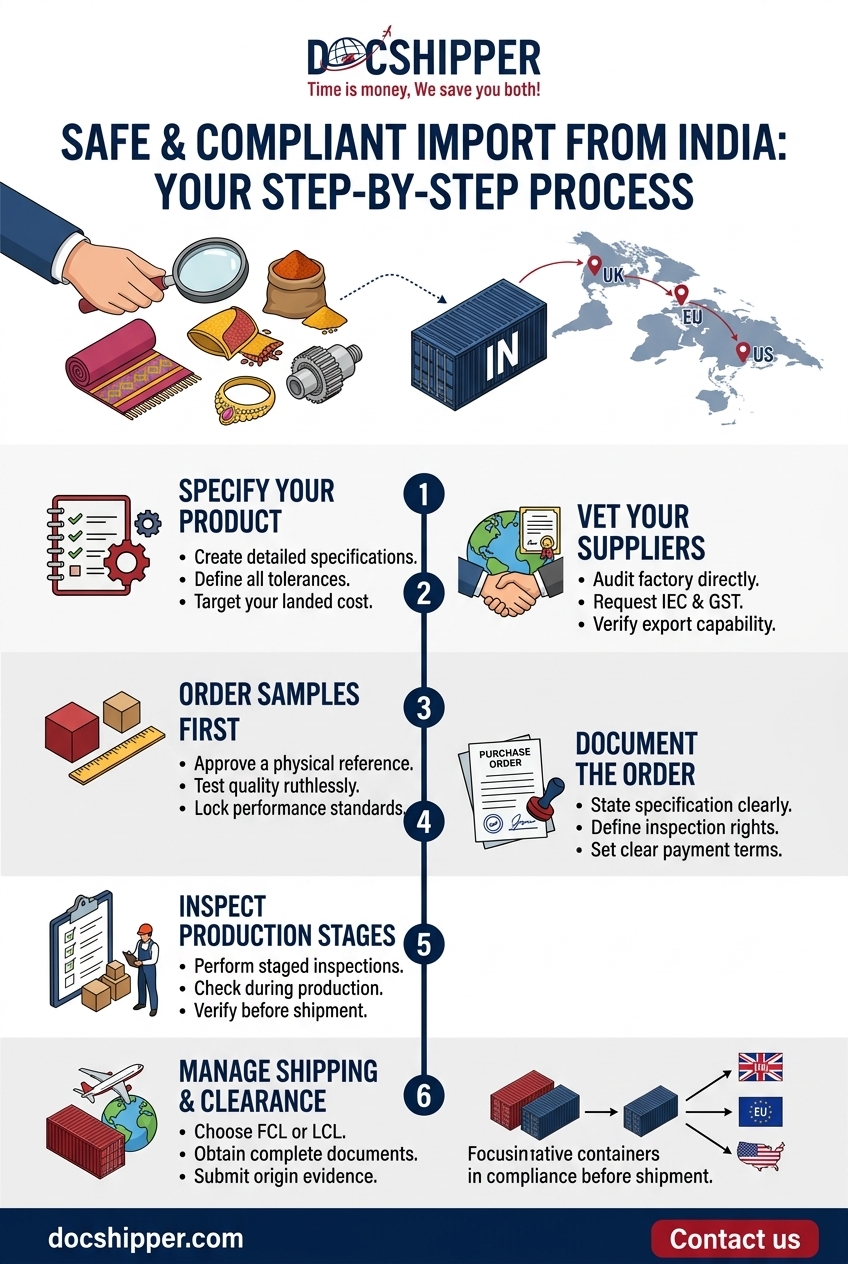
To import from India safely, choose a product, verify its tariff treatment, shortlist and audit suppliers, approve samples, document the order, inspect production and clear customs with complete origin and shipping documents. Do not begin with a supplier’s price alone; begin with the target landed cost and compliance requirements for your destination.
- Define the product: write the material, dimensions, performance, packaging, labelling, acceptable tolerances and intended use.
- Classify the goods: identify the likely HS or destination tariff code and confirm the classification with a customs professional where necessary.
- Calculate landed cost: include product price, tooling, inland transport, inspection, freight, insurance, duty, taxes, customs fees and final delivery.
- Check the destination framework: verify the current UK, EU or US tariff, rules of origin and any additional measures on the planned import date.
- Build a supplier shortlist: use trade fairs, export councils, verified networks and B2B platforms, then request the same information from each candidate.
- Vet the suppliers: check IEC, GST registration, references, capacity, subcontracting, quality controls and export documentation.
- Order and test samples: approve a reference sample and test the product against your market’s safety, technical and labelling requirements.
- Negotiate the purchase order: state the specification, quantity, price, currency, payment milestones, Incoterm, packaging, delivery window and inspection rights.
- Inspect production: perform the agreed inspection before shipment and record defects, quantities, corrective actions and final approval.
- Prepare shipment and clearance: verify the commercial invoice, packing list, transport document, origin evidence and destination customs information.
- Review the landed result: compare actual freight, duty, taxes, defects and delivery performance with the original model before reordering.
Supplier enquiry email template
Subject: Request for quotation and export capability for [product]
Hello [name],
We are sourcing [product] for the [UK/EU/US] market. Please confirm whether you manufacture the product directly or act as a merchant exporter, and provide your factory or production address.
Please send the following information:
- Product catalogue and technical specification
- MOQ, sample cost and sample lead time
- Price based on [quantity], with the proposed Incoterm and port
- Production capacity and standard production lead time
- IEC and GST registration details
- Relevant product test reports and certifications
- Export markets and two recent customer references, where available
- Subcontracting information and quality-control procedure
- Packaging details, carton dimensions and shipping marks
Our order would be subject to sample approval, written specifications and a pre-shipment inspection. Please confirm that you can provide the commercial invoice, packing list, transport documents and origin evidence required for our destination market.
Regards,[name]
| Stage | Decision to make | Document or evidence |
| Product selection | Can India meet the specification and target cost? | Product brief and landed-cost model |
| Supplier selection | Can the supplier produce and export consistently? | IEC, GST, references and audit report |
| Order approval | Are quality and commercial expectations measurable? | Approved sample and purchase order |
| Shipment approval | Do the goods and documents match the order? | Inspection report and shipping file |
| Customs clearance | Can the destination authority verify the import? | Invoice, packing list, transport and origin documents |
Conclusion: importing from India in 2026
India can be a strong second source when your product matches its manufacturing strengths and you price the order using the correct destination rules. The key is to combine supplier verification, product compliance, inspection and date-specific tariff research before committing to production.
- India exported USD 441.74 billion of goods in FY2025-26.
- The UK CETA has been in force since 15 July 2026, with nearly 99% of Indian exports receiving duty-free access according to the cited report, subject to the agreement’s conditions.
- The EU-India FTA was concluded on 27 January 2026, but entry into force is expected only after the formal implementation steps, with early 2027 reported as the expected timing.
- In the United States, Indian goods have faced a 10% Section 301 tariff under the cited 2026 framework since 24 July 2026, on top of normal duties and any applicable additional measures.
- Supplier audits, sample approval and pre-shipment inspection are essential to control quality and documentation risk.
Looking at India as a new source? We help you find and audit suppliers, inspect production and ship your goods with the right origin documents for your market.
FAQ | How to Import from India in 2026: Products, Suppliers, Duties and Shipping
Do not send payment solely because the supplier’s quotation looks legitimate. The beneficiary name on the bank account should match the contracted legal entity, and any change in bank details should be independently confirmed by video call or a previously verified contact. For a first order, consider a staged payment structure, documentary credit or another protected payment method rather than paying the full balance upfront.
Treat the approved sample as a contractual quality reference, not just a buying aid. Attach photographs, measurements, materials, colour references and acceptable tolerances to the purchase order. For a first production run, arrange an inspection during manufacturing as well as before shipment. If defects exceed the agreed tolerance, require a written corrective-action plan before authorising the balance payment.
Establish this responsibility in the purchase order before production begins. The contract should identify the approved production site, prohibit unauthorised subcontracting and require the exporter to remain responsible for quality, labour practices, documentation and delivery. If subcontracting is necessary, request the subcontractor’s address and audit access rather than accepting an unexplained change of factory.
A unit price may exclude tooling, export packing, inland transport, inspection, documentation, port charges, insurance, freight, customs clearance, duties, taxes and final delivery. Ask for the quotation to state the currency, Incoterm, named place or port, validity period and exactly which charges are excluded. Then compare suppliers using the same delivery basis and a complete landed-cost model.
Customs clearance can be delayed, and inaccurate information may lead to reassessment, penalties or a customs inspection. Ask the supplier to send draft documents before dispatch and compare the quantities, descriptions, weights, values, HS information and package marks with the approved purchase order. Do not ask a supplier to understate the value or describe goods inaccurately; correct discrepancies before the cargo leaves India.
LCL cargo is handled during consolidation and deconsolidation, so packaging must withstand more movement than a dedicated container shipment. Use reinforced cartons or crates, internal cushioning, moisture protection and clear handling marks. Confirm whether the forwarder’s insurance covers the goods’ full commercial value, and photograph the packaging before handover. If damage is discovered, record it immediately on the delivery receipt and request a formal cargo survey.
Put ownership and permitted use in writing before paying for development. The agreement should state who owns the moulds, dies, patterns, technical drawings, artwork and finished tooling; where they will be stored; whether the supplier may reuse them; and how they will be released if you change factories. Also clarify the approval process for design changes and prohibit production for third parties using your confidential specifications.
Need Help with
Logistics or Sourcing ?
First, we secure the right products from the right suppliers at the right price by managing the sourcing process from start to finish. Then, we simplify your shipping experience - from pickup to final delivery - ensuring any product, anywhere, is delivered at highly competitive prices.