In short ⚡
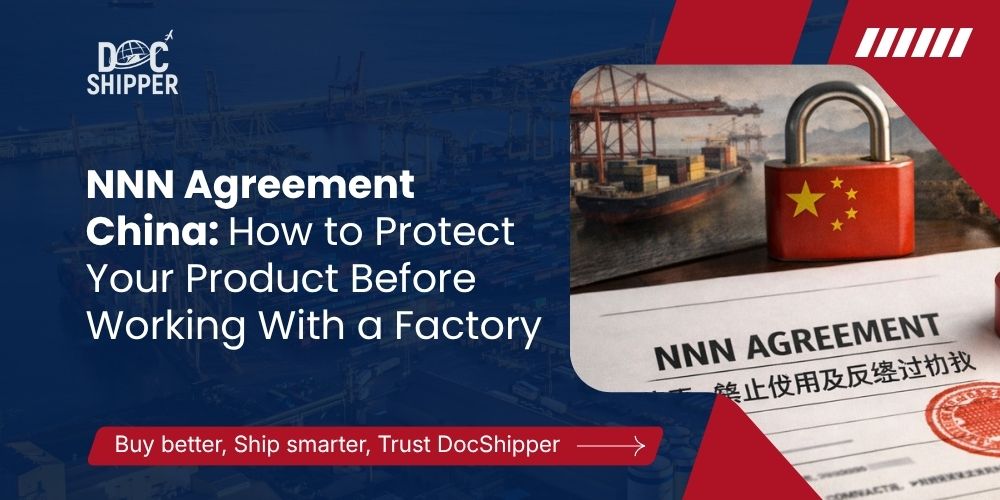
NNN Agreement: Protecting Your IP with Chinese Manufacturers means using a Chinese-language contract governed by Chinese law and enforceable in a competent Chinese court. It protects against disclosure, unauthorised use and circumvention, provided the correct manufacturing entity signs and applies its company chop before receiving drawings, specifications, samples, formulas or tooling.The guidance covers how an NNN differs from an NDA, when it is needed, the six China-enforceability conditions, supplier verification and signing steps, disclosure records, and how to combine it with Chinese trademarks, patents or utility models and a manufacturing contract.
We hope you’ll find this article genuinely useful, but remember, if you ever feel lost at any step, whether it’s finding a supplier, validating quality, managing international shipping or customs, DocShipper can handle it all for you!
If you are about to send drawings, specifications, samples, formulas or tooling to a Chinese manufacturer, a standard NDA from your home country may not give you the protection you expect. An NNN agreement China manufacturers can sign is designed to address three separate risks: disclosure, use and circumvention.
The practical objective is not simply to obtain a signature. You need a Chinese-language contract, governed by Chinese law, enforceable before a competent Chinese court and signed by the legal entity that actually manufactures your product. This article provides general information, not legal advice. Have a China-qualified lawyer draft or review your agreement.
DocShipper Tips
Start with a China-ready NNN, then have qualified counsel review it before any technical disclosure.
What an NNN agreement is and why an NDA is not enough in China
An NNN agreement is a contract covering non-disclosure, non-use and non-circumvention. Unlike a standard Western NDA, it can prevent a factory from revealing your information, using your design for its own benefit or bypassing you to sell the product to your customers.
Non-disclosure restricts the supplier from sharing your confidential information with third parties. Non-use prevents the factory from using your drawings, specifications, formula, samples or manufacturing method outside your authorised project. Non-circumvention prevents the supplier from going around you to approach your customers, distributors or commercial partners.
A typical US, UK or EU NDA often focuses on confidential disclosure and relies on the law and courts of the country where it was drafted. That creates a practical problem if the factory, evidence, employees and assets are in China. Even if a foreign judgment is theoretically usable, enforcing it locally may be slower, more expensive and less predictable than using a contract prepared for a Chinese court.
The risk is not hypothetical. The USTR 2026 Special 301 Report places China on its Priority Watch List. Separately, the European Commission reported that EU authorities detained 112 million counterfeit items in 2024, with China and Türkiye among the main countries of origin. These figures do not prove that every factory will copy a product, but they show why preventive controls matter.
Dan Harris, founding partner of Harris Sliwoski LLP and a specialist in business law with China, writes: “Most NDAs my law firm’s China lawyers see are completely useless for China.” His point is not that confidentiality contracts never work, but that a document designed for another jurisdiction may fail to address the actual enforcement problem.
| Contract feature | Typical home-country NDA | NNN for a Chinese manufacturer |
| Governing law | Often US, UK, EU or another foreign law | Chinese law |
| Language | Usually English or another foreign language | Chinese version, often bilingual, with the prevailing version identified |
| Court | Foreign court | Competent Chinese court, commonly where the factory is located |
| What it forbids | Primarily unauthorised disclosure | Disclosure, unauthorised use and circumvention |
| Practical effect | May be difficult to enforce against a Chinese factory | Creates a more direct basis for action in China |
When do you need an NNN?
You need an NNN whenever you share something that a factory could reuse, reproduce or commercialise. That includes product drawings, technical specifications, a custom mould, a formula, a distinctive manufacturing process, a prototype or confidential customer information.
For a standard catalogue product that you buy as-is, an NNN may add little value. The factory already sells the same product to multiple buyers, so your main priorities may be trademark registration, quality control, product compliance and a clear purchase contract.
The need becomes stronger when the product is customised. In an ODM arrangement, the supplier may adapt an existing product to your requirements, while an OEM project usually involves manufacturing from your drawings or specifications. In both cases, decide what you own, what the factory already owned before the project and what the supplier is prohibited from reusing.
Sign before sending the sensitive material. Once several factories have received your full drawings or samples, your negotiating leverage is reduced. If you are comparing suppliers, use a separate NNN with each factory you approach, including the factories you ultimately reject.
| Situation | Is an NNN needed? | Protection to prioritise |
| Standard catalogue product bought as-is | Usually limited value | Trademark filing, quality control and purchase terms |
| Customised ODM product | Recommended before sharing custom requirements | NNN, ownership terms and trademark registration |
| OEM product made from your drawings | Essential before technical disclosure | NNN, tooling ownership, patent review and manufacturing contract |
| Custom formula or manufacturing process | Strongly recommended | NNN, restricted access and technical IP protection |
| Custom mould paid for by you | Recommended before the mould is ordered | NNN plus an express mould ownership and return clause |
Looking for a Reliable
Sourcing Partner?
We handle the entire sourcing process, supplier research, negotiation, production, and inspections, so you can focus on what matters most: growing your business.

Making an NNN enforceable in China: the 6 conditions
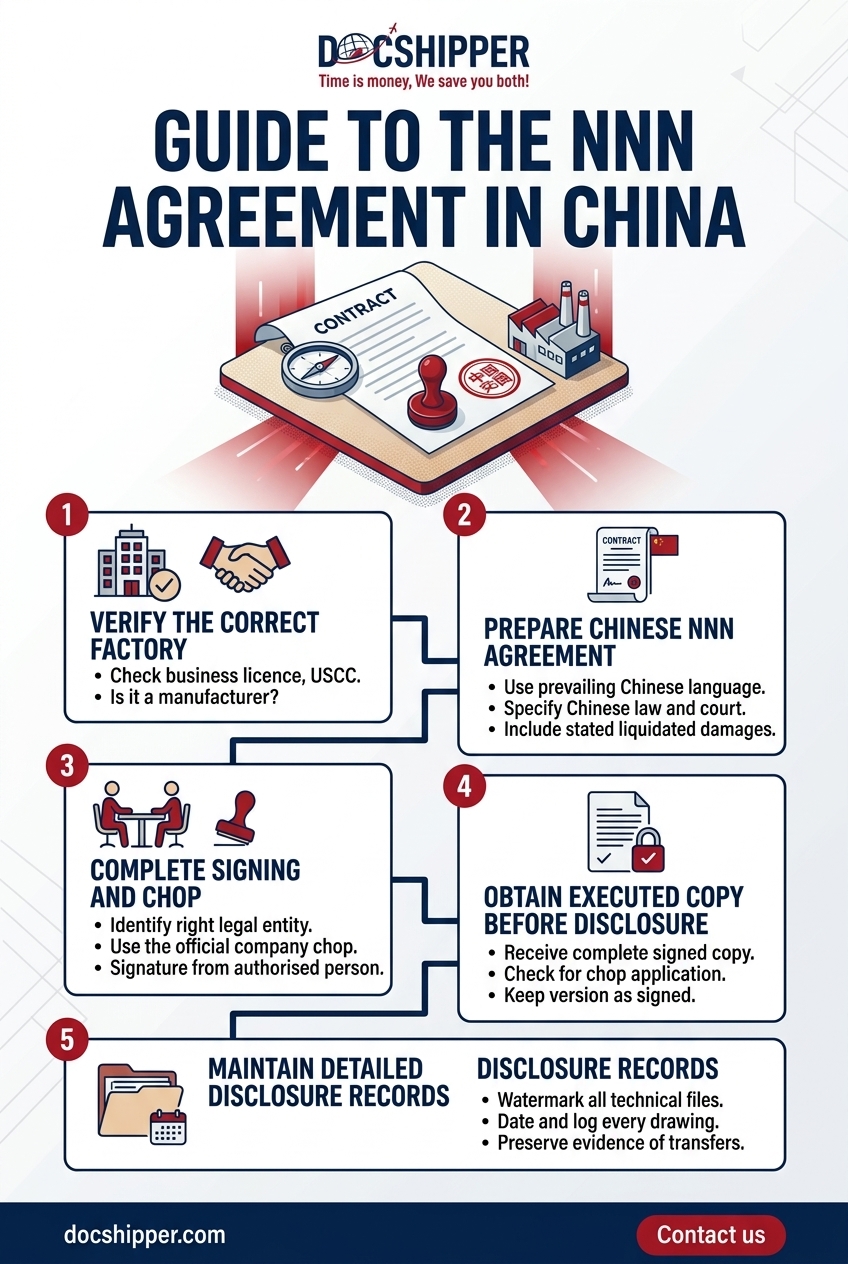
An NNN is more likely to protect you when it uses Chinese language, Chinese law, a competent Chinese court, the correct signing entity and company chop, a precise definition of the protected information and stated liquidated damages. These six conditions work together; a well-written clause is of limited value if the wrong company signs it.
1. Use a Chinese version that controls. Prepare the contract in Chinese or have it properly translated by a qualified professional. If the agreement is bilingual, state which version prevails in case of inconsistency. Adam Philipp, founder of AEON Law, explains that an NNN should be “written in (or properly translated into) Chinese, governed by Chinese law, and enforceable in a Chinese court.”
2. Choose Chinese governing law. The agreement should identify Chinese law rather than leaving the applicable law uncertain. This allows the provisions to be assessed within the legal framework most directly connected to the manufacturer and the conduct taking place in China.
3. Select a competent Chinese court. Identify a court with jurisdiction, commonly one connected with the factory’s location. Do not simply name a convenient foreign court without checking whether its judgment could be recognised and enforced where the supplier’s assets are located.
4. Identify and verify the right entity. Insert the supplier’s exact Chinese legal name, Unified Social Credit Code, registered address and legal representative. A trading company found on an online marketplace may not be the factory making your product. If the manufacturer is a separate company, it should sign the NNN too. The company chop, the official seal used by Chinese companies, should be applied to the signed agreement.
5. Define the protected information and products precisely. List the drawings, specifications, samples, formulas, packaging, customer information, product categories and project names covered by the contract. Add a clause for moulds and tooling stating who owns each item, who paid for it, where it is stored, whether the factory may use it for another customer and how it must be returned or destroyed.
6. State liquidated damages. The agreement should state a financial amount payable if the supplier breaches the NNN. There is no universal “standard” amount: it should reflect the project and be reviewed by a qualified lawyer. A Chinese court may adjust an amount it considers excessive or otherwise inappropriate, so presenting an arbitrary penalty as automatically enforceable is misleading.
| Condition | What to include | How to verify it |
| Chinese language | Chinese version and prevailing-language clause | China-qualified lawyer or professional legal translator reviews the text |
| Chinese law | Express choice of Chinese governing law | Check that the clause matches the intended enforcement strategy |
| Chinese court | Competent court connected to the supplier’s location | Confirm jurisdiction before signing |
| Right entity and chop | Chinese name, USCC, address, legal representative and company chop | Compare the contract with the business licence and corporate records |
| Precise scope | Protected information, products, customers, moulds and tooling | Match the wording to the files and samples you will actually share |
| Liquidated damages | A stated figure and breach mechanism | Have a lawyer assess proportionality and enforceability |
DocShipper Alert
Verify the Chinese legal name, company chop and court clause before disclosing valuable files.
Getting your NNN signed: step by step
The signing process should begin with supplier verification, not with sending a template. Verify the factory’s legal identity, adapt the agreement for the project, sign and chop it before technical disclosure, then preserve evidence of every file and sample transferred.
1. Verify the supplier and entity. Obtain the Chinese business licence and compare the legal name, USCC, registered address and legal representative with the information in the contract. Check whether the company is a manufacturer or a trading company. An onsite supplier audit can confirm the relationship between the registered entity, the factory premises, production capacity and the people handling your project.
2. Draft or adapt the NNN. A template can help you identify the required clauses, but it should not be treated as universal legal protection. For a high-value OEM project, ask a China-qualified lawyer to adapt the contract, review the damages provision and align the NNN with the later manufacturing agreement. For a lower-value project, legal review may still be appropriate if the design or brand is strategically important.
3. Introduce the document as a normal project step. Do not accuse the supplier of intending to copy your product. Explain that all shortlisted factories sign the same confidentiality and non-use framework before receiving technical information. This makes the request commercial and procedural rather than confrontational.
Email template
Subject: Confidentiality agreement before technical discussion
Hello [Name],
We are preparing the technical information for our [product] project and would like to review the attached bilingual NNN agreement before sharing drawings, specifications or samples.
This is our standard process for all factories shortlisted for a custom project. It covers confidentiality, non-use, non-circumvention and ownership of buyer-funded tooling.
Please confirm that the legal entity named in the agreement is the company manufacturing the product, then return the agreement signed and stamped with your company chop.
Once this is complete, we can share the technical package and arrange the next production discussion.
Best regards,[Name]
4. Sign and chop the final version. Make sure the person signing has authority to bind the company. Obtain a complete copy showing the signature and company chop, preferably before sending the sensitive documents. Keep the final Chinese or bilingual version exactly as signed.
5. Keep a disclosure record. Date the drawings, watermark technical files, record which version was sent to which factory and keep delivery confirmations. Store photographs and serial numbers for samples and moulds. These records help demonstrate what information was disclosed and when.
If a factory refuses any reasonable confidentiality framework for a custom product, treats the legal entity as a secret or asks you to sign with an unrelated intermediary, treat that as a supplier-selection warning. It does not automatically prove bad faith, but you should understand why the supplier refuses before sharing valuable information.
| Step | Action | Result |
| 1. Verify entity | Check business licence, USCC, address, legal representative and factory relationship | You know who should sign |
| 2. Draft or adapt | Have a China-qualified lawyer review the bilingual agreement | The contract reflects your project and enforcement needs |
| 3. Introduce | Send the agreement as a standard step before technical disclosure | The supplier understands the commercial process |
| 4. Sign and chop | Obtain an authorised signature and company chop | You retain an executed agreement with the correct entity |
| 5. Keep records | Watermark, date and log every drawing, sample and mould | You preserve evidence of the protected disclosure |
DocShipper Tips
Audit the factory and preserve a disclosure trail before sending drawings, samples or tooling.
Why Choose DocShipper
Lower risk, transparent pricing, and a single point of contact from pickup to delivery.
-
One single point of contactA dedicated consultant coordinating every step and keeping you informed.
-
9,200+ operations / 6,000+ clientsProven processes on China ↔ EU/US lanes (FCL, LCL, air, road, rail).
-
No hidden feesTransparent quotes and document guidance to avoid surprises.
NNN, trademark and patent: the protections to combine
An NNN binds the factories and other parties that sign it. It does not prevent an unrelated third party from registering your brand, filing an application or copying a product outside the contract. Combine it with trademark registration, technical IP protection and a detailed manufacturing agreement.
File your trademark in China early through the China National Intellectual Property Administration, or CNIPA. China uses a first-to-file system, meaning that the party that files first may obtain the registration even if you used the brand elsewhere first. The EU China IP SME Helpdesk also warns that “Trademarks rejected as deceptive are not merely unregistrable, but may not be used in China at all,” so the proposed mark should be reviewed before filing.
A utility model generally targets the structure or practical technical configuration of a product, while an invention patent addresses a qualifying technical invention and usually involves a more demanding examination. The right route depends on the technical features, disclosure timing and commercial plan. CNIPA reported approximately 972,000 invention patents and 1,461,000 utility models granted in 2025, illustrating the scale of the Chinese filing system, not a guarantee that your application will succeed.
Your manufacturing agreement should add operational protection: quality standards, approved materials, inspection rights, exclusivity where appropriate, mould ownership, restrictions on subcontracting, return or destruction of rejected goods and procedures for ending the relationship. Dan Harris summarises the boundary clearly: “An NNN Agreement controls what its signers can do with the information you give them.”
| Protection | Protects against | Who it binds or reaches | When to use it |
| NNN agreement | Disclosure, unauthorised use and circumvention | Factories and other signatories | Before sharing confidential information |
| China trademark | Unauthorised registration or use of your brand | Third parties in the relevant trademark classes | As early as possible, before production and market launch |
| Patent or utility model | Unauthorised use of qualifying technical features | Potential infringers within the protected scope | Before public disclosure, subject to legal advice |
| Manufacturing contract | Quality failures, tooling disputes, unauthorised subcontracting and delivery problems | The contracting manufacturer | Before production orders are placed |
DocShipper Info
Combine your NNN with China trademark filings and production controls to protect both information and market access.
Conclusion
An NNN is worth considering when a Chinese manufacturer will receive information that could be reused. Its value depends on execution: the right entity, the right language, the right jurisdiction and a clear record of what you disclosed.
- A home-country NDA may focus only on disclosure, while an NNN also addresses use and circumvention.
- Sign before sharing drawings, specifications, samples, formulas or moulds.
- Use Chinese language, Chinese law, a competent Chinese court and stated liquidated damages.
- Verify the manufacturer’s Chinese legal name, USCC and company chop before signing.
- Register your trademark in China early because the system is first-to-file.
- Consider a patent or utility model for qualifying technical features.
- Have a China-qualified lawyer adapt the document to your product and transaction.
Before you send your drawings, make sure you are dealing with the real manufacturer. We can verify the factory and its legal entity onsite so your NNN is signed with the company that actually makes your product. Contact us to plan the supplier audit and establish the right confidentiality framework.
FAQ | NNN Agreement China: How to Protect Your Product Before Working With a Factory
Not automatically. An NNN normally binds the company that signs it, not every employee, affiliate or subcontractor involved in production. Your agreement should prohibit unauthorised subcontracting and require the factory to impose equivalent confidentiality, non-use and non-circumvention obligations on any approved third party. For sensitive tooling or formulas, consider obtaining a direct agreement from the subcontractor as well.
This is why the agreement should distinguish between your project materials and the factory’s documented pre-existing technology, designs and know-how. Ask the supplier to identify any relevant pre-existing materials in writing before receiving your files. The contract should also clarify that the factory cannot use your improvements, specifications, combination of features or confidential adaptations merely by describing them as general manufacturing knowledge.
It may, but only if the contract defines the restricted product and prohibited conduct precisely. A vague promise not to copy “the product” may be difficult to apply when the factory changes the dimensions, packaging, materials or branding. Identify the relevant product features, versions, technical files, customer segments and sales channels, and have a lawyer ensure that the restriction is commercially reasonable under Chinese law.
Preserve evidence before making accusations. Keep the signed agreement, file metadata, disclosure logs, photographs, product listings, customer communications and samples of the allegedly copied goods. Then have China-qualified counsel assess whether to send a formal demand, seek interim measures or begin court proceedings. Avoid modifying or deleting original files, because proving what was disclosed and when may be central to the claim.
A scanned copy may help demonstrate the agreement, but it can create avoidable disputes about authenticity, completeness and signing authority. Retain the complete final version, request a clear scan immediately and preserve the original wherever possible. If the agreement is signed electronically, use a method that can authenticate the signer, the company and the document’s integrity; do not assume that an email exchange alone provides the same evidence as a properly executed contract.
Yes, especially when they can access drawings, formulas, customer information or supplier quotations. Your NNN with the factory does not control people on your side who may disclose or reuse the same information. Use internal or contractor confidentiality agreements, limit access to the information required for each person’s role and keep a record of who received each version of the technical package.
First determine whether the trading company or the factory will manufacture, store tooling and control the production records. If both entities are involved, identify both in the agreement and obtain signatures and company chops from each. A trading company’s signature alone may provide limited protection against a separate factory that never accepted the NNN, so treat any refusal by the actual manufacturer as a material risk before disclosing sensitive information.
Need Help with
Logistics or Sourcing ?
First, we secure the right products from the right suppliers at the right price by managing the sourcing process from start to finish. Then, we simplify your shipping experience - from pickup to final delivery - ensuring any product, anywhere, is delivered at highly competitive prices.