In short ⚡
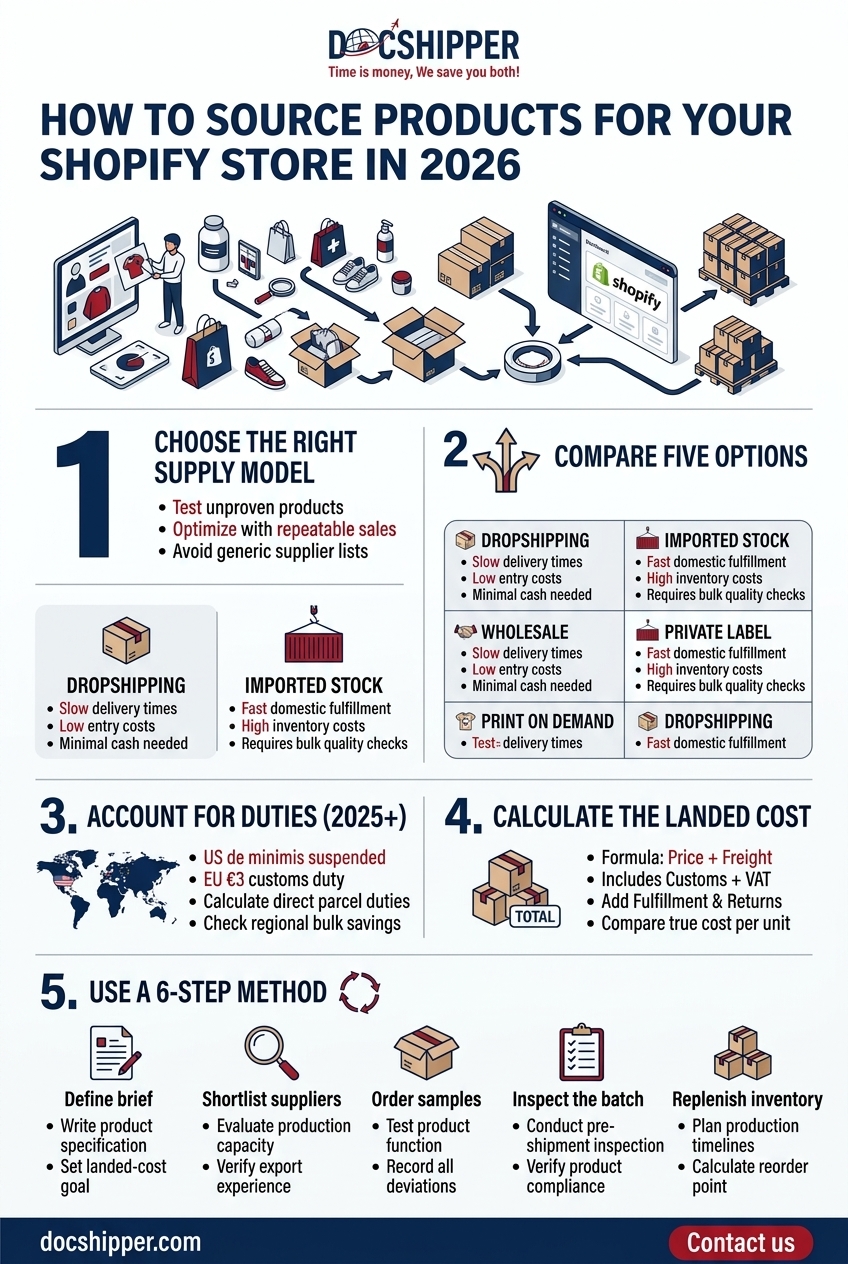
How to source products for a Shopify store: choose the right supply model, compare suppliers using landed cost, test samples, verify the factory, and control quality before committing to inventory. Account for duties, freight, fulfillment, returns, delivery speed, and brand requirements. Follow these six steps:- Define the product brief: Specify the product, variants, packaging, destination market, required documents, quantity, and target landed cost.
- Build and filter a shortlist: Compare suppliers’ capacity, export experience, certifications, production site, and response quality.
- Compare written quotes: Ask about MOQ, sample costs, lead times, packaging, payment terms, shipping, defect policies, and compliance evidence.
- Order and evaluate samples: Test dimensions, materials, function, packaging, labeling, durability, and consistency with the specification.
- Verify and inspect: Audit the supplier when appropriate and conduct a pre-shipment inspection using written acceptance criteria before releasing the balance.
- Secure the order and plan replenishment: Confirm the purchase order, approved sample, payment milestones, production timeline, and reorder point.
Key topics include supply models, changing US, EU, and UK duty rules, supplier sourcing for dropshipping and private label, landed-cost calculations, and the six-step supplier verification method.
We hope you’ll find this article genuinely useful, but remember, if you ever feel lost at any step, whether it’s finding a supplier, validating quality, managing international shipping or customs, DocShipper can handle it all for you!
To source products for a Shopify store, choose your supply model before you search for suppliers. Dropshipping, wholesale, imported stock, private label and print on demand each require different supplier criteria, cash commitments, quality controls and margin calculations.
Shopify merchants processed $115.6 billion in GMV in Q2 2026, compared with $87.8 billion in Q2 2025, according to Shopify’s Q2 2026 results. The opportunity is substantial, but a product that looks profitable in a Shopify dashboard can become unprofitable after duties, freight, fulfillment and returns.
The decision is especially important if you are moving beyond one-by-one shipments from China. Your Shopify store gives you control over the offer and customer experience, but your supply model determines how much control, cash and operational risk you take on.
DocShipper Tips
Match sourcing to your stage, cash flow and desired level of control.
Sourcing for Shopify: start with the right supply model
Before looking for suppliers, decide how your Shopify store will be supplied: dropshipping, wholesale, imported stock, private label or print on demand. Each model changes delivery speed, margin logic, cash tied up, quality control and your ability to build a brand.
Start with your store stage. If you are testing an unproven product, a low-commitment model can help you validate demand. Once the product has repeatable sales, importing stock or developing a private label can improve delivery times, packaging and contribution margin, provided you can finance inventory and control quality.
Do not select a supplier from a generic “Shopify suppliers” list and then force your business into that supplier’s operating model. A supplier designed to ship individual parcels may have no experience with production specifications, packaging development or batch inspection. Conversely, a factory may offer a better unit price but be unsuitable for rapid product testing.
Print on demand follows a different logic again. It reduces inventory risk, but product choice, customization limits, base costs and fulfillment speed are controlled by the production partner. If your priority is a differentiated physical product, private label usually offers more control, but requires samples, packaging decisions and a minimum order quantity.
| Supply model | Delivery speed | Margin logic | Cash tied up | Quality control | Brand control |
| Dropshipping | Often slow unless stock is local | Convenience and low entry cost, less control over product cost | Low before the sale | Limited unless samples and supplier checks are completed | Low to medium |
| Wholesale | Fast when the distributor holds local stock | Buy at a wholesale price and resell existing products | Medium | Moderate, based on distributor documentation and samples | Low |
| Imported stock | Fast after bulk goods reach your warehouse | Lower unit cost can improve contribution margin | High compared with dropshipping | High if you inspect before shipment | Medium |
| Private label | Usually slower at launch because of development and production | Brand differentiation and pricing power | High, including samples, packaging and MOQ | High if specifications and inspections are controlled | High |
| Print on demand | Depends on the production partner’s location and workflow | Pay for flexibility rather than the lowest unit cost | Low before the sale | Sample-based and partner-dependent | Medium to high for designs, lower for the base product |
What changed in 2025-2026: duties on small parcels
The United States ended duty-free de minimis treatment for all countries on 29 August 2025, so a China-to-US parcel can no longer be treated as duty-free simply because its value is below the former threshold. The EU introduced a €3 customs duty per tariff line on consignments under €150 from 1 July 2026, while the UK plans to remove its £135 low-value customs duty relief by March 2029.
These changes make the old “ship every order directly from China” calculation less reliable. In the US, check the applicable HTS code and the tariff treatment for the product, including any additional measures. The USITC HTS database is the starting point, but the correct classification and origin still need to be verified.
For EU orders under €150, Shopify states that the €3 duty is calculated and collected at checkout. Shopify Managed Markets is also moving supported markets from delivered duty unpaid, or DDU, to delivered duty paid, or DDP, on 24 August 2026. DDP means duties are collected and managed before delivery rather than left as an unexpected charge for the customer.
The commercial effect is a stronger case for importing stock in bulk to a warehouse or 3PL in the destination region. After the EU duty took effect, small parcel volumes fell by 53% in Belgium and 46% in the Netherlands, while Dutch customs observed a shift towards bulk imports and EU storage, according to Euronews. Dirk Gotink, Member of the European Parliament for the Netherlands, said: “The temporary €3 import duty that has been in force since July 1 has already significantly reduced the flow of parcels, but we are not there yet.”
| Market | Change | What it means for a Shopify store |
| United States | Duty-free de minimis treatment was suspended for all countries from 29 August 2025. | Do not assume direct China-to-US parcels are duty-free. Classify the product and model duty and customs costs for every shipment. |
| European Union | €3 customs duty per tariff line on consignments under €150 from 1 July 2026. | A multi-item parcel can create several tariff-line charges. Shopify calculates and collects the duty at checkout in the relevant flow. |
| United Kingdom | The £135 low-value customs duty relief is scheduled to end by March 2029. | Build a future duty scenario into your supplier and fulfillment comparison instead of relying on the current relief. |
| Shopify Managed Markets | DDU support ends for relevant markets on 24 August 2026, with a move to DDP. | Review checkout prices, customer communications and the way landed costs are passed through to the buyer. |
Use two scenarios before deciding. Scenario one is direct dropshipping, where each order creates a parcel, its applicable duty and its own clearance event. Scenario two is one bulk import to a warehouse, followed by domestic fulfillment to customers. The second scenario may add inventory financing and 3PL costs, but it can reduce repeated international shipment events and improve delivery speed.
DocShipper Alert
Verify duties and tariff codes before relying on direct international fulfillment.
DocShipper Info
Model duties, 3PL fees and delivery speed for each destination market.
Dropshipping, wholesale, imported stock or private label: how to source for each
Dropshipping relies on suppliers with dependable fulfillment and tracking, wholesale on distributors with suitable stock and terms, imported stock on factories that can meet a defined specification, and private label on manufacturers able to customize both product and packaging at an acceptable MOQ. The right supplier is therefore a consequence of the model, not the starting point.
Looking for a Reliable
Sourcing Partner?
We handle the entire sourcing process, supplier research, negotiation, production, and inspections, so you can focus on what matters most: growing your business.

Dropshipping
Look for suppliers through established dropshipping platforms, manufacturer directories, trade contacts or sourcing partners that can confirm warehouse location and shipping routes. Ask whether orders are fulfilled from the advertised warehouse, whether tracking is generated promptly, and how stockouts, damaged parcels and returns are handled.
Order samples to test the actual product and packaging before listing it. Check dispatch time, tracking events, delivery condition and whether the item matches the images and specifications. A supplier that only provides product photos is not yet a reliable Shopify supplier.
The main pitfall is comparing only the supplier’s product price. Direct China-to-customer shipping can now create duty and clearance costs on every US parcel, while EU orders may face the €3 per tariff line charge. Use dropshipping for product validation or where local stock makes delivery and landed cost competitive, not automatically as the permanent model.
Wholesale
Find wholesale suppliers through distributors, trade shows, brand-authorized networks and curated wholesale marketplaces. Review the supplier’s resale conditions, minimum order, available stock, replenishment policy, territory restrictions and evidence that the goods are authentic and compliant.
Wholesale is useful when you want established products without developing a factory specification. Request a current catalog, wholesale price list, lead times and shipping terms, then order a sample or small opening order before committing to a larger quantity.
The pitfall is confusing a low MOQ with a strong margin. A distributor can offer fast delivery while leaving little room after payment fees, fulfillment, returns and advertising. Calculate the landed cost and confirm whether the product can be replenished before your Shopify store depends on it.
Imported stock from a factory
For imported stock, start with a product specification rather than a marketplace search. Define materials, dimensions, tolerances, colors, packaging, labeling, quantity, destination market and required documents. Then shortlist factories that can demonstrate relevant capacity and export experience.
Verify the legal company, production location, capacity, certifications and references. Ask for a sample produced as close as possible to the intended specification, not merely a generic catalog sample. For regulated products, identify requirements such as CPSIA, FCC, GPSR or CE obligations before production.
The main risk is inventory exposure. Once you own the goods, a defective batch becomes cash stuck on a shelf. A pre-shipment inspection using an agreed sampling method and acceptance criteria should take place before the balance is released.
Why Choose DocShipper
Lower risk, transparent pricing, and a single point of contact from pickup to delivery.
-
One single point of contactA dedicated consultant coordinating every step and keeping you informed.
-
9,200+ operations / 6,000+ clientsProven processes on China ↔ EU/US lanes (FCL, LCL, air, road, rail).
-
No hidden feesTransparent quotes and document guidance to avoid surprises.
Private label
Private label begins with a product that can be differentiated, not only with a logo. Ask manufacturers whether they can modify the product, source approved materials, print packaging, apply labels, manage color consistency and reproduce the approved sample.
Request a development sample, packaging mock-up and written quotation showing the MOQ for each customization. Negotiate by separating the product MOQ, packaging MOQ and color or variant MOQ. This can reveal whether a factory is flexible enough for a first launch.
Protect the brand operationally by documenting the specification, approved artwork, inspection standard and ownership of molds or tooling where relevant. The common pitfall is choosing the lowest unit quote before confirming sample quality, packaging costs, lead time and compliance documentation.
Print on demand can remain appropriate when your main differentiator is artwork or personalization and you want to avoid inventory. However, test several sample orders and compare actual delivery times, print durability, packaging and returns before scaling the catalog.
| Model | Where to find suppliers | What to check | Typical pitfall |
| Dropshipping | Dropshipping platforms, factories, sourcing partners | Warehouse location, dispatch time, tracking, returns | Ignoring duties and delivery time because the initial cash commitment is low |
| Wholesale | Distributors, trade shows, authorized networks, wholesale marketplaces | Authenticity, stock depth, terms, replenishment and resale restrictions | Accepting a thin margin for faster access to existing products |
| Imported stock | Audited factories, sourcing agents, manufacturer directories | Capacity, specification, compliance, inspection and freight plan | Paying for a batch before verifying its quality |
| Private label | Manufacturers with customization and packaging capability | Samples, MOQ, artwork, materials, documentation and repeatability | Choosing a factory that can make the item but cannot control the brand specification |
| Print on demand | Print and fulfillment partners | Print quality, production location, delivery, customization and returns | Scaling designs before testing the complete customer experience |
DocShipper Tips
Test packaging, durability and delivery before scaling your catalog.
Calculate your landed cost to compare suppliers
Landed cost is the real cost of one unit once it reaches your warehouse or your customer. It includes the factory price, freight, duties, customs fees, import VAT where applicable, fulfillment, final-mile shipping and an allowance for returns, so suppliers must be compared on landed cost rather than unit price alone.
Use the same formula for every model. For a bulk import, divide the relevant freight and import costs across the units in the shipment. For dropshipping, calculate those costs per order or per parcel. The resulting figures will not be perfectly identical across destinations, but they will make the commercial difference visible.
For duties, identify the correct tariff code for the destination market. Use the US HTS for the United States, TARIC for the European Union and the UK Trade Tariff for the United Kingdom. The applicable rate can depend on classification, origin, trade measures and shipment conditions, so do not insert a marketplace estimate without verification.
Also include costs that are easy to forget. Payment and app fees reduce the contribution from each sale, while returns provision protects the comparison from an unrealistically perfect scenario. A cheaper factory price can lose once parcel-level duty, slow delivery and returns are included.
| Variable | Formula or question | Why it matters |
| Factory price | P = product price per unit | Shows the supplier’s quoted price, but not the cost of reaching the customer. |
| Freight share | F/Q = total freight divided by quantity | Spreads international transport across the units in a bulk shipment. |
| Duties | D = duty based on the verified tariff code and shipment method | Captures US, EU or UK customs exposure. Direct parcel and bulk-entry treatment may differ. |
| Customs fees | C = broker, clearance and related entry costs per unit | Separates customs administration from the duty itself. |
| Import VAT | VAT = import VAT where applicable and not recoverable | Prevents the comparison from ignoring a destination-market tax cost. |
| Fulfillment | 3PL = receiving, storage, pick and pack | Shows the cost of holding and processing inventory locally. |
| Customer shipping | S = domestic or final-mile shipping per order | Reveals the delivery cost after stock reaches the warehouse. |
| Returns | R = expected returns provision per sale | Accounts for reverse logistics, replacement and unsellable goods. |
| Complete landed cost | P + F/Q + D + C + VAT + 3PL + S + R | Creates the comparable cost per sale before payment and app fees, which should be added to the final margin model. |
For dropshipping, substitute parcel-level freight and duty for the bulk freight allocation. For imported stock, calculate the duty and customs costs attached to the bulk entry, then add warehouse and domestic delivery costs. This is why the same product can produce different margins under two supply models.
Keep a version of the calculation for each destination market. A product can work for the US but fail in the EU after the €3 per tariff line charge, or appear attractive in the UK only because the current low-value relief has not yet been removed. Update the model when Shopify changes checkout tax or duty handling.
DocShipper Tips
Document every quote, sample and inspection to protect margins when Shopify sales accelerate.
Find, test and secure your supplier: the 6-step method
Shortlist suppliers, ask each one the same written questions, order samples, verify the company and factory, place a first order with payment linked to inspection, and plan replenishment before stock runs out. The first order is where problems are still relatively inexpensive to correct.
- Define the product brief. Write the specification, target market, quantity, variants, packaging, required documents and delivery destination. Include the target landed cost, not only a target factory price.
- Build and filter a shortlist. Contact several relevant suppliers and compare capacity, years in business, export experience, certifications, response quality and willingness to provide documents. Remove suppliers that avoid basic questions or cannot identify their production site.
- Send the same questions and compare written answers. Ask for MOQ, sample cost, production lead time, packaging options, payment terms, shipping terms, defect policy and applicable compliance evidence. Consistent questions make vague promises easier to identify.
- Order and evaluate samples. Test dimensions, materials, function, packaging, labeling and durability. Record deviations against the brief and require a revised sample when the product is not acceptable. A sample is evidence of capability, not a guarantee of batch consistency.
- Verify the supplier and inspect the first order. Conduct a supplier audit where the product or order value justifies it. Before shipment, use a pre-shipment inspection with a written acceptance standard and sampling plan. Keep the inspection report, photographs and corrective-action record.
- Secure payment and plan replenishment. Confirm the purchase order, approved sample, packaging artwork, production timeline and payment milestones. Release the final balance only according to the agreed conditions, then set a reorder point based on sales velocity, production lead time, freight and inspection time.
Use this first supplier email template to make the initial comparison efficient:
Subject: Shopify product sourcing inquiry for [product]
Hello, we are sourcing [product] for sale in [destination market]. Our first quantity is [quantity], with [number] variants. Please quote the product, packaging, sample and shipping costs, and confirm your MOQ. Please also provide your sample lead time, mass-production lead time, available certifications, payment terms and shipping options. Our target is [target price or landed-cost objective]. Please confirm whether you manufacture this product and share relevant factory information.
| Step | Goal | Proof to keep |
| 1. Product brief | Define what the supplier must make and where it will be sold | Specification, packaging requirements, destination and landed-cost model |
| 2. Shortlist | Identify suppliers suited to the chosen model | Company profile, capacity notes, certifications and contact history |
| 3. Written comparison | Make commercial and operational differences visible | Quotes, MOQ, lead time, payment and shipping terms |
| 4. Samples | Test the product before production | Sample approval record, photos and list of deviations |
| 5. Audit and inspection | Reduce factory and batch risk | Audit findings, inspection report and corrective actions |
| 6. First order and restock | Protect payment and avoid a stockout | Purchase order, approved sample, payment record and reorder plan |
For a first bulk import, quality control is part of the margin rather than an optional extra. DocShipper provides pre-shipment inspections using AQL sampling, with a report within 24 hours, and its sourcing missions start at about $3,000 in project size. Compliance verification is available from $290 per reference for EU-bound products.
That process matters most when you move from dropshipping to imported stock or private label. A product that sells well on Shopify can still create losses if the factory changes materials, packaging or dimensions without approval. Inspect before the balance becomes irreversible, then use the approved sample as the production reference for future orders.
Conclusion
Product sourcing for Shopify works best when the supply model comes before the supplier search. Use the model that matches your current stage, then compare suppliers using landed cost, delivery performance, quality evidence and the duty rules of your destination market.
- Choose the supply model before choosing the supplier.
- Since 2025-2026, US parcels from China no longer benefit from duty-free de minimis treatment, while EU consignments under €150 face a €3 duty per tariff line.
- Compare suppliers on landed cost, not unit price.
- Source dropshipping, wholesale, imported stock, private label and print on demand using different criteria.
- Order samples, verify the factory and tie the balance to an inspection.
- Plan restocks before the first order sells out, including production, freight, customs and inspection time.
Thinking of moving from dropshipping to your own stock or private label? We source and audit manufacturers, inspect your goods and ship them in bulk to your warehouse. Contact DocShipper to compare your sourcing, quality-control and import options.
FAQ | How to Source Products for a Shopify Store in 2026
Not necessarily. A supplier that handles one-off dropshipping orders may not have the capacity, quality systems or packaging expertise required for bulk production. Before scaling, ask whether the supplier can support your forecasted volume, maintain the approved sample across batches and meet your required production timeline. If not, keep the first supplier for testing and qualify a separate factory for scale.
Stop further sales if the difference affects safety, function, branding or customer expectations. Document the issue with dated photos, quantities and inspection results, then compare the batch with the approved sample and purchase order. Ask the supplier for a written corrective-action plan, such as rework, replacement or a credit. Do not release the final balance or reorder until the resolution is documented.
Model each color, size or configuration as its own inventory position rather than dividing the total MOQ evenly. Start with fewer variants or negotiate a mixed-variant MOQ before placing the order. Otherwise, one popular variant can sell out while slow-moving variants trap cash and increase your real landed cost.
Confirm exactly what the price includes and request the responsible party for each cost in writing. Check the following points:
- Destination country and delivery address
- Product classification and declared origin
- Duties, import VAT and customs-clearance fees
- Final-mile delivery and any remote-area surcharge
- Whether the quote covers all variants and packaging
A low DDP price can be misleading if taxes, inspections or delivery charges are excluded from the quotation.
Consider the switch when sales are consistent enough to support a realistic forecast, not simply after one successful product launch. Compare several months of parcel-level freight, duties, refunds and delivery-related support with the cost of one bulk shipment, storage and working capital. Holding stock becomes more attractive when faster delivery can increase conversion or repeat purchases without creating excessive unsold inventory.
Keep a complete product file for every SKU and destination market. It should include the signed specification, approved sample photos, packaging artwork, purchase order, commercial invoice, packing list, shipping documents, compliance evidence, inspection report and records of defects or corrective actions. This documentation helps you challenge quality disputes, repeat a successful order and respond more efficiently to customs or marketplace requests.
Need Help with
Logistics or Sourcing ?
First, we secure the right products from the right suppliers at the right price by managing the sourcing process from start to finish. Then, we simplify your shipping experience - from pickup to final delivery - ensuring any product, anywhere, is delivered at highly competitive prices.