In short ⚡
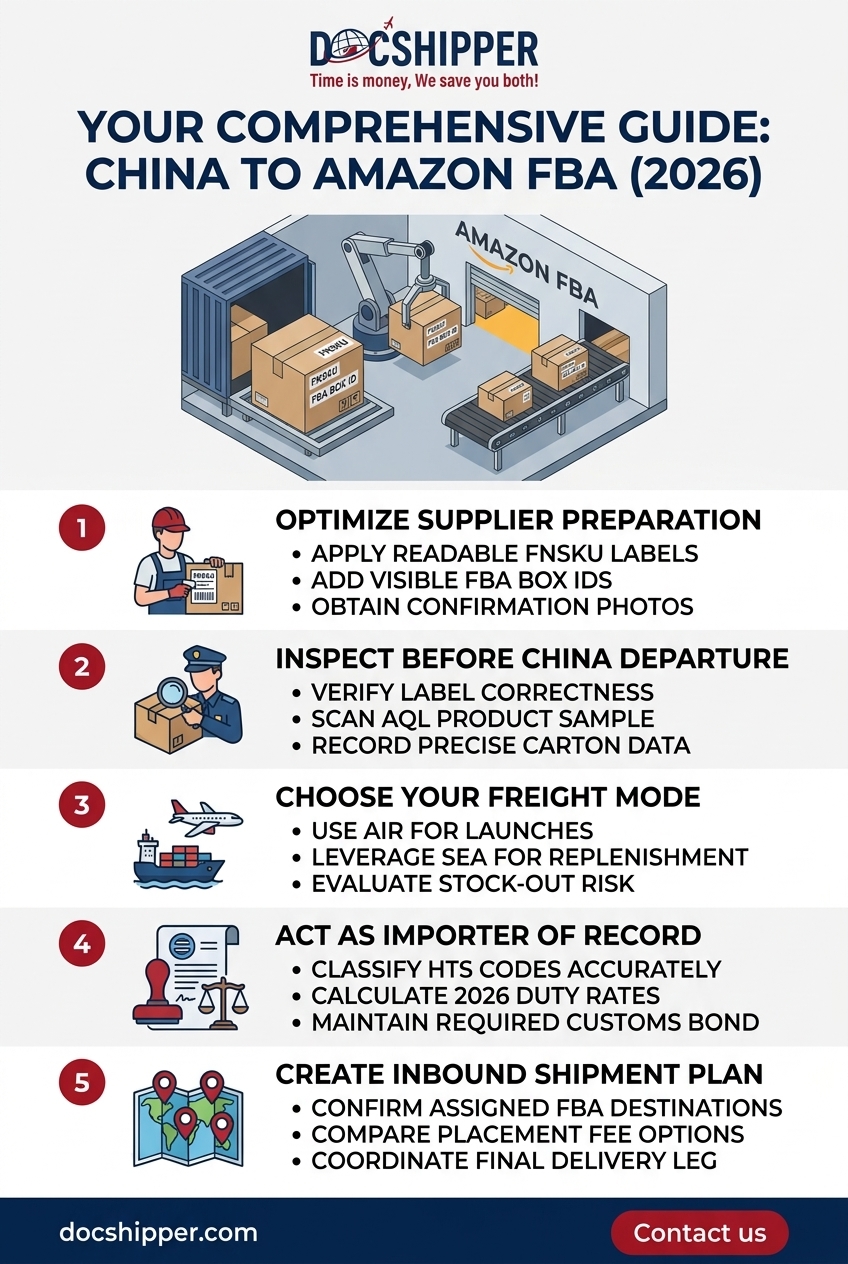
Shipping Directly from China to an Amazon FBA Warehouse: Step by Step works when the factory prepares and labels every unit and carton, while the seller controls inspection, freight, customs, importer-of-record responsibilities and inbound placement. Direct shipping is best suited to inspected replenishment orders with one to three SKUs and stable packaging. Key steps include:- Decide whether direct-to-FBA is suitable or whether a 3PL or AWD buffer is safer for first orders, many SKUs, bundling, relabeling or peak-season inventory.
- Prepare FBA-ready cartons by applying the correct FNSKU to each eligible unit and an FBA box ID label to every outer carton.
- Inspect the products, labels, carton quantities, weights, dimensions and packing list before releasing the balance payment.
- Choose express, air freight, sea LCL, sea FCL, Amazon Global Logistics or an independent forwarder according to urgency, volume and inventory risk.
- Clear U.S. customs with an importer of record, accurate commercial documents, the correct HTS classification, a suitable bond and current duty calculations.
- Create the inbound shipment, confirm Amazon’s assigned fulfillment centers and compare placement fees with the additional transport and delivery coordination required.
The complete workflow covers direct-to-FBA versus 3PL or AWD routing, FBA preparation in China, pre-shipment inspection, freight-mode selection, U.S. customs clearance and inbound placement control.
We hope you’ll find this article genuinely useful, but remember, if you ever feel lost at any step, whether it’s finding a supplier, validating quality, managing international shipping or customs, DocShipper can handle it all for you!
Shipping from China to Amazon FBA works best when the factory prepares, labels and documents every carton before pickup. You must also control the importer of record, tariff classification, freight mode and inbound placement choice. Otherwise, a shipment that looks inexpensive can become delayed, refused or more expensive than a controlled 3PL route.
This guide follows the physical route from the Chinese factory to an Amazon fulfillment center. It focuses on the decisions that create risk: FBA prep in China, inspection, air or sea freight, customs, and the final delivery plan.
DocShipper Info
Need a safer route? Compare factory prep, 3PL support and customs coordination with DocShipper
Can you ship directly from China to Amazon FBA?
Yes. A Chinese supplier can ship FBA-ready cartons directly to Amazon fulfillment centers if you or an appointed party acts as importer of record and the shipment is correctly prepped, labeled, inspected and documented before departure. A 3PL or Amazon Warehousing and Distribution (AWD) buffer is safer for first orders, many SKUs, relabeling, bundling or peak-season inventory.
When direct-to-FBA works
Direct-to-FBA removes a handling step. It is generally realistic when you have one to three SKUs, a replenishment order, stable packaging, an inspected production lot and enough time to correct errors before pickup.
The factory must be able to apply an FNSKU to each eligible unit, print the correct FBA box ID label for every carton, separate SKUs correctly and provide carton-level weights and dimensions. You also need a freight partner that can coordinate customs and the final delivery to each assigned fulfillment center.
Direct shipping is not the same as asking a supplier to send goods under an inexpensive DDP quote. You still need to know who files the import entry, whose customs bond is used, which HTS code applies and who pays any duties or fees. Amazon does not become responsible for those decisions because the destination is an Amazon facility.
When a 3PL or AWD buffer is safer
Use a 3PL or AWD buffer when this is your first shipment, when the order contains many SKUs, or when products need bundling, relabeling, repacking or a final quality decision. A buffer also helps when Amazon assigns multiple destinations, imposes capacity limits or you are building stock for Q4.
For example, a 2-SKU replenishment with an inspected lot is a reasonable direct-to-FBA candidate. A 12-SKU first order that requires a bundle should normally move through a 3PL or another controlled prep point before Amazon receives it.
The commercial logic is simple: direct-to-FBA saves a handling step but moves nearly all operational risk to the factory floor. A 3PL adds a cost, yet it gives you a place to count, relabel, consolidate and hold inventory before an Amazon receiving problem affects the entire order.
| Route | Cost logic | Control | Best use |
| Direct to FBA | Fewer handling and storage steps | Factory must complete prep and carton controls | Inspected replenishment, few SKUs, stable packaging |
| Via 3PL | Adds receiving, prep or storage fees | Relabeling, bundling and counting remain possible | First order, many SKUs, uncertain quality or peak season |
| Via AWD | Uses an Amazon distribution buffer before FBA replenishment | Useful for inventory positioning and replenishment | Planned volume and demand across fulfillment locations |
Use the existing shipping-plan guide for the general Seller Central mechanics. Here, the focus is the China-origin workflow that must happen before and around that plan.
DocShipper Tips
Send clear bilingual instructions and approve carton evidence before booking pickup
Step 1: Make your supplier ship FBA-ready cartons
Since 1 January 2026, Amazon no longer offers FBA prep and item-labeling services in the United States. Preparation must therefore be completed by the factory or a prep center, making the supplier checklist one of the most important controls in the entire shipment.
Unit labels, carton labels and packing
An FNSKU is Amazon’s fulfillment network identifier for a specific seller’s offer. It identifies the inventory Amazon should associate with your account, while a UPC or EAN is the product barcode used in broader retail identification. Use an FNSKU on each unit unless the product is eligible for Amazon’s manufacturer-barcode process and you have deliberately chosen that option.
Each outer carton also needs the FBA box ID label generated for that shipment. The supplier should apply the correct label to the correct carton, keep the label visible and avoid placing tape or another label over the barcode.
Packaging requirements depend on the product. Examples include a suffocation warning for certain poly bags, bubble wrap for fragile items and sealed packaging for products that could leak or shed parts. Check Amazon’s live packaging and prep requirements at publication rather than relying on an old carton-size or weight limit.
Looking for a Reliable
Sourcing Partner?
We handle the entire sourcing process, supplier research, negotiation, production, and inspections, so you can focus on what matters most: growing your business.


The checklist to send to your factory
Send the instructions before production is finished, not when the truck is already waiting. Ask for photos of representative units and every carton marking before sealing, plus a packing list that matches the shipment plan.
For a first order, require the factory to identify the carton number, SKU, unit quantity, gross weight and dimensions. This information allows your broker and forwarder to prepare the shipment accurately and gives you evidence if Amazon later reports a carton discrepancy.
Use the following message as a starting point. Keep the operational instructions in English and Chinese so the production and packing teams can act on the same document.
Subject: FBA-ready packing and labeling instructions
Please prepare this order for direct shipment to Amazon FBA.
请将此订单按照 Amazon FBA 要求准备并包装。
Apply one correct FNSKU label to every unit, unless we confirm that the manufacturer barcode may be used.
每个产品贴上正确的 FNSKU 标签,除非我们书面确认可以使用制造商条形码。
Apply the correct FBA box ID label to every outer carton and keep each carton label visible.
每个外箱贴上正确的 FBA 箱唛标签,并确保标签清晰可见。
Where possible, pack one SKU per carton. Send carton-by-carton quantities, gross weights and dimensions before pickup.
如可能,请每箱只装一个 SKU。提货前请提供每箱数量、毛重和尺寸。
Send photos of the product labels, carton labels and cartons before sealing. Do not ship until we approve the photos and packing list.
封箱前请发送产品标签、外箱标签和纸箱照片。未经我们确认照片和装箱单,请勿出货。
| FBA preparation item | Who does it | Proof to request |
| FNSKU or approved manufacturer barcode on each unit | Factory or prep center | Close-up photos and sample scan |
| FBA box ID label on each carton | Factory or prep center | Photo of every carton label before sealing |
| Product-specific protective packaging | Factory or prep center | Photos showing the completed prep |
| One SKU per carton where possible | Factory packing team | Carton-level packing list |
| Weight and dimensions for every carton | Factory or inspection team | Recorded carton measurements |
| Shipment-plan quantities | Seller and factory | Signed or approved packing list |
Amazon’s change is not a minor administrative detail. Amazon stated that “the vast majority of Amazon sellers now handle their own packaging, including prep and item labeling.” That statement, reported by Supply Chain Dive on 1 August 2025, explains why your supplier’s packing instructions now determine whether the fulfillment center can receive the inventory.
DocShipper Alert
Verify labels, carton data and quantities before releasing the balance payment
Step 2: Inspect before the goods leave the factory
A pre-shipment inspection checks both product quality and FBA readiness before the goods leave China. The inspection should verify the units, labels, packaging, carton count, carton measurements, weights and packing list, with the balance payment released only after the report is approved.
AQL, or Acceptance Quality Limit, is a statistical sampling method used to assess whether a production lot falls within agreed defect limits. Standards such as ANSI/ASQC Z1.4-2003 and ISO 2859-1 help define the sample and acceptance approach, but an FBA inspection must add logistics-specific checks beyond product defects.
For FBA, ask the inspector to scan or visually verify FNSKU labels, check that carton labels correspond to the shipment plan and confirm that the correct number of units is packed in each carton. The inspector should also record carton weights and dimensions instead of accepting the supplier’s estimate.
Consider a lot of 1,200 units packed in 40 cartons. If the inspection finds 3 cartons with missing box labels, the factory can correct them before pickup. The same error discovered after delivery to a fulfillment center can create receiving delays, relabeling work or unfulfillable inventory.
The payment structure should support this control. In a 30/70 flow, the supplier receives the initial 30% according to the agreed order terms, while the remaining 70% is released after the final inspection has been approved. DocShipper’s quality-control process records carton measurements and weights, uses AQL sampling and provides the report within 24 hours according to its service information.
The factory is the last place where a label or carton mistake can be corrected without moving inventory between countries. A report that covers only product appearance is incomplete for a direct-to-FBA shipment.
| Inspection point | What to verify | Corrective action |
| Product sample | Quantity, workmanship and agreed specifications | Repair, replace or reject before balance payment |
| Unit labeling | FNSKU or approved barcode is readable and correctly placed | Relabel at the factory |
| Carton labels | FBA box ID matches the planned carton and remains visible | Print and apply the correct label |
| Carton data | Count, gross weight and dimensions recorded per carton | Repack or update freight documents |
| Packing list | SKU and unit totals match the shipment plan | Reconcile before pickup |
DocShipper Tips
Choose air, sea or AGL after comparing lead time, receiving and delivery control
Step 3: Choose the freight mode: air, sea or Amazon Global Logistics
Air or express freight suits launches and urgent restocks, while sea freight usually fits planned replenishment with enough inventory runway. Amazon Global Logistics can book ocean or air freight from mainland China, Hong Kong and Vietnam to FBA, but you still provide importer-of-record details and remain responsible for customs information.
Air and express: speed for launches and stock-outs
Express courier is useful for small, urgent shipments when speed and simple door-to-door handling justify the price. Air freight is better suited to larger urgent quantities, product launches and replenishment where a stock-out would cost more than the freight premium.
Do not select air only because the supplier says it is faster. Confirm the available service, customs process, final-mile delivery and receiving assumptions in writing. Amazon states that its Global Logistics air service can reach fulfillment centers “within 7-10 days,” but that is a program statement, not a promise that every shipment will be received within that period.
Sea LCL and FCL: cost for replenishment
LCL, or less-than-container load, combines your cargo with other shippers’ goods. It is useful when your volume does not justify a full container, but it adds consolidation and deconsolidation handling. FCL, or full-container load, gives you a dedicated container and can improve handling control when the order fills enough space.
Choose sea freight only after checking production time, consolidation cutoffs, port handling, customs clearance, final-mile appointments and Amazon receiving time. Chinese New Year and Q4 require additional planning because production and transport capacity can tighten while demand becomes less forgiving.
Use this inventory formula to plan a replenishment: reorder point = D × (P + T + R) + safety stock, where D is daily sales, P is production lead time, T is transit time and R is receiving time. Insert your own measured or quoted variables rather than assuming a generic transit period.
Why Choose DocShipper
Lower risk, transparent pricing, and a single point of contact from pickup to delivery.
-
One single point of contactA dedicated consultant coordinating every step and keeping you informed.
-
9,200+ operations / 6,000+ clientsProven processes on China ↔ EU/US lanes (FCL, LCL, air, road, rail).
-
No hidden feesTransparent quotes and document guidance to avoid surprises.
Amazon Global Logistics versus your own forwarder
Amazon Global Logistics can simplify booking and connect eligible freight from China, Hong Kong and Vietnam to Amazon fulfillment centers. An independent forwarder can offer more flexibility for factory consolidation, pre-shipment inspection, temporary storage, relabeling, mixed suppliers and delivery through a 3PL.
AGL does not replace your importer-of-record decision or your factory quality-control process. Amazon’s program information specifically asks sellers to provide importer-of-record details at onboarding, so treat AGL as a freight option rather than a transfer of customs responsibility.
The commercial context matters. 50.03% of Amazon’s global active seller base was represented by Chinese sellers in Marketplace Pulse’s September 2025 analysis. Juozas Kaziukėnas, founder of Marketplace Pulse, wrote that “Chinese sellers now represent more than 50% of the top sellers on Amazon.com, with U.S. sellers representing roughly 45%.” The implication is practical: freight mode affects your in-stock rate and therefore your competitive position, not just your transport budget.
| Mode | Typical use | Cost logic | Main risk |
| Express courier | Small urgent shipment or samples | Highest cost per unit, simple handling | Limited shipment economics and customs surprises |
| Air freight | Launch, urgent restock or high-value goods | Premium for speed and lower inventory exposure | Higher freight cost if demand is uncertain |
| Sea LCL | Planned smaller replenishment | Lower transport cost with shared handling | Consolidation and receiving complexity |
| Sea FCL | Large planned replenishment | Efficient when volume fills a container | More inventory committed at once |
| Amazon Global Logistics | Eligible air or ocean shipments into FBA | Program-based booking to Amazon facilities | Seller still controls IOR, prep and classification |
| Independent forwarder | Consolidation, inspection, buffer or custom routing | Flexible service scope and additional handling | Quality varies, so verify the customs and delivery process |
DocShipper Alert
Confirm classification, duties and bond requirements before departure
Step 4: Clear US customs as importer of record
Amazon does not act as your importer of record. You or a nominated IOR must arrange the entry, provide the customs broker with accurate documents, maintain the required bond and pay the duties and fees associated with the import.
Who is the importer of record
The importer of record is the party legally responsible for the accuracy of the import entry, including product description, value, country of origin, tariff classification and duty payment. A customs broker prepares or transmits documents on your behalf, but using a broker does not remove your underlying responsibility.
A single-entry bond covers a particular import entry. A continuous bond can cover repeated imports over its validity period and may be more suitable for regular shipments. Ask your broker which structure applies to your volume and entry profile before the first shipment leaves China.
Be cautious with a DDP offer that hides the customs process. A low quote is not protection if the forwarder understates the value, uses an unsuitable importer or gives you no evidence of the entry. Classification or valuation errors can create duty bills, delays and compliance exposure for the IOR.
Duties in 2026: how to calculate them
Do not use one generic “China tariff” percentage. Start with the precise HTS code, identify the applicable MFN duty, check the relevant Section 301 list rate, verify the additional 12.5% Section 301 measure described in the brief, check any valid exclusion and then add applicable processing or harbor fees.
The 2026 context requires dated checks:
- U.S. Customs and Border Protection suspended duty-free de minimis treatment for all countries from 29 August 2025, with an indefinite suspension for relevant non-postal modes published on 24 June 2026.
- On 20 February 2026, the U.S. Supreme Court struck down the IEEPA reciprocal and trafficking tariffs in Learning Resources, Inc. v. Trump.
- From 24 July 2026, the brief identifies a 12.5% forced-labor Section 301 tariff stacking on the existing 25% Section 301 tariff for covered Chinese goods, producing a 37.5% aggregate Section 301 rate before MFN duty.
Use the USITC HTS database, USTR notices and your broker’s current guidance before booking. The exclusion information in the brief is stated as valid to 10 November 2026, so verify that status at the time of entry.
For a customs value of V, the working method is:
Customs duties = V × (MFN rate + applicable Section 301 rates) + applicable fees
Do not insert a rate until the exact HTS code and current measures have been checked. The customs value, country of origin, product composition and intended use can all affect the result.
| Document or control | Who provides it | Common mistake |
| Commercial invoice | Supplier and seller | Vague description or inconsistent value |
| Packing list | Factory | Carton totals do not match the shipment plan |
| HTS classification | Seller with broker support | Choosing a code from a similar product |
| Importer-of-record details | Seller or nominated IOR | Assuming Amazon automatically becomes IOR |
| Customs bond | IOR and customs broker | Arranging it after cargo departure |
| Duty and fee calculation | IOR and broker | Using a frozen “China rate” or relying on de minimis |
DocShipper Tips
Confirm assigned destinations first, then compare delivery legs with the current Seller Central charges
Step 5: Create the inbound shipment and control placement fees
The inbound shipment tells Amazon what is arriving, how many cartons are included and where the inventory is expected. The choice between an Amazon-optimized split and a minimal shipment split can change the inbound placement fee and the number of delivery legs your forwarder must complete.
Complete the operational sequence in this order: create or confirm the shipment in Seller Central, send the generated unit and carton labels to the factory, approve the packing evidence, book freight, clear customs and coordinate final-mile delivery to the assigned fulfillment center or centers.
Do not book the final delivery leg before you know the assigned destinations. An LCL or FCL shipment split across several fulfillment centers may require separate appointments, trucking legs or handling instructions. Compare the placement fee with the additional transport and delivery coordination cost rather than selecting the cheapest-looking option in isolation.
A simple comparison is a single FCL split into 3 fulfillment centers versus delivery to 1 fulfillment center. The three-destination option may alter the inbound placement fee and adds delivery coordination. The one-destination option may reduce final-mile complexity while changing the placement charge. Use the current figures shown in Seller Central because the fee depends on the shipment and service selected.
Amazon’s 2026 U.S. fee update took effect on 15 January 2026. Amazon reported an average FBA fee increase of about $0.08 per unit sold, no increase in U.S. referral fees and no new FBA fee types in 2026. Dharmesh Mehta, Vice President of Worldwide Selling Partner Services at Amazon, stated: “Our innovations to drive down our costs enable us to only make a slight average increase in our fees – about $0.08 per unit sold.” Treat that as Amazon’s published platform position and still calculate the current fees for your specific shipment.
| Placement approach | What it means | Cost effect | Best fit |
| Amazon-optimized split | Amazon assigns inventory across its network | May increase delivery destinations while changing placement cost | Sellers prioritizing network positioning and availability |
| Minimal shipment split | Fewer initial fulfillment-center destinations | May simplify final-mile delivery while changing the placement fee | Controlled loads where delivery complexity matters |
| Via 3PL or AWD | Inventory reaches a buffer before FBA replenishment | Adds storage or handling but reduces one-shot placement risk | Many SKUs, uncertain demand or peak-season planning |
Conclusion: make China-to-FBA a controlled process
Shipping directly from China to Amazon FBA is viable when the factory, inspection team, broker and forwarder work from the same shipment data. The cheapest route is not automatically the most profitable route: direct shipping only wins when cartons leave China correctly labeled, documented and ready for Amazon receiving.
- Use direct-to-FBA for a small number of SKUs and inspected replenishment lots; use a 3PL or AWD buffer for first orders, many SKUs, bundling or peak season.
- Since 1 January 2026, U.S. FBA prep and item labeling must be handled by your supplier or a prep center, so send written instructions before production ends.
- Inspect the product, FNSKU labels, carton labels, quantities, weights, dimensions and packing list before releasing the balance payment.
- Choose express, air, LCL, FCL, AGL or an independent forwarder according to stock risk and lead-time requirements, not freight price alone.
- You or your nominated party are the importer of record. Classify the goods by HTS code and calculate duties using the current 2026 tariff measures.
- Confirm the inbound placement choice before booking the final delivery leg, especially when Amazon assigns multiple fulfillment centers.
Want your cartons to leave China FBA-ready? We inspect your goods, verify labels and carton data at the factory, coordinate customs information and organise freight to Amazon’s warehouses. Contact DocShipper to plan your next shipment from sourcing through FBA delivery.
FAQ | Shipping from China to Amazon FBA: A Step-by-Step Guide for 2026
Yes, but only if the shipment is physically and commercially segregated. Keep FBA cartons grouped by shipment and clearly separate them from goods going to a 3PL, another customer or a different destination. Your packing list and commercial invoice should identify each portion accurately. Ask the forwarder how the cargo will be separated during deconsolidation so non-FBA goods are not accidentally delivered to Amazon.
Do not ship with carton data that no longer matches the shipment plan. Stop the pickup, reconcile the final packing list with the factory and compare every carton against the labels already generated. If the changes affect the shipment information or freight documents, update the relevant records and ask your forwarder whether new labels or customs documents are required. A last-minute discrepancy is easier to correct in China than after Amazon receives the cargo.
First, collect the carrier’s proof of delivery, appointment records, carton photos and the carton-level packing list. Then compare the affected FBA box IDs with the cartons that actually left the factory and open a case with Amazon using the shipment ID and supporting evidence. Ask the carrier whether the issue resulted from a missed appointment, an incorrect destination, damaged packaging or a receiving discrepancy. Do not immediately resend replacement inventory until you know whether Amazon has rejected, delayed or partially received the original shipment.
No. A commercial invoice and packing list prove what was shipped, but they do not replace product-specific compliance documentation. Before production, confirm whether your product requires testing reports, safety certificates, labeling evidence or approvals from agencies such as the CPSC, FCC, FDA or EPA. Keep the documentation consistent with the product description, model number and country of origin shown on the customs entry and Amazon listing.
No. Each FBA box ID label is linked to a specific shipment and carton record. Reusing an old label can associate the inventory with the wrong shipment, SKU or destination and create receiving discrepancies. Remove outdated labels completely, generate the current labels after the inbound shipment is confirmed and verify that the carton number and barcode match the final packing list before sealing.
Hold the cargo before the final delivery leg whenever possible. Confirm the new destination in Seller Central, check whether the existing carton labels and shipment data are still valid, and ask the forwarder to revise the delivery instructions before booking an appointment. Never redirect the shipment based only on a verbal message from a supplier or carrier. The destination, shipment ID, carton labels and customs delivery instructions should all refer to the same final plan.
Need Help with
Logistics or Sourcing ?
First, we secure the right products from the right suppliers at the right price by managing the sourcing process from start to finish. Then, we simplify your shipping experience - from pickup to final delivery - ensuring any product, anywhere, is delivered at highly competitive prices.