In short ⚡
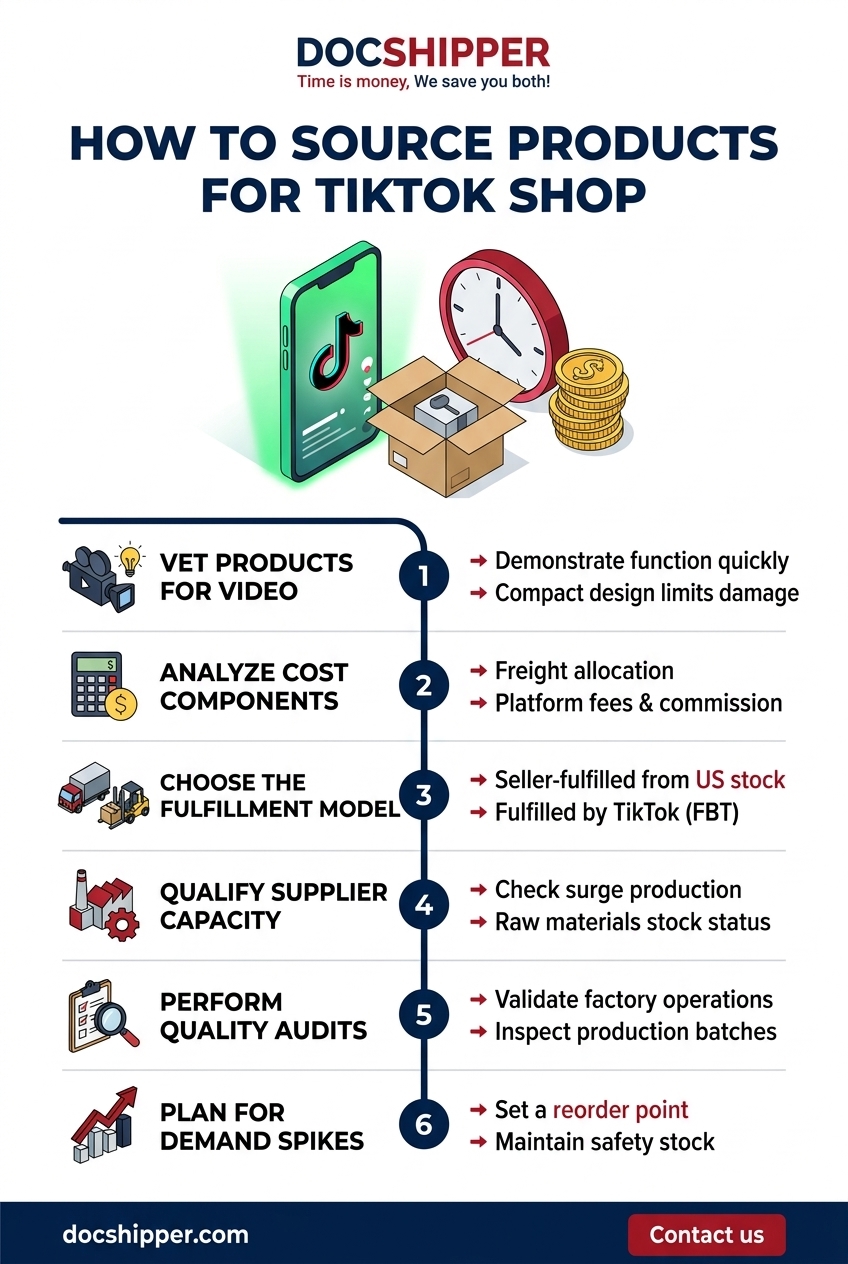
How to Source Products for TikTok Shop: start by choosing a product that performs well on video, then validate supplier capacity and position inventory in the US to meet TikTok Shop’s regular-order deadlines. Test demand with a controlled batch before planning bulk replenishment and safety stock. Key steps include:- Choose a demonstrable, durable product with sufficient margin after product costs, freight, duties, fulfillment, platform fees, creator commissions and returns.
- Select a fulfillment model—US stock, a 3PL or Fulfilled by TikTok—that can support dispatch within 2 business days and delivery within 6 business days.
- Shortlist suppliers and verify their capacity, raw-material availability, packaging stock, repeat-order lead time, MOQ and subcontracting arrangements.
- Request a supplier audit, approve product specifications and use pre-shipment inspections before releasing the production balance.
- Launch with a controlled test batch, then use bulk freight and US-based safety stock for proven products.
- Set a reorder point using average daily sales, expected demand spikes, production lead time, transit time, receiving time and safety stock.
The sourcing process covers TikTok Shop shipping rules, fulfillment models, video-friendly product selection, supplier validation, quality inspections, test batches and demand-spike replenishment.
We hope you’ll find this article genuinely useful, but remember, if you ever feel lost at any step, whether it’s finding a supplier, validating quality, managing international shipping or customs, DocShipper can handle it all for you!
Sourcing for TikTok Shop is not the same as sourcing for a regular online store. A product can go viral overnight through a video or live stream, while TikTok Shop still expects orders to move through a strict fulfillment clock. You therefore need products that demonstrate well, suppliers that can absorb a spike, and inventory positioned close to your customers.
In the US, regular orders must be marked in transit within 2 business days and delivered within 6 business days. That requirement changes the sourcing decision from “Which supplier offers the lowest unit price?” to “Which supplier can keep stock available in the US and replenish it before the next viral wave?”
DocShipper Info
Prioritize US inventory, reliable replenishment and fulfillment capacity over the lowest unit price.
Sourcing for TikTok Shop: why it is different from a regular online store
TikTok Shop combines rapid, content-driven demand with platform-controlled delivery expectations. The best sourcing model is one that can support a sudden increase in orders without sacrificing delivery performance, product quality or restock speed.
The opportunity is substantial. According to data from Momentum Works and Tabcut reported by Tubefilter, TikTok Shop generated $50.3 billion in global GMV in H1 2026, including $11.8 billion in the US. Approximately half of sales came through the Shop tab, around 40% through videos and about 8% through live shopping.
That demand is not distributed evenly. Marketplace Pulse reported that the top 1% of TikTok Shop sellers generated 60% of GMV, compared with 1.6% of Amazon sellers generating 50%. As analyst and Marketplace Pulse writer Ben Donovan put it, “The platform that removed the paywall on discovery has not flattened outcomes. It has sharpened them.”
The practical meaning is clear: a first viral sale is not the same as a scalable business. Your supplier must be able to reproduce the product, maintain the same specifications, prepare packaging quickly and support a restock when demand exceeds your forecast.
The main difference from Shopify is control over the delivery promise. On Shopify, you generally define the shipping offer and communicate your own handling times. TikTok Shop imposes platform rules that influence where inventory must sit before you select a supplier or fulfillment partner.
| Decision point | What changes on TikTok Shop |
| Demand | Videos and lives can create a sharp, immediate sales spike. |
| Inventory | Regular US orders generally need stock already located in the US. |
| Supplier selection | Capacity and repeat-order lead time matter as much as price. |
| Quality | A defective batch can generate negative comments, returns and visible complaints during a live. |
| Scaling | The supplier must support replenishment before the current stock reaches zero. |
DocShipper Alert
Build your supply chain around US-based inventory, accurate tracking and dependable dispatch times.
TikTok Shop shipping rules and what they mean for your supply chain
For regular US orders, TikTok Shop requires the order to be marked in transit within 2 business days and delivered within 6 business days. An order without tracking can be automatically cancelled after 5 business days, while a late dispatch rate above 10% can trigger enforcement measures.
The official TikTok Shop Seller University also sets performance thresholds including a Valid Tracking Rate of at least 95%, an On-Time Delivery Rate of at least 80% and a Seller-Fault Cancellation Rate of no more than 2.5%. These are operational constraints, not general recommendations. Check the current official policy before launching because platform requirements can change.
For example, take a regular order placed on Monday:
- Monday: the order enters the Awaiting Shipment stage.
- Wednesday: the order must be marked In Transit within the 2-business-day dispatch window.
- By the sixth business day: the order must be delivered.
- After 5 business days without tracking: the order may be automatically cancelled.
The precise calendar date depends on weekends and holidays, but the operational conclusion does not change. A parcel dispatched individually from China must pass through export handling, international transport, customs and domestic delivery inside a window designed for inventory already near the buyer. Shipping regular orders directly from China is therefore structurally unsuitable for this requirement.
The suspension of US duty-free de minimis treatment also makes the direct-parcel model less attractive. U.S. Customs and Border Protection suspended duty-free de minimis treatment for all countries from 29 August 2025, with the indefinite suspension published on 24 June 2026. Instead of sending thousands of individual parcels from China, importing a planned bulk shipment into the US can provide a cleaner inventory and customs process. Do not assume a tariff amount without checking the product classification and current customs rules.
Dropshipping from China
China-based dropshipping can be useful for product discovery, samples or markets with different fulfillment rules. It is generally a poor fit for regular US TikTok Shop orders when the supplier only dispatches after each sale, because the product is not positioned inside the required delivery window.
Use this model only after checking the specific product category, order type and current TikTok Shop policy. Made-to-order and custom products have a separate handling framework, with handling time of 3 to 15 business days and a dispatch SLA calculated as handling time plus 1 day. That exception does not make ordinary ready-to-ship products compatible with long international fulfillment.
Looking for a Reliable
Sourcing Partner?
We handle the entire sourcing process, supplier research, negotiation, production, and inspections, so you can focus on what matters most: growing your business.

Seller-fulfilled from US stock or a 3PL
A seller-fulfilled model stores inventory in your own US facility or with a third-party logistics provider, commonly called a 3PL. The 3PL receives bulk stock, stores it, picks and packs orders, and passes shipment data back to your store.
This option gives you more control over packaging, inserts, bundling and inventory allocation. When comparing providers, verify their order cut-off time, carrier integrations, returns process, inventory reporting and ability to handle a sudden increase in daily orders.
Fulfilled by TikTok
Fulfilled by TikTok, or FBT, places eligible inventory inside TikTok’s fulfillment network. It can reduce the operational workload associated with picking, packing and dispatching, but it does not remove the need to source reliable products or forecast inventory correctly.
Before selecting FBT, confirm product eligibility, inbound requirements, packaging rules, storage charges and replenishment procedures. Your supplier still needs to produce consistent stock and deliver it to the required fulfillment location on time.
| Fulfillment model | Meets the 2-day dispatch and 6-day delivery logic? | Cash tied up | Control |
| Dropshipping from China | Generally no for regular US orders when dispatched after purchase. | Lower initial stock commitment. | Lower control over delivery and customer experience. |
| Seller-fulfilled from US stock | Yes, if inventory and operations are managed correctly. | Higher, because stock is imported in advance. | High control over packaging and fulfillment. |
| US 3PL | Yes, if the 3PL meets the required handling schedule. | Higher, plus storage and fulfillment fees. | Shared control with the logistics provider. |
| Fulfilled by TikTok | Designed to support TikTok’s fulfillment environment, subject to eligibility and compliance. | Higher, with platform-related fees. | Lower direct fulfillment control, more operational convenience. |
DocShipper Tips
Confirm inventory location, handling speed and replenishment procedures before approving your sourcing plan.
Choose a product that sells on video and can be sourced reliably
The strongest TikTok Shop products show a visible result in seconds, travel without excessive damage risk, retain a healthy margin after all selling costs and can be reproduced consistently. A product that is easy to demonstrate but impossible to restock is not a reliable TikTok Shop product.
Start with the product rather than the supplier. Review the product’s demonstration potential, size, weight, packaging requirements, return risk, compliance obligations and ability to withstand repeated handling in fulfillment. For broader product-selection criteria, use a structured sourcing evaluation rather than relying only on current video views.
Your margin grid should include every cost that affects the sale:
- Retail price
- Product unit cost
- Freight allocation per unit
- Duties and import charges
- Fulfillment and storage fees
- Platform fees
- Creator commission
- Returns and replacement provision
The calculation is: retail price minus product cost, freight share, duties, fulfillment, platform fees, creator commission and returns provision. Creator commission is often forgotten because it is linked to the content or affiliate sale rather than the factory invoice, but it can materially change the contribution margin.
Decide whether the first batch should remain generic or move toward private label. Generic products usually allow faster testing and lower development effort. Private label adds packaging, artwork, brand assets and often higher minimum order quantities, but it can make the offer more distinctive and reduce reliance on an identical listing.
| Product criterion | What to verify before sourcing |
| Demo-ability | Can the product’s benefit or transformation be shown clearly in a short video or live? |
| Shipping profile | Is it compact, durable and unlikely to create excessive damage or return costs? |
| Margin | Does the contribution remain acceptable after freight, fees, commissions and returns? |
| Repeatability | Can the factory reproduce the same materials, dimensions, color and function in every batch? |
| Compliance | Does the product require testing, labeling or documentation under rules such as CPSIA, FCC or other market-specific requirements? |
| Brand potential | Would private label packaging or a product variation create a meaningful difference? |
DocShipper Tips
Test demand with a generic product, then invest in private label once margins and repeatability are proven.
Why Choose DocShipper
Lower risk, transparent pricing, and a single point of contact from pickup to delivery.
-
One single point of contactA dedicated consultant coordinating every step and keeping you informed.
-
9,200+ operations / 6,000+ clientsProven processes on China ↔ EU/US lanes (FCL, LCL, air, road, rail).
-
No hidden feesTransparent quotes and document guidance to avoid surprises.
Find and validate a supplier who can follow a sales spike
A suitable TikTok Shop supplier can answer questions about monthly capacity, raw material availability, packaging stock, repeat-order lead time and surge production. Do not qualify a supplier only by sample quality and initial price. You need evidence that the factory can reproduce the product when demand doubles.
Build a shortlist from platforms such as Alibaba, 1688 through a sourcing agent, trade fairs or direct factory introductions. For each supplier, request the legal company name, factory address, production process, current capacity, standard MOQ, repeat MOQ, lead time for a normal order and lead time for an urgent replenishment.
Ask what happens if you place a larger order than forecast. A supplier may quote a low price for a stable monthly volume but lack the molding capacity, raw materials, labor or packaging required for a viral spike. Confirm whether key components are made in-house or purchased from another supplier, because subcontracting can add another source of delay and quality variation.
Before committing to volume, request a supplier audit. An audit can verify the factory’s operating status, production lines, quality system, workforce, storage conditions and claimed capacity. DocShipper’s supplier audit process provides a report within 24 hours after the audit, according to the supplied service information.
Use pre-shipment inspection before releasing the balance of a production order. An AQL inspection, or Acceptable Quality Limit inspection, checks a statistically selected sample against agreed specifications rather than relying on a visual review of one sample. DocShipper provides an inspection report within 24 hours, and its 30/70 quality-control flow can be used to connect approval of the order balance with inspection results.
Supplier capacity email template
Send a written request so that every shortlisted supplier answers the same questions:
- Product: Please confirm the exact materials, dimensions, colors, packaging and included accessories for this product.
- Capacity: What is your normal monthly capacity for this specification? What is the maximum capacity without changing the production line?
- Surge: If our order volume doubles, how many units can you produce per month and what additional lead time would apply?
- Materials: Which raw materials and components are kept in stock, and which are purchased after receiving an order?
- Packaging: How many finished packages, boxes, labels and inserts do you currently hold?
- Repeat order: What is the lead time for a repeat order after the first approved production run?
- MOQ: What are the MOQ and lead time for generic packaging, custom packaging and private label packaging?
- Quality: What inspections are performed during production and before shipment?
- Subcontracting: Which steps are performed outside your factory?
- Evidence: Please provide recent production photos, relevant certifications and a capacity plan for a potential restock.
Red flags include a trading company that refuses to disclose its operating address, a supplier that cannot distinguish sample lead time from repeat-order lead time, no written quality specifications, unclear subcontracting and an unwillingness to discuss capacity limits. A low-cost supplier that needs 45 days to restock can cost you the trend that created the demand.
| Supplier checkpoint | Evidence to request |
| Factory identity | Legal company details, address, production photos and audit access. |
| Capacity | Normal output, maximum output and response to a doubled order. |
| Materials | Stock status, component suppliers and replenishment risks. |
| Packaging | Available packaging inventory and custom packaging lead time. |
| Restock | Written repeat-order lead time and production schedule. |
| Quality | Approved sample, specification sheet and pre-shipment inspection plan. |
| Commercial terms | MOQ, payment terms, change-control process and treatment of defective units. |
DocShipper Alert
Set a reorder point that protects availability when demand accelerates unexpectedly.
Test, then restock without running out
Start with a controlled test batch, then move to planned bulk replenishment once sales and returns confirm product-market fit. Use the test phase to validate the video demonstration, conversion, product quality, customer feedback and fulfillment process rather than simply chasing the lowest MOQ.
A small test batch can be shipped by air when speed is the priority and the quantity is limited. Once the product is proven, planned restocks can use bulk sea freight when appropriate. The correct choice depends on the product, shipment size, destination, urgency and total landed cost, so calculate both options instead of assuming one mode is always cheaper.
Set a reorder point before the first viral spike. Use the following variables:
- D: average daily sales
- S: spike factor that represents expected viral demand
- P: production lead time
- T: transit time
- R: receiving and inventory check-in time
- Safety stock: additional units reserved for uncertainty
The reorder point is: D × S × (P + T + R) + safety stock. This is a planning formula, not a guarantee. Recalculate it when the creator mix changes, when daily sales accelerate, when production lead time changes or when your US warehouse receives stock more slowly than expected.
Worked example using the brief’s variables:
- Daily sales: D
- Expected spike factor: S
- Production lead time: P
- Transit time: T
- Receiving time: R
- Demand covered during replenishment: D × S × (P + T + R)
- Final reorder point: D × S × (P + T + R) + safety stock
For example, if your available inventory falls to that calculated point, place the next order rather than waiting for the warehouse to reach zero. Keep safety stock in the US where it can support regular TikTok Shop orders. Inventory still at the factory cannot solve a same-week stockout.
Inspect every production batch before it leaves the factory. On TikTok Shop, defects can appear in comments and live streams within days, where a single quality issue can influence many potential buyers. As a result, inspection protects the account and customer experience, not only the margin.
| Stage | Freight approach | Inspection | Goal |
| Product test | Small batch, often air freight when speed is essential. | Sample approval and checks against the product specification. | Validate demand, quality and fulfillment. |
| First proven restock | Planned bulk shipment based on sales and lead-time data. | Pre-shipment inspection before balance payment. | Reduce unit cost and maintain US availability. |
| Viral scaling | Repeat bulk orders with a defined safety stock level. | Inspection for every batch and review of recurring defects. | Support the spike without compromising delivery or quality. |
Conclusion
Sourcing products for TikTok Shop starts with the platform’s fulfillment clock, not with a supplier directory. For regular US orders, the requirement to dispatch within 2 business days and deliver within 6 means that stock should generally be positioned in the US through your own operation, a 3PL or Fulfilled by TikTok.
- TikTok Shop’s US rules require regular orders to move in transit within 2 business days and reach the customer within 6 business days.
- Choose the fulfillment model before finalizing the supplier.
- Select products that demonstrate clearly on video, ship safely and can be produced consistently.
- Qualify suppliers on capacity, packaging availability and repeat-order lead time, not only unit price.
- Test with a controlled batch, then use planned bulk restocks and a reorder point designed for demand spikes.
- Inspect every batch before it leaves the factory to protect quality, reviews and account performance.
Ready to scale a TikTok Shop product? We find and audit suppliers able to follow your demand spikes, inspect each batch and ship it in bulk to your US warehouse or 3PL. Contact us to plan your next restock.
FAQ | How to Source Products for TikTok Shop
Treat the approved sample as a golden sample, not just a reference. Record its materials, dimensions, weight, color, finish, packaging and accessories in a signed specification sheet. Require the supplier to obtain written approval before changing a component, subcontractor or production method. Keep one approved sample with your inspection company so future batches can be compared against the same standard.
Before shipping, confirm who will act as the importer of record and verify the correct product classification with a customs professional. Your shipment will typically require commercial documentation such as an invoice, packing list and bill of lading or air waybill. Depending on the product, you may also need testing reports, labeling records, certificates or other agency documentation. Do not rely on the supplier to determine US compliance without independently checking the requirements for your product category.
Avoid paying the full balance before production and inspection. A common structure is a deposit to begin production, followed by payment after the goods pass an agreed pre-shipment inspection. Put the product specifications, acceptable defect limits, delivery date, packaging requirements and remedy for defective units in the purchase order. For a new supplier, consider using a platform payment-protection service or another documented payment method rather than making an untraceable transfer.
First, stop promoting the product through additional creators until you know how many units are genuinely available. Adjust the listing or campaign to avoid accepting more orders than your fulfillment capacity allows, and contact your supplier about a partial urgent shipment rather than waiting for the complete production run. At the same time, review TikTok Shop’s current stockout, cancellation and seller-performance rules. Selling beyond your available inventory can create more account risk than temporarily slowing demand.
Ask the 3PL for operational data, not only a price list. Confirm its receiving time, inventory accuracy target, same-day order cut-off, carrier handoff schedule, returns workflow and peak-volume capacity. Also clarify how it handles lost or damaged units, stock discrepancies, relabeling and emergency order surges. Run a small pilot shipment first so you can compare the 3PL’s actual scan and dispatch times with the service levels promised in the contract.
Identify the rules that apply to the product and its intended US use before requesting a large quotation. Ask the supplier for current test reports and certificates, then verify that they cover the exact model, materials, manufacturer and production location—not merely a similar product. Check required warnings, age grading, label information and records of any component changes. If the product involves children, electronics, cosmetics or health-related claims, have a qualified compliance specialist review the documentation before listing it.
Need Help with
Logistics or Sourcing ?
First, we secure the right products from the right suppliers at the right price by managing the sourcing process from start to finish. Then, we simplify your shipping experience - from pickup to final delivery - ensuring any product, anywhere, is delivered at highly competitive prices.