In short ⚡
How to Import Paper and Printing Products from China: classify your goods, prepare a detailed specification, qualify a printer, approve proofs, inspect production and plan compliant shipping with suitable moisture protection.
Follow these key steps:
- Classify the product: Determine whether it is printed matter, paper packaging or stationery, and confirm the proposed HS chapter.
- Prepare the specification: Define paper stock and gsm, dimensions, page count, binding, colour process, Pantone references, finishing, packing and destination.
- Choose and audit the printer: Compare samples and identical quotations, then verify equipment, capacity, paper storage, quality procedures, certifications and subcontracting.
- Approve proofs and samples: Review the digital proof, use a physical or wet proof when necessary, and approve a pre-production sample before the full run.
- Confirm compliance and inspect: Collect relevant paper-source, certification and destination-market documents, then check colour, paper, binding, finishing, quantity and packing before shipment.
- Plan production and freight: Reserve a production slot around seasonal demand, compare LCL, FCL and air freight, and protect dense paper cargo from humidity.
Key topics include choosing and auditing Chinese printers, classifying products under chapters 48 or 49, managing EUDR and CPSIA requirements, approving proofs, controlling quality and planning production timelines and freight.
We hope you’ll find this article genuinely useful, but remember, if you ever feel lost at any step, whether it’s finding a supplier, validating quality, managing international shipping or customs, DocShipper can handle it all for you!
Importing books, packaging, stationery or other paper goods from China is rarely difficult because of the printing price alone. The real risks are unclear specifications, unapproved colour differences, missed production slots, paper compliance and unexpectedly expensive freight.
This guide explains how to choose a Chinese printer, classify your goods, approve proofs, control quality and plan delivery. The key decision comes first: printed matter, paper packaging and stationery may look similar, but they can fall under different customs and compliance rules.
DocShipper Info
Our specialists can confirm the right product category before you request quotations
Why source printed and paper products in China
China is a major sourcing base for book printing, custom packaging boxes, stationery and complex paper products. It combines large production capacity with finishing options such as foiling, embossing, die cutting, pop-ups, special papers and rigid boxes.
China exported US$4.03 billion of HS 49 printed products in 2023, including books, newspapers and pictures. The United States represented 34% of those exports, followed by Hong Kong at 8.95%, the United Kingdom at 6.95% and Australia at 4.28%, according to TrendEconomy data based on UN Comtrade, consulted on 14 October 2026.
The advantage is not limited to unit price. A suitable printer may consolidate printing, binding and finishing in one production line, which can simplify quality control for a board game, a children’s book or a branded box. The limits are equally practical: paper is dense, production capacity is seasonal and a low factory quote does not include every freight, inspection, customs or compliance cost.
| Strength | What it means for you |
| Complex finishing | Useful for premium books, rigid boxes, cards and branded packaging. |
| Production capacity | Suitable for repeat orders and larger print runs when the specification is stable. |
| Heavy cargo | Sea freight and moisture protection must be considered before confirming the price. |
| Seasonal capacity | Chinese New Year and the Q3 holiday rush can affect your production slot. |
DocShipper Tips
Request a detailed freight and compliance estimate before approving your supplier
Three product families, three rule sets
Classify your product before requesting quotations. Books and catalogues generally belong to HS chapter 49, while paper packaging, printed labels, notebooks, pads and envelopes generally belong to HS chapter 48.
This distinction affects the EU deforestation regulation, customs documentation and the information you should request from the printer. One order can sit on both sides of the line: a book may be treated as printed matter, while its printed shipping box or a branded notebook sold with it may be a paper product subject to different requirements.
For the United States, ordinary children’s books may benefit from relief under the Consumer Product Safety Improvement Act framework, but novelty products, books containing additional play features and products marketed as toys require closer review. Check the current position with the US Consumer Product Safety Commission before production.
| Product family | Typical HS chapter | EU point to check | US point to check |
| Books, catalogues, calendars and other printed matter | 49 | Printed products in chapter 49 are treated as exempt from EUDR after the December 2025 update, subject to classification and verification. | Children’s books may require CPSIA analysis, especially where the product includes novelty or toy-like elements. |
| Printed boxes, paper packaging and labels | 48 | Remain in the EUDR scope according to the current secondary guidance. Prepare paper-source and due-diligence information. | Check tariff classification, marking and any product-specific requirements. |
| Notebooks, pads, envelopes and stationery | 48 | Remain in the EUDR scope according to the current secondary guidance. | Check classification, labelling and product safety obligations for the intended user. |
Choosing a Chinese printer
Choose a printer that already produces your format, rather than selecting only on the lowest quotation. Ask for comparable samples, production photographs, export references and details of the equipment used for printing, binding, die cutting and finishing.
Separate a genuine manufacturer from a trading company by asking who will print, bind and pack the order. A trading company can still be useful, particularly for a complex order, but you need the factory name, production address, subcontracting policy and responsibility for quality clearly stated.
Request evidence for relevant certifications rather than placing logos in the specification by assumption. FSC or PEFC chain of custody can support responsible paper sourcing, while ISO 12647 relates to process control for print colour. These certifications do not replace a proof, inspection or product-specific legal review.
Use a factory audit to check legal identity, production capacity, paper storage, colour-control procedures, calibration, subcontracting and packing. Then compare quotations using one identical specification sheet. Otherwise, a cheaper quotation may simply exclude the paper grade, proofing, carton protection or finishing included by another printer.
- Product type, finished dimensions and open dimensions.
- Paper stock, recycled content if required, and paper weight in gsm.
- Page count, colour pages, cover construction and binding method.
- Finishing, including lamination, varnish, foil, embossing and die cutting.
- Colour profile, Pantone references and proof requirements.
- Quantity, packing method, carton marks and delivery address.
- Paper certification and traceability documents where required.
DocShipper Info
Standardise paper, dimensions, finishing and packing details before comparing printers
Looking for a Reliable
Sourcing Partner?
We handle the entire sourcing process, supplier research, negotiation, production, and inspections, so you can focus on what matters most: growing your business.


Specs, proofs and approvals
Fix the paper stock and weight, size, binding, finishing and colour process in writing before production. Approve the artwork and a pre-production sample before the printer starts the full run.
A digital proof confirms layout, text, images and pagination, but it does not always reproduce the final paper or press result. A wet proof is a physical proof produced to approximate the final stock and printing process; it is more useful when colour, paper tone or premium finishing is commercially important.
Specify whether the job uses CMYK, spot colours or both. CMYK describes the four process inks used to reproduce colour, while Pantone references identify standard spot colours. Ask the printer how the agreed Pantone colour will be handled if it is converted to process printing, and record acceptable tolerances in the approval file.
Keep one approved proof, one signed specification and one approved pre-production sample. The inspection team should compare production against those references, not against a screen image or an informal message. This simple document trail makes it easier to reject a wrong paper stock, weak binding or colour shift before the goods leave China.
DocShipper Alert
Review each product category separately and collect the documents required for its destination market
Compliance: EUDR, children’s books and labelling
For EU shipments, the current distinction is important: printed matter in HS chapter 49 is treated as exempt from EUDR, while chapter 48 paper packaging, labels and stationery remain in scope. The reported application dates are December 2026 for enterprises and June 2027 for SMEs, but confirm the amended legal text and your company status before placing the order.
The distinction comes from the product classification, not simply from whether ink appears on paper. A printed book, a branded mailer and a printed notebook in the same shipment should therefore be reviewed separately. Ask your printer for the paper mill, paper origin and chain-of-custody information for products that may fall within EUDR.
For the United States, review children’s books under the current CPSIA and CPSC guidance. Ordinary children’s books may receive relief from lead testing requirements in specific circumstances, including the CPSC position concerning ordinary books printed after 1985, but book-plus products and novelty items can be treated differently. Verify the current rule directly with the CPSC.
Also check country-of-origin marking, product labels, packaging claims and tariff classification for the destination market. FSC certification can support your sourcing claim, but it is not a substitute for checking the applicable customs code or EUDR obligations. The FSC chain-of-custody framework should be matched to the claim you intend to make on the product.
| Market | Buyer action before production |
| European Union | Classify the item as chapter 49 or 48, verify the EUDR treatment and collect paper-source information where applicable. |
| United States | Check CPSIA and CPSC guidance for children’s books, especially novelty or book-plus products, and confirm the current HTS treatment. |
| United Kingdom | Review UK customs, product safety, marking and paper-sourcing requirements separately from the EU assessment. |
DocShipper Tips
Agree defect limits and sampling rules before production to protect your negotiation position
Quality control before shipment
Inspect the finished goods before the balance payment and before loading. The inspection should compare the production run with the approved proof, signed specification and pre-production sample.
For books, check cover alignment, page order, binding strength, glue or stitching, trimming, spine formation and opening behaviour. For boxes and stationery, check die-cut accuracy, folding, glue points, surface finishing, dimensions and whether the product closes or stacks as intended.
Use an agreed sampling plan such as AQL, or acceptable quality limit. AQL is a statistical inspection method that defines the sample size and the number of defects that can be accepted for a production lot. Agree the critical, major and minor defect limits before inspection rather than negotiating them after a problem appears.
- Colour compared with the approved physical proof.
- Paper stock, gsm, texture and surface finish.
- Binding, page order, trimming and cover alignment.
- Print registration, foil, varnish, embossing and die cuts.
- Quantity counted by finished unit and by carton.
- Carton strength, internal protection and moisture protection.
- Carton marks, SKU references and shipping labels.
Do not accept a shipment solely because the cartons look undamaged. Paper products can contain internal colour, binding or count defects that are invisible from the outside. A pre-shipment inspection gives you a practical decision point while the printer can still rework or replace the goods.
DocShipper Tips
Compare LCL, FCL and air freight using packed data, then protect cartons before loading
Why Choose DocShipper
Lower risk, transparent pricing, and a single point of contact from pickup to delivery.
-
One single point of contactA dedicated consultant coordinating every step and keeping you informed.
-
9,200+ operations / 6,000+ clientsProven processes on China ↔ EU/US lanes (FCL, LCL, air, road, rail).
-
No hidden feesTransparent quotes and document guidance to avoid surprises.
Shipping printed goods and planning timelines
Printed goods are dense and heavy, so sea freight is normally the starting point for commercial quantities. Use air freight only when the quantity, launch value or deadline justifies its higher cost, and request a comparison based on the actual packed dimensions and weight.
For smaller consignments, LCL means less-than-container load and shares container space with other cargo. FCL means full-container load and can provide better control when the shipment is large enough. In both cases, use pallets where appropriate, protect cartons from humidity and avoid packing directly against a container wall without suitable protection.
Production capacity, not only transport time, determines whether you meet a launch date. Reserve a slot before Chinese New Year and allow additional planning time for the Q3 rush for holiday titles. Your schedule should include artwork approval, proof shipment, pre-production approval, manufacturing, inspection, rework risk, export handling and transit.
Freight rates change, so use a dated benchmark rather than a permanent assumption. Freightos FBX week 40 2026 data reported China or East Asia to North Europe at US$3,260 per FEU, and China or East Asia to the US West Coast at US$8,319 per FEU on 7 October 2026, as reported by Sourcing.center. These are market indicators, not a quotation for your shipment.
| Decision | Practical approach |
| Dense, planned stock | Compare LCL and FCL sea freight using packed weight, volume and pallet plan. |
| Urgent launch | Protect the production slot first, then compare air, sea-air and sea options. |
| Humidity-sensitive paper | Use suitable cartons, pallets and moisture protection, and inspect packing before loading. |
| US low-value shipments | Check current entry and duty treatment. KPMG reported that duty-free de minimis treatment for all countries was suspended from 29 August 2025, requiring formal entry treatment for shipments of USD 800 or less. |
DocShipper Info
Use our sourcing support to qualify printers, approve samples and coordinate shipment
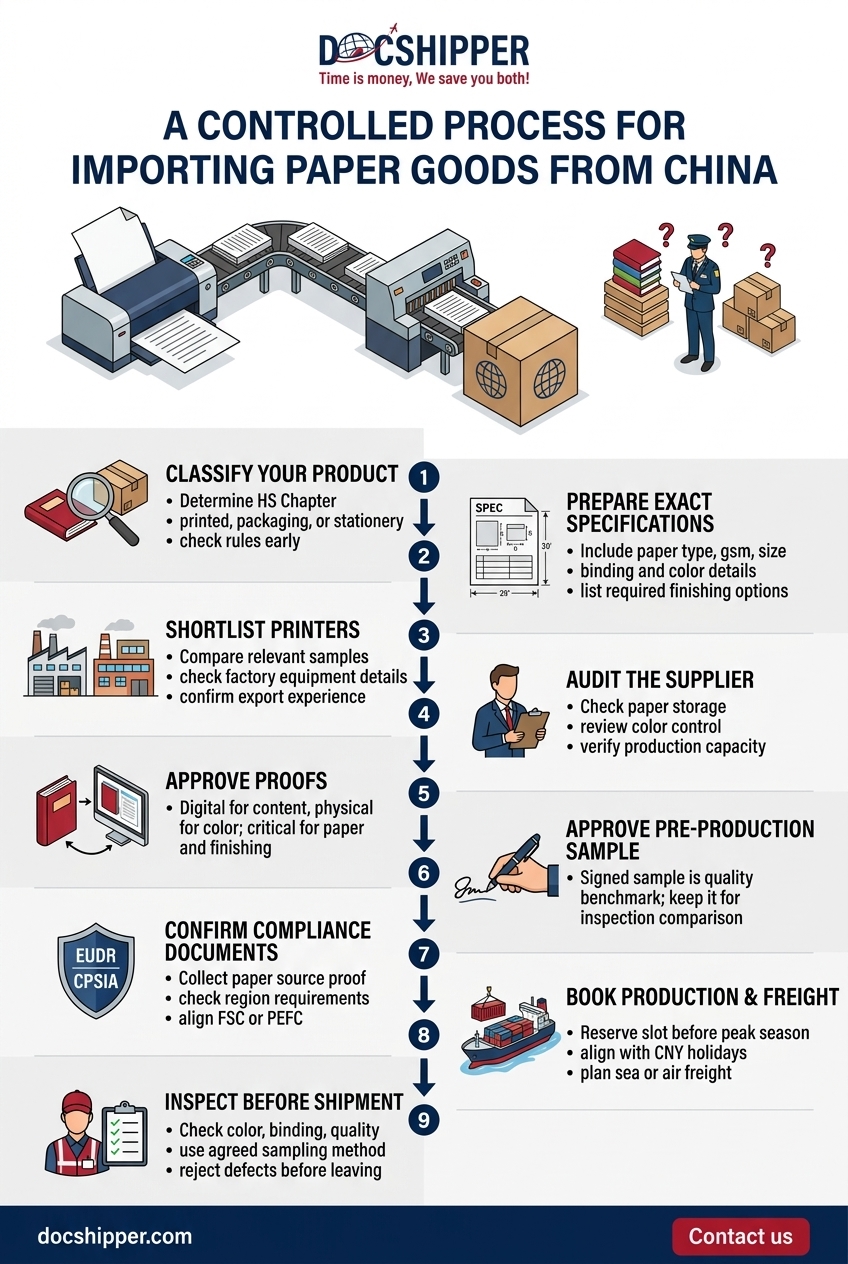
Step by step: your first print order from China
Follow a controlled sequence: classify the product, write the specification, qualify the printer, approve proofs, reserve production, inspect the order and ship with suitable protection.
- Classify the product. Decide whether it is printed matter, paper packaging or stationery. Record the proposed HS chapter and obtain a customs review where classification is uncertain.
- Prepare the specification. Include paper stock and gsm, size, page count, binding, colour process, Pantone references, finishing, packing and destination.
- Shortlist printers. Request samples of comparable work, factory details, export experience, certification evidence and a quotation based on the same document.
- Audit the supplier. Check equipment, paper storage, calibration, subcontracting, quality procedures and capacity for your required production slot.
- Approve the proof. Review the digital proof for content and layout, then use a wet or physical proof where paper, colour or finishing is critical.
- Approve the pre-production sample. Keep the approved sample as the reference for inspection and contractual quality discussions.
- Confirm compliance documents. Collect paper-source, FSC or PEFC, CPSIA or other destination-market documents relevant to the product.
- Book production and freight. Align the slot with Chinese New Year, seasonal demand, inspection timing and the chosen LCL, FCL or air plan.
- Inspect before shipment. Check colour, paper, binding, trimming, counts, defects, carton marks and moisture protection using the agreed inspection plan.
- Ship and retain records. Keep the specification, proof, sample approval, inspection report, packing list, commercial invoice and compliance documents with the shipment file.
Conclusion
Importing paper and printing products from China works best when you manage the order as a specification and compliance project, not simply as a search for the lowest unit price.
- China offers strong capacity for printed matter, finishing, packaging and stationery.
- Classify the product first: printed matter, packaging and stationery do not follow identical rules.
- Lock the paper, dimensions, binding, finishing and colour references before requesting comparable quotes.
- Approve proofs and a pre-production sample before the full print run.
- Check the EUDR distinction between chapter 49 printed matter and chapter 48 packaging or stationery.
- Review CPSIA and CPSC guidance carefully for children’s and novelty books.
- Reserve production early and plan sea freight, palletisation and moisture protection for dense paper cargo.
- Inspect the goods before shipment, not only after they arrive.
Printing books, boxes or stationery in China? We can shortlist and audit printers, check proofs and quality before shipment, and ship your order door to door.
FAQ | How to Import Paper and Printing Products from China
Yes, but do not treat the shipment as one single product line. Ask the supplier to separate each product by description, quantity, value, materials and proposed HS code on the commercial invoice and packing list. Your customs broker should review each category individually, particularly when books, printed boxes and notebooks are covered by different compliance requirements.
Share only the files needed for quoting at the beginning, and use a written confidentiality and intellectual-property agreement before sending production-ready artwork. The agreement should identify your designs, prohibit unauthorised production or resale, restrict subcontracting and require the supplier to delete or return files after completion. Avoid allowing the printer to use your artwork in samples, catalogues or online listings without written permission.
Avoid paying the full amount before production. A common structure is a deposit to reserve materials and production capacity, followed by the balance only after a satisfactory pre-shipment inspection. Make the payment milestones, inspection rights, rework obligations and refund conditions part of the purchase contract rather than leaving them in informal messages.
Treat any change in paper mill, gsm, coating, ink system, adhesive or finishing as a specification change requiring written approval. Ask the printer to explain the reason, provide a replacement sample where the change may affect appearance or performance, and confirm whether the price or delivery date changes. If the supplier makes the change without approval, document the difference immediately with photographs, measurements and the approved reference before discussing payment or rework.
Notify the supplier and your freight or sourcing partner as soon as the defect is identified, while keeping the cartons, labels and affected units available for evidence. Record the defect rate by carton and product type, compare it with the agreed critical, major and minor defect limits, and request a written corrective-action plan. Depending on the severity, the remedy may involve rework before shipment, replacement units, a credit note or a partial refund.
Confirm the Incoterm and importer-of-record arrangement before placing the order. Under a delivered service, the provider may coordinate transport and customs, but you should still confirm who pays duties, import VAT, brokerage fees, port charges and inspection costs. Ask for a clear landed-cost breakdown and verify that the commercial invoice, packing list, bill of lading or air waybill and any origin or compliance documents match the actual goods.
Need Help with
Logistics or Sourcing ?
First, we secure the right products from the right suppliers at the right price by managing the sourcing process from start to finish. Then, we simplify your shipping experience - from pickup to final delivery - ensuring any product, anywhere, is delivered at highly competitive prices.