In short ⚡
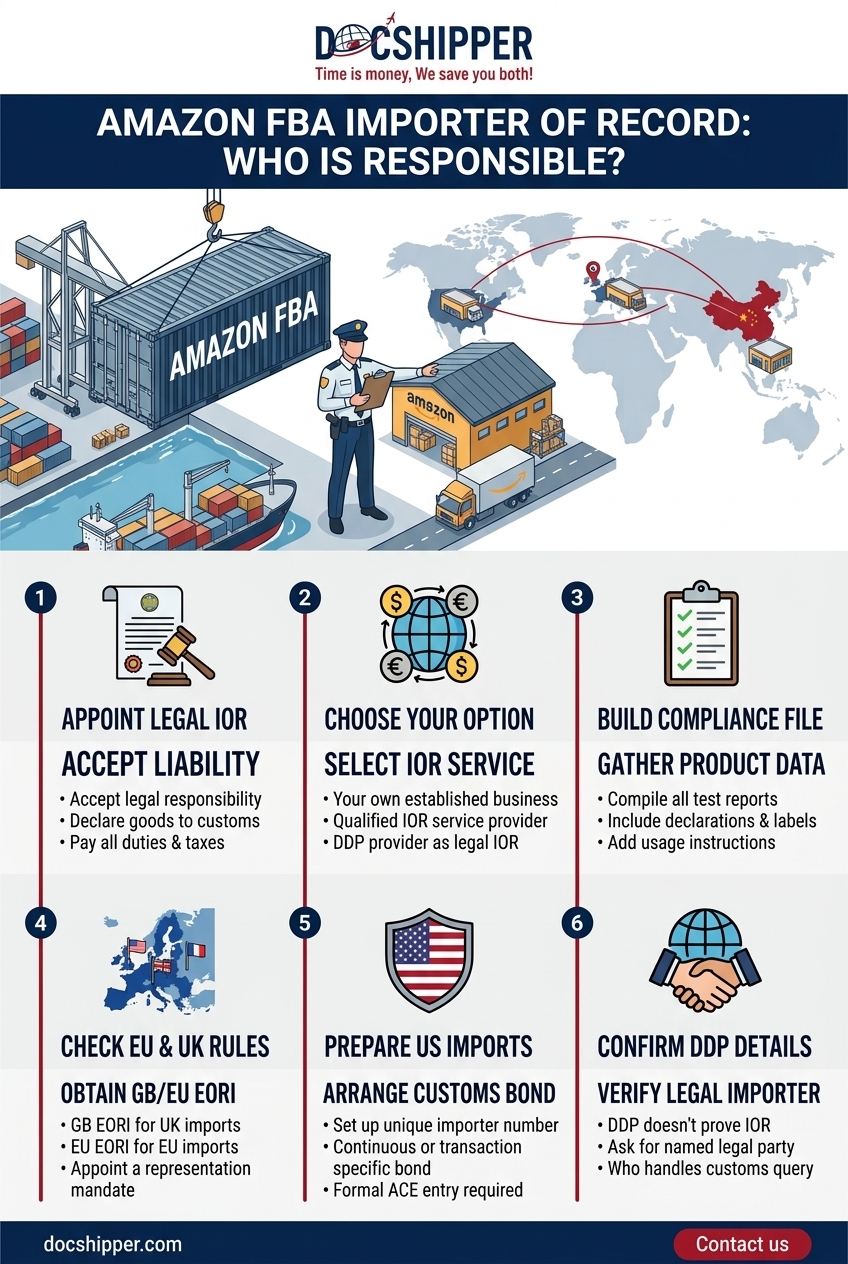
Amazon FBA Importer of Record: Why Amazon Cannot Be Your IOR: Amazon is the delivery address and fulfilment operator, not normally the importer of record for your stock. You, your company, an eligible IOR service, or a logistics provider legally acting as IOR must handle customs declarations, duties, taxes, and applicable product-compliance responsibilities before inventory reaches an FBA warehouse.The guidance covers the IOR’s legal role, why Amazon cannot assume it, available IOR and DDP options, US, EU and UK requirements, product compliance, and the pre-dispatch FBA checklist.
We hope you’ll find this article genuinely useful, but remember, if you ever feel lost at any step, whether it’s finding a supplier, validating quality, managing international shipping or customs, DocShipper can handle it all for you!
For an Amazon FBA shipment imported from China, Amazon is the delivery address, not the importer of record. You, your company, an importer of record service, or a logistics provider acting legally on your behalf must take responsibility for customs clearance, duties, taxes and applicable product compliance.
Choosing the importer of record before the goods leave China prevents a common failure: a shipment reaches the destination country, but nobody is legally authorised or prepared to clear it. The result can be customs holds, unexpected charges, missing documents or inventory that never reaches the FBA warehouse.
DocShipper Info
Confirm who will clear the goods, pay import charges and provide compliant documentation before booking
What an importer of record is
The importer of record is the party legally responsible for declaring goods, paying duties and taxes, and ensuring that the products meet import rules in the destination country. For Amazon FBA, this role is separate from the Amazon warehouse receiving your inventory.
The IOR provides or authorises the customs entry, supports the tariff classification and customs value, and keeps the records required by the destination authorities. The IOR may also be contacted if customs questions the origin, description, valuation or admissibility of the products.
Do not confuse the IOR with the consignee. The consignee is the party named to receive or control the shipment at destination, while the IOR is the party legally responsible for the import. An Amazon FBA warehouse can be the delivery location without becoming either your commercial importer or your compliance representative.
The customs broker is different again. A broker prepares or submits customs documentation on behalf of the IOR, but using a broker does not automatically transfer the legal liability away from the IOR. Before booking, ask the broker or forwarder in writing: “Who will be named as importer of record, and who remains liable for the entry?”
For a non-resident seller, this distinction matters. Your supplier may manufacture the goods, your forwarder may transport them, Amazon may receive them, and a customs broker may file the entry. None of those facts alone identifies the IOR.
| Role | What it does |
| Importer of record | Accepts legal responsibility for the import declaration, duties, taxes and applicable import compliance. |
| Consignee | Receives or controls the shipment at destination. The consignee is not automatically the IOR. |
| Customs broker | Handles customs procedures for the IOR. The broker is not necessarily the liable importer. |
| Amazon FBA warehouse | Receives inventory after import clearance under the seller’s shipment plan. |
DocShipper Alert
Verify the legal IOR in writing, because an incorrect name can trigger holds, returns and unexpected costs
DocShipper Tips
Compare your company, an IOR service and DDP provider based on registrations, liability and destination rules
Why Amazon will not be your importer of record
Amazon receives FBA inventory as a warehouse and fulfilment operator. It does not normally act as the importer of record for your stock, so the seller must arrange an eligible IOR before shipping goods to an FBA destination.
Amazon Seller Central contains the applicable import and export inventory policy, but its wording and operational requirements should be checked on the day you create the shipment. Do not rely on a supplier’s interpretation or an old forum response. Confirm the current policy in Seller Central and give the relevant instructions to your forwarder.
Naming Amazon as the importer can create a mismatch between the customs entry and the FBA shipment. Customs may ask for an importer number, bond, tax registration or compliance documentation that Amazon will not provide for your inventory. The shipment can therefore be delayed, returned or subjected to storage and handling charges.
The practical consequence is simple: Amazon can only receive the cartons after the import has been correctly organised. The FBA shipment plan is not a customs clearance solution. It tells Amazon what inventory is expected, while the import declaration tells the destination authorities who is bringing the goods into the country.
Before your supplier hands the cargo to a carrier, confirm three names in the shipping instructions: the legal IOR, the customs broker and the final Amazon delivery address. If those names are missing or inconsistent, stop the booking and resolve the structure first.
| Incorrect assumption | What you must arrange instead |
| “Amazon is receiving the cartons, so Amazon is the importer.” | Name your company or an eligible provider as IOR. |
| “The forwarder is clearing the goods, so the forwarder carries every liability.” | Confirm whether the forwarder is only the broker or is legally acting as IOR. |
| “The FBA shipment plan covers customs.” | Prepare the customs entry, importer number, bond or EORI and compliance documents separately. |
Looking for a Reliable
Sourcing Partner?
We handle the entire sourcing process, supplier research, negotiation, production, and inspections, so you can focus on what matters most: growing your business.


Your IOR options
You can act as importer through your own company, use an importer of record service, or ship under DDP with a provider that legally acts as importer where permitted. The right choice depends on your residence, destination market, product category, shipment volume and willingness to carry ongoing liability.
Decision path:
- If your company is established and registered to import in the destination market, assess whether it can act as its own IOR.
- If you are a non-resident seller or lack the required registrations, ask an IOR service provider whether it can legally represent the shipment and for which products and markets.
- If your forwarder offers DDP, request the legal IOR name, the customs entry arrangement and confirmation of who pays duties and taxes.
- If nobody will identify the IOR in writing, do not treat the quote as a complete import solution.
Using your own company gives you direct control over customs records and product compliance, but it also places the liability on your business. This can be appropriate for regular volume, established registrations and products that you expect to import repeatedly.
An IOR service can help a non-resident seller organise importation without creating a local operating company, subject to the provider’s legal structure and the destination rules. Check whether the service covers your product category, whether it remains responsible after delivery, and whether it will provide customs and compliance records.
DDP means the seller or its logistics provider arranges delivery with import charges handled under the agreed commercial terms. It does not, by itself, prove who is legally named as the importer. A DDP quote is only useful when it states who files the entry, who is responsible for the duties and taxes, and who answers customs or product-safety authorities.
| Option | Who is liable | Best for |
| Own company as IOR | Your company, including its customs and product compliance obligations. | Established sellers with the required registrations and recurring imports. |
| IOR service | The provider for the responsibilities it legally accepts, subject to its contract and local rules. | Non-resident sellers or businesses without a suitable import structure. |
| DDP provider acting as IOR | The provider only if it is legally named and accepts that role for the shipment. | Sellers seeking an integrated transport, clearance and delivery service. |
DocShipper Alert
Require written confirmation of who files the entry, pays duties and answers customs authorities
Requirements by market: US, EU and UK
US imports generally require an importer number and customs bond; EU imports require an EORI number and may require indirect representation; UK imports require a GB EORI for the relevant import activity. The exact documents depend on the importer’s status, the product and the shipment route.
United States: confirm the importer identity and the number used for the customs entry with your broker. A customs bond supports the importer’s obligations to US Customs and Border Protection, and the broker should confirm whether a continuous or transaction-specific arrangement is appropriate for your situation. The importer must also provide accurate product descriptions, classification, value and origin information.
Do not assume that a low-value FBA parcel avoids the need for an IOR. The United States suspended duty-free de minimis treatment for shipments from all countries on 29 August 2025; shipments valued at USD 800 or less require a formal entry type in ACE, according to KPMG’s TaxNewsFlash dated 28 August 2025. Your broker should verify the current entry procedure before dispatch.
European Union: the importer generally needs an EORI number. A non-EU seller may need an EU-established party or indirect customs representative, depending on the import structure and the member state involved. Import clearance is only one part of the setup: product safety, labelling, VAT and any sector-specific rules must also be reviewed.
United Kingdom: confirm that the importer has the appropriate GB EORI and that the customs representative can clear the goods under the agreed representation model. Do not use an EU EORI as a substitute for checking the UK requirement. Your broker should also confirm the customs procedure, commodity code, origin evidence and import VAT treatment.
| Market | IOR requirement | Key documents or checks |
| United States | Importer identity and importer number, with customs bond arrangements where required. | CBP entry data, bond confirmation, product classification, value and origin. |
| European Union | EORI and, for some non-resident structures, indirect customs representation. | EORI, representation mandate, commercial invoice and product compliance file. |
| United Kingdom | GB EORI for the relevant import activity. | GB EORI, customs representation details, commodity code, origin and VAT checks. |
DocShipper Tips
Confirm the correct importer number, EORI or GB EORI before your broker submits the entry
Why Choose DocShipper
Lower risk, transparent pricing, and a single point of contact from pickup to delivery.
-
One single point of contactA dedicated consultant coordinating every step and keeping you informed.
-
9,200+ operations / 6,000+ clientsProven processes on China ↔ EU/US lanes (FCL, LCL, air, road, rail).
-
No hidden feesTransparent quotes and document guidance to avoid surprises.
Compliance follows the importer
Product safety, labelling and market-surveillance responsibilities do not disappear when a forwarder handles customs. The importer or its legally appointed representative must ensure that the goods can be placed on the destination market before the shipment leaves China.
In the EU, the General Product Safety Regulation, Regulation (EU) 2023/988, adds a separate responsible-person requirement for products from outside the EU. An economic operator established outside the EU must appoint an EU-established responsible person, and a product cannot be placed on the EU market unless an EU operator handles the tasks referred to in Article 4(3) of Regulation 2019/1020.
The importer’s name and postal and electronic address must be shown on the product, packaging or an accompanying document where the rules require it. According to Soulier Bunch’s overview dated 4 March 2025, marketplaces must remove dangerous offers within two working days after an authority order. Read the GPSR summary and obtain product-specific advice before listing.
Build the compliance file before booking transport. It should connect the product, manufacturer, importer or representative, test reports, declarations, labels, instructions and shipment documents. A customs clearance does not confirm that a product is safe or legally marketable.
Amazon’s fulfilment requirements also change over time. For example, Hopstack reported on 20 August 2025 that from 1 January 2026 Amazon would no longer provide several US FBA prep and labelling services, including FNSKU and carton labelling, poly bagging, bubble wrap, bundling, warning and origin labels. Review the current Amazon requirements and arrange preparation before dispatch.
| Compliance area | Action before shipment |
| Product safety | Confirm applicable regulations, testing and technical documentation. |
| Importer details | Ensure the responsible importer or representative appears where required. |
| EU GPSR | Arrange an EU-established responsible person for covered products from outside the EU. |
| FBA preparation | Verify current labelling, packaging and prep requirements before goods leave China. |
Checklist before your first FBA import
Confirm the IOR, registrations, broker, Incoterm, product compliance and Amazon shipment details before the goods leave China. A signed quotation or a DDP label is not enough if the legal importer remains unidentified.
- 1. Identify the market: confirm whether the shipment enters the US, an EU member state or the UK, and identify the exact FBA receiving location.
- 2. Choose the IOR: decide whether your company, an IOR service or a DDP provider will be legally responsible.
- 3. Verify registrations: confirm the US importer number and bond arrangement, EU EORI and representation structure, or UK GB EORI.
- 4. Appoint the broker: obtain the broker’s name, contact details and written confirmation of who it represents.
- 5. Review the commercial invoice: check seller, buyer, importer, product description, quantity, value, currency, origin and Incoterm.
- 6. Validate classification: ask for the proposed commodity or tariff code and review it against the actual product.
- 7. Check compliance: collect test reports, declarations, labels, instructions and any EU responsible-person information.
- 8. Confirm the DDP scope: check whether the price includes duties, taxes, customs clearance, delivery and any examination or storage charges.
- 9. Match the FBA plan: ensure carton labels, product labels, packaging and delivery appointments match the current Seller Central instructions.
- 10. Approve the booking: keep the IOR confirmation, broker authorisation and shipping documents in one file before the supplier hands over the cargo.
Ask your provider to answer these questions in one document: Who is the importer? Which number will be used? Who is the customs broker? Who pays duties and taxes? Who handles a customs query? Who is responsible for product compliance? If the answer changes by country, product or transport mode, record each scenario separately.
Review this file for every new SKU, not only for the first shipment. A change in product composition, packaging, destination, seller entity or import route can change the classification, compliance obligations or IOR structure.
Conclusion
Amazon is never the importer of record for your ordinary FBA import. The delivery address does not carry your customs and product compliance responsibilities, so choose and document the IOR before the goods leave China.
- Amazon receives cleared FBA inventory but does not replace your importer of record.
- Choose the IOR before dispatch and confirm the role in writing.
- For the US, check the importer number and customs bond arrangement.
- For the EU, arrange the EORI, representation and applicable GPSR responsible person.
- For the UK, confirm the GB EORI and customs representation structure.
- DDP can simplify the process, but verify who is legally liable rather than relying on the Incoterm alone.
Shipping from China to Amazon FBA? We organise IOR and customs clearance for the US, EU or UK and deliver your inventory DDP to Amazon warehouses.
FAQ | Amazon FBA Importer of Record: Who Is Responsible for Your Shipment?
Not automatically. An IOR must be eligible for the country where the goods enter customs, and one registration may not cover the US, EU and UK simultaneously. Even within the EU, confirm whether the same entity and customs representation arrangement can be used for each route. Ask your provider to confirm the IOR, registration and representation model for every destination country before consolidating shipments.
Sometimes, but it can be difficult and costly. The carrier or broker may need to amend the transport documents or customs entry, and the replacement party must already be legally eligible to import the goods. If the shipment has reached the destination, changing the IOR may require customs approval and can create storage delays. Treat any change in seller, buyer or logistics provider as a reason to revalidate the import structure before dispatch.
The named IOR remains the party responsible for responding, even when a broker or forwarder communicates with customs. Prepare a clear file containing the commercial invoice, product specifications, purchase records, classification rationale, origin evidence and valuation documents. Do not provide a description that merely matches an Amazon listing if it does not accurately describe the physical product.
No. Customs clearance only confirms that the goods were accepted for import; it does not confirm compliance with Amazon’s receiving rules. Amazon may still reject or delay cartons because of incorrect labels, packaging, quantities, shipment-plan discrepancies or missing delivery requirements. Keep the customs documents and the Amazon shipment records aligned, but manage them as two separate approval processes.
Stop the shipment if possible and ask the supplier and broker to correct the documents before export. If the goods have already shipped, notify the IOR and broker immediately rather than allowing them to file inaccurate data. An incorrect invoice can affect duties, product admissibility, valuation and future customs audits. Keep both the original and corrected versions with an explanation of the change.
The original import arrangement may not cover the next movement. A return to China, re-export, destruction or transfer to another fulfilment country can trigger separate customs, tax and documentation requirements. Before authorising the movement, ask the IOR and broker who will act for the new transaction, whether duties can be recovered, and what proof of export or destruction must be retained.
Keep the customs entry, invoice, packing list, transport documents, proof of payment, classification analysis, origin evidence, compliance file and communications with the broker for the period required by the destination country. Because retention periods vary, obtain the applicable period in writing from the IOR or customs broker. Preserve the records by SKU and shipment so you can respond quickly to a customs or product-safety review.
Need Help with
Logistics or Sourcing ?
First, we secure the right products from the right suppliers at the right price by managing the sourcing process from start to finish. Then, we simplify your shipping experience - from pickup to final delivery - ensuring any product, anywhere, is delivered at highly competitive prices.