In short ⚡
CE Marking: Complete Guide for Importers into the EU explains the checks required before selling products in the EU: identify applicable legislation, verify conformity documents, inspect markings and instructions, confirm importer responsibilities, and organise the required EU economic operator. The essential pre-shipment checks are:- Classify the product and identify every applicable EU directive or regulation.
- Confirm whether the manufacturer can self-declare or must use a notified body.
- Obtain the EU Declaration of Conformity, matching test reports, standards list and technical documentation access.
- Verify that documents match the exact model, configuration, manufacturer and critical components.
- Check CE marking, importer details, traceability, warnings and instructions on production samples.
- Confirm GPSR responsibilities, retain compliance records and prepare for corrective action or authority requests.
Key topics include applicable CE legislation, importer obligations, GPSR and the EU responsible economic operator, supplier documents, weak or fake CE claims, and the seven-step process for compliant imports.
We hope you’ll find this article genuinely useful, but remember, if you ever feel lost at any step, whether it’s finding a supplier, validating quality, managing international shipping or customs, DocShipper can handle it all for you!
CE marking is not a certificate that transfers responsibility to your Chinese supplier. As an importer, you must verify that the manufacturer completed the correct conformity assessment, prepared the required documents, applied the marking correctly and provided safe instructions before you place the product on the EU market.
This guide explains when CE marking applies, which documents to request, how GPSR changes your responsibilities and how to identify weak or misleading supplier claims.
DocShipper Info
Need help mapping your product? Let DocShipper review the applicable EU rules before you order.
What CE marking means and what it does not
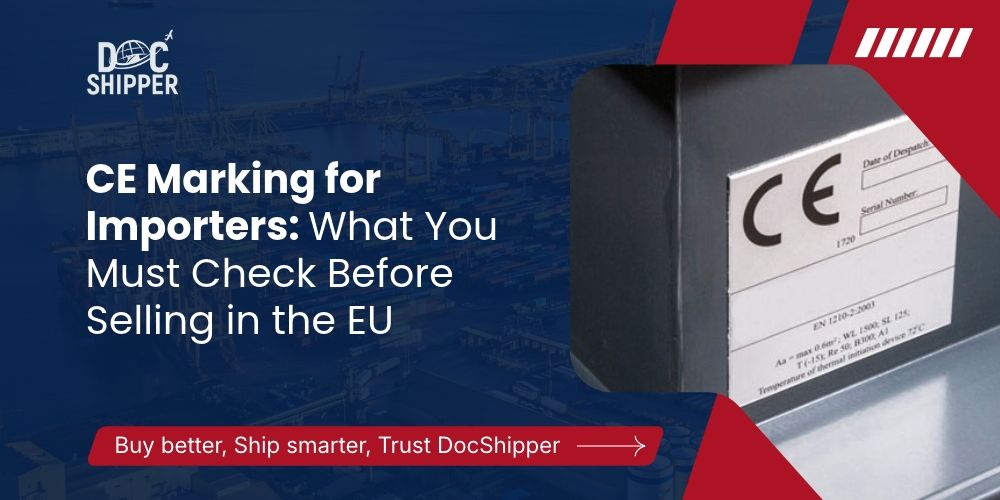
CE marking shows that the manufacturer declares the product meets all applicable EU harmonised legislation. It is a legal conformity marking, not an independent quality label, approval seal or guarantee that a product is safe in every commercial sense.
The manufacturer must identify the EU legislation that applies, assess the product against its essential requirements and follow the correct conformity assessment procedure. Harmonised standards are technical standards recognised at EU level that can help demonstrate compliance with those requirements, although the applicable legal act determines what is required.
Some products can be self-declared by the manufacturer. Others require the involvement of a notified body, which is an organisation designated by an EU country to assess specific products or conformity procedures. The presence of a laboratory report does not, by itself, prove that the correct route was followed.
CE marking is only permitted where specific EU legislation requires or allows it. Products outside that legislation must not carry a CE mark merely because a supplier believes it will make the product easier to sell. General consumer safety rules may still apply, including the General Product Safety Regulation, or GPSR.
Start with the European Commission’s CE marking guidance and the Blue Guide on EU product rules. Then map the product, its intended use and its technical characteristics to every relevant legal act.
DocShipper Tips
Confirm every applicable EU act before relying on a supplier’s category or table.
Which products need CE marking
Electrical and electronic equipment, radio devices, toys, machinery, personal protective equipment and medical devices are among the main product groups commonly subject to CE legislation. The exact answer depends on the product’s function, design, energy source, intended user and market version.
Do not classify a product only by its supplier’s category. A rechargeable children’s toy, for example, may involve toy safety requirements as well as electrical safety and electromagnetic compatibility rules. A connected device may also fall under radio equipment legislation. Several EU acts can apply to one product at the same time.
Use the following table as a starting point, not as a final legal classification. Before ordering, compare the product specification with the current version of each applicable act and confirm whether a notified body is required.
| Product family | Main EU legislation or framework | Conformity route |
| Low-voltage electrical equipment | Low Voltage Directive, commonly called LVD | Often manufacturer self-assessment, subject to the applicable procedure |
| Electronic equipment | Electromagnetic Compatibility Directive, or EMC | Often manufacturer self-assessment with technical evidence |
| Radio and wireless devices | Radio Equipment Directive, or RED | Procedure depends on the product and standards used; a notified body may be involved |
| Toys | Toy Safety Directive | Self-assessment may be possible for some products; third-party assessment can be required in certain cases |
| Machinery | Machinery legislation applicable to the product and placing-on-market date | Route depends on the machine and applicable conformity procedure |
| Personal protective equipment | PPE Regulation | Third-party assessment is required for relevant PPE categories |
| Medical devices | Medical Devices Regulation or applicable medical-device framework | Often involves a notified body, depending on device classification |
| Construction products | Construction Products Regulation where applicable | Depends on the product, harmonised specifications and assessment system |
Looking for a Reliable
Sourcing Partner?
We handle the entire sourcing process, supplier research, negotiation, production, and inspections, so you can focus on what matters most: growing your business.


Your obligations as an importer
Before placing a product on the EU market, you must check that the manufacturer completed the conformity assessment, prepared the EU Declaration of Conformity and technical documentation, applied the CE mark and supplied the required instructions. You must also identify yourself as the importer on the product, packaging or accompanying document where the legislation permits that format.
Importers are expected to act before shipment, not only after an authority raises a problem. Review the product model, manufacturer identity, applicable legislation, conformity route, markings, warnings and instructions against the actual goods you plan to buy. A document for a similar product or an earlier version is not enough.
The importer’s name and postal address, and where required an electronic address, must be visible in the legally permitted location. Do not assume that printing your trading name on an outer carton always satisfies the rule. Check whether the information must appear on the product, packaging or an accompanying document for the specific product legislation.
Keep the EU Declaration of Conformity and the relevant conformity evidence available for authorities. For many CE regimes, records must be retained for 10 years after the product is placed on the market, although the applicable legal act should be checked before you set your retention policy.
If an authority requests information, you must be able to cooperate and provide the relevant documentation within the required timeframe. You may also need to take corrective action, withdraw a product, recall it or report a safety issue through the appropriate channels.
- Identify every applicable EU act before ordering.
- Verify the manufacturer and exact product model.
- Check that the conformity assessment matches the product and its intended use.
- Obtain and retain the EU Declaration of Conformity.
- Confirm that instructions, warnings and safety information are supplied in the required languages.
- Check the CE marking and importer details during inspection.
- Maintain a document and traceability file for the required retention period.
- Cooperate with market surveillance authorities and manage corrective action.
DocShipper Alert
Verify the exact model, markings and records before placing goods on the EU market.
DocShipper Info
Identify your EU responsible operator and prepare traceability, complaint and corrective-action procedures before launch.
GPSR and the EU responsible economic operator
GPSR requires many non-EU sellers to have an EU-established responsible person or another economic operator handling the relevant compliance tasks. A product generally cannot be placed on the EU market without an EU operator performing the tasks linked to Article 4(3) of Regulation (EU) 2019/1020 where that rule applies.
The General Product Safety Regulation, Regulation (EU) 2023/988, applies to consumer products within its scope, including products that may not require CE marking. This means that “no CE mark required” does not mean “no compliance responsibility.” You still need a safety assessment, traceability information, warnings and a process for complaints, incidents and corrective measures.
For products supplied by an operator outside the EU, identify who performs the responsible-person function and record that operator’s details in your compliance file. The role is not simply a forwarding address. The responsible operator must support safety information, cooperate with authorities and help ensure that product documentation is available.
Your sales channel matters. The GPSR framework includes obligations affecting online marketplaces, and marketplaces must remove dangerous offers within 2 working days of an order from an authority, according to the overview published by Soulier Bunch on 4 March 2025. Review the requirements in the GPSR legal overview and the current regulation before launch.
On your own shop, you control the product page, warnings and recall communication. On a marketplace, you must also be prepared for rapid document requests, listing suspension and removal if the platform or an authority identifies a safety concern.
DocShipper Tips
Request matching evidence before payment and link every document to the exact model you will import.
Documents to request from a Chinese supplier
Request the EU Declaration of Conformity, matching test reports, the applicable standards list and access to the technical documentation before you place the order. A Chinese supplier’s “CE certificate” is not a substitute for checking the full conformity package.
The EU Declaration of Conformity, or DoC, is the manufacturer’s formal legal declaration. It should identify the manufacturer, the product or model, the applicable EU legislation, the standards or other technical specifications used and the person authorised to sign it. Check that the document describes the exact product you are importing, not only a product family or visually similar model.
Ask for test reports from a competent laboratory that identify the same model, revision, rated input, wireless module and critical components used in production. Read the report scope, test methods, sample description, standard editions, deviations and result pages. A report can support conformity, but it is not automatically a DoC and does not prove that all applicable legislation has been covered.
The technical documentation, often called the technical file, contains the evidence behind the conformity claim. It can include product drawings, bills of materials, risk assessments, calculations, component approvals, software or radio information, user instructions and test evidence. The importer may not always hold the complete file, but you should know who can provide it to authorities and obtain access or a written commitment before shipment.
- EU Declaration of Conformity signed by the manufacturer.
- Test reports matching the exact model and configuration.
- List of applicable EU legislation and standards.
- Technical file access or a clear arrangement for authority requests.
- Risk assessment and safety analysis where relevant.
- Product drawings, specifications and critical component information.
- User instructions, warnings and translations for the destination markets.
- Details of any notified body, including its name, identification number and scope of involvement.
Why Choose DocShipper
Lower risk, transparent pricing, and a single point of contact from pickup to delivery.
-
One single point of contactA dedicated consultant coordinating every step and keeping you informed.
-
9,200+ operations / 6,000+ clientsProven processes on China ↔ EU/US lanes (FCL, LCL, air, road, rail).
-
No hidden feesTransparent quotes and document guidance to avoid surprises.
Red flags of fake or weak CE claims
A supplier certificate alone proves very little if it comes from an unknown organisation, covers another model or does not identify the applicable EU legislation. Treat unclear documents as a purchasing risk and pause the order until the manufacturer provides verifiable evidence.
First, compare the product, model number, brand, factory and electrical ratings across every document. Differences in voltage, battery, motor, radio module or enclosure can make a report irrelevant. Ask the supplier to explain every mismatch in writing rather than accepting a generic statement that the products are “the same.”
Next, check the issuing organisation’s role. A laboratory may issue a test report, while a notified body may be involved in a legally defined conformity procedure. Neither label should be accepted without checking the organisation, its scope and the actual service performed. A document called a “CE certificate” may be a private marketing certificate with no legal status.
Inspect the physical goods before shipment. Look for the CE mark, manufacturer details, importer information, batch or serial traceability, warnings and instructions. Also check the mark’s shape and proportions against the official CE presentation. A mark printed on a product does not cure missing documentation or a failed conformity assessment.
Common warning signs include:
- A certificate that does not name the exact model or manufacturer.
- A test report issued for a different product, factory or component configuration.
- Standards listed without editions, test scope or clear connection to the product.
- A document containing only a logo and a pass statement, with no technical detail.
- A private “CE certification” offered as a replacement for the manufacturer’s DoC.
- A notified body number that cannot be linked to the relevant conformity procedure.
- Pressure to pay before documents are reviewed.
- A CE mark or importer address missing from production samples.
DocShipper Tips
Build one compliance file linking your purchase order, inspection and shipment records.
Step by step: CE-compliant import
A defensible import process follows seven stages: classify the product, map the legislation, collect documents, verify the evidence, inspect the goods, organise the EU operator and retain records. Complete these checks before the cargo leaves the supplier whenever possible.
- Define the product. Record the intended use, users, technical specifications, power source, radio functions, accessories, packaging and sales markets. Freeze the model and critical components before compliance review.
- Identify the legislation. Use the European Commission’s CE resources and the Blue Guide to determine which directives or regulations apply. Document why each act is included or excluded, especially where several acts overlap.
- Confirm the conformity route. Establish whether the manufacturer can self-declare or whether a notified body is required. Request the notified body’s details and evidence of involvement where applicable.
- Request the document package. Obtain the DoC, matching test reports, standards list, instructions, risk assessment and technical file access. Do not approve a purchase order while essential documents remain unexplained.
- Verify and test. Compare documents against the product specification and production sample. If evidence is incomplete or risk is material, coordinate additional laboratory testing before mass shipment.
- Inspect and label. During pre-shipment inspection, check the CE mark, manufacturer and importer details, traceability, warnings, instructions, packaging and actual model configuration. Record photographs and deviations in the inspection file.
- Place on the market and monitor. Confirm the EU responsible economic operator where GPSR or Regulation 2019/1020 requires one. Keep records, monitor complaints and incidents, and prepare a corrective-action process for authorities or marketplace requests.
For an SME, the practical control point is a single product compliance file linked to the purchase order, supplier, model number, inspection report and shipment. This prevents a common failure: approving one sample and then receiving goods with a different battery, power supply, casing or firmware.
DocShipper can support the process through supplier-document review, compliance verification, laboratory testing coordination and pre-shipment inspection. The objective is not a decorative CE logo, but evidence you can defend when a marketplace or market surveillance authority asks questions.
Conclusion: CE marking is an importer responsibility
CE marking is a legal declaration, not a quality label, and a supplier’s certificate does not remove your obligations. Before shipping, verify the legislation, conformity route, DoC, technical evidence, markings, instructions and EU responsible operator.
- CE marking applies only to products covered by relevant EU legislation.
- The importer must verify, label, document and retain evidence.
- A test report is not the same as an EU Declaration of Conformity.
- GPSR can require an EU-established responsible economic operator even where a product does not carry CE marking.
- Model mismatches, unknown issuers and generic certificates are serious red flags.
- Check documents and physical markings before the goods leave the supplier.
Importing CE-marked products from China? We review your supplier documents, coordinate lab tests and check markings before shipment so your CE compliance is ready for scrutiny.
FAQ | CE Marking for Importers: What You Must Check Before Selling in the EU
You may be treated as the manufacturer rather than only the importer if you sell the product under your own name or trademark, substantially modify it or affect its compliance. In that case, you must assume the manufacturer’s responsibilities, including completing the conformity assessment, preparing and signing the EU Declaration of Conformity and maintaining the technical documentation. A supplier’s existing CE documents may no longer be sufficient for the modified or rebranded product.
No. A final product made from CE-marked components may still require its own conformity assessment. The assembly can create new risks involving electrical safety, electromagnetic compatibility, machinery or other applicable requirements. Assess the complete product in its final configuration, including how the components interact, and do not simply combine the suppliers’ declarations.
No. Customs release is not an approval of CE compliance. A shipment can clear customs even if its documentation, markings or safety information are incomplete. Your responsibility begins before placing the product on the EU market, so resolve compliance issues before sale rather than treating customs clearance as proof that the product is authorised.
Stop treating the existing compliance file as automatically valid. A change to the power supply, battery, radio module, motor, firmware or enclosure can affect the applicable requirements and test results. Ask the manufacturer to document the change, assess its impact and update the relevant technical evidence and EU Declaration of Conformity before shipping the revised product.
Not always. Placing a used product on the EU market, importing it from outside the EU or substantially modifying it can create new compliance obligations. The original CE documentation may not cover its current condition, modifications or intended use. Before resale, verify the product’s age, applicable legislation, safety condition and whether the refurbishment amounts to a substantial modification requiring a new assessment.
The Declaration of Conformity and required instructions must be available in the languages required by the EU countries where the product is sold. Ask the manufacturer for the original signed declaration and arrange accurate translations where necessary. Do not rely on an informal summary, marketing sheet or machine translation when the document must be provided to an authority or customer.
Need Help with
Logistics or Sourcing ?
First, we secure the right products from the right suppliers at the right price by managing the sourcing process from start to finish. Then, we simplify your shipping experience - from pickup to final delivery - ensuring any product, anywhere, is delivered at highly competitive prices.